


Factitious disease: clinical lessons from case studies at Baylor University Medical Center
- PMID: 17252033
- PMCID: PMC1484524
- DOI: 10.1080/08998280.2006.11928162
Factitious disease: clinical lessons from case studies at Baylor University Medical Center
Abstract
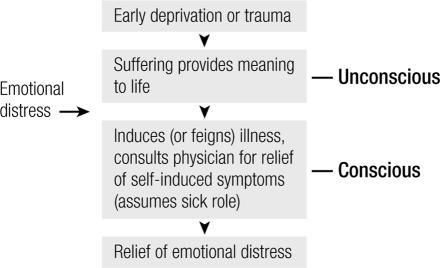
Factitious disease is defined as the intentional production (or feigning) of disease in oneself to relieve emotional distress by assuming the role of a sick person. Although the self-induction of disease is a conscious act, the underlying motivation is usually unconscious. It has been estimated that 3% to 5% of physician-patient encounters involve factitious disease. This article presents 6 case studies from Baylor University Medical Center that highlight various clinical aspects of factitious disease. Patients with factitious diseases are extremely difficult to recognize because they do not appear different from patients with authentic causes of similar symptoms, because their psychiatric abnormalities are not appreciated, and because doctors and nurses have alowindex of suspicion. Since patients with factitious disease present a false medicalhistory, their physicians prescribe unnecessary procedures and therapies that may result in iatrogenic disease. In many cases, damage to these patients from doctors' actions exceeds the harm resulting from the patients' self-induced illness. The clues that should suggest factitious disease, the diagnostic roles of the clinician and a consulting psychiatrist, and the ethical conflicts that confront doctors taking care of such patients are discussed. To help keep factitious disease in clinical perspective, one of the case studies involves the antithesis of factitious disease, where a patient was mistakenly diagnosed as having psychogenic pain when in fact the symptoms were caused by an overlooked physical disease. Better knowledge of the clinical features of factitious disease might have prevented the disastrous outcome.
Figures
References
-
- Lyons AS, Petrucelli RJ., II . An Illustrated History. New York: Abradale Press; 1987. Medicine; pp. 250–261.
-
- Feldman MD. Untangling the Web of Munchausen Syndrome, Munchausen by Proxy, Malingering, and Factitious Disorder. New York: Brunner-Routledge; 2004. Playing Sick? pp. 18–32.
-
- Gavin H. On Feigned and Factitious Diseases, Chiefly of Soldiers and Seamen; on the Means Used to Simulate or Produce Them, and on the Best Modes of Discovering Imposters; Being the Prize Essay in the Class of Military Surgery, in the University of Edinburgh Session, 1835-6, with Additions. London: John Churchill; 1843.
-
- Elwyn TS, Ahmed I. Factitious disorder. eMedicine, November 6, 2002. Available at http://www.emedicine.com/MED/topic3125.htm; accessed March 30, 2006.
LinkOut - more resources
Full Text Sources