


doi: 10.1080/08998280.2006.11928163.
Cronkhite-Canada syndrome presenting as eosinophilic gastroenteritis
Affiliations
- PMID: 17252034
- PMCID: PMC1484525
- DOI: 10.1080/08998280.2006.11928163
Item in Clipboard
Cronkhite-Canada syndrome presenting as eosinophilic gastroenteritis
Proc (Bayl Univ Med Cent).
2006 Jul.
Abstract
Cronkhite-Canada syndrome (CCS), first described in 1955, is a rare clinical syndrome of unknown etiology. CCS is diagnosed clinically, and the presenting symptoms include alopecia, cutaneous hyperpigmentation, gastrointestinal polyposis, and onychodystrophy, often accompanied by diarrhea, weight loss, and abdominal pain. We describe a unique case of CCS that presented with eosinophilic infiltrate on gastric and duodenal biopsies and review the literature pertaining to this rare syndrome.
Figures

Esophagogastroduodenoscopy results. (a) Endoscopic view showing thickened hypertrophic rugal folds in the body of the stomach. (b) The mucosa was erythematous and edematous on close inspection.
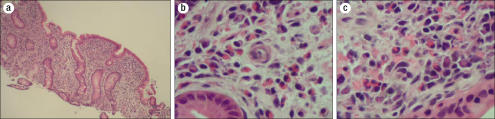
(a) Low-power view demonstrating blunting of the villi.(b) Medium-power and (c) high-power views illustrating the prominent eosinophilia in the lamina propria of the duodenal mucosa.
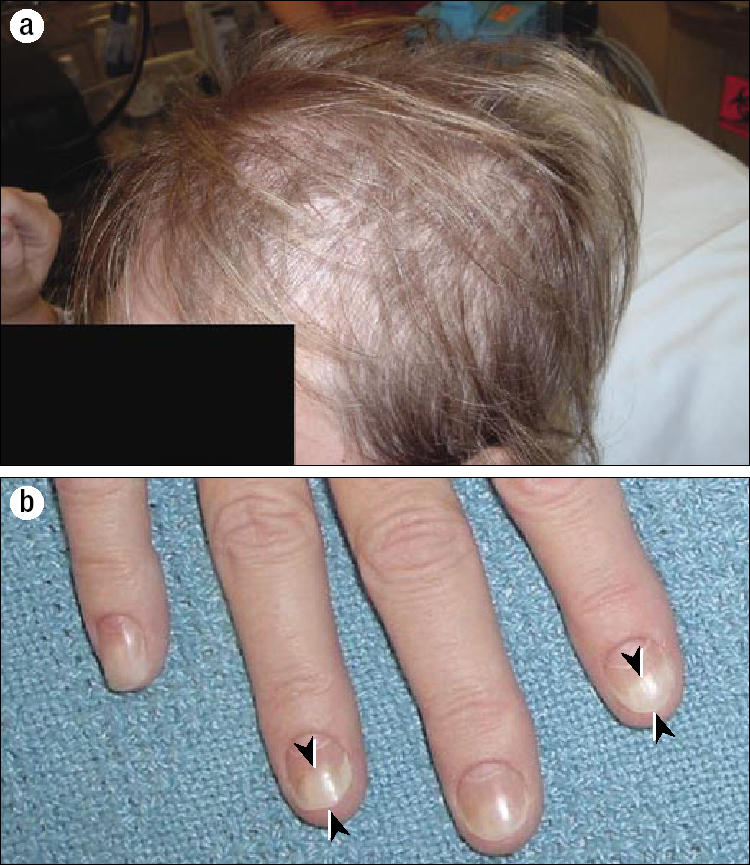
Cutaneous symptoms. (a) Diffuse thinning of the hair began shortly after the cholecystectomy. (b) The patient's fingers and toes were affected by onychodystrophy (arrowheads).

A small bowel radiograph with contrast revealed polyposis in the proximal small bowel (arrow).
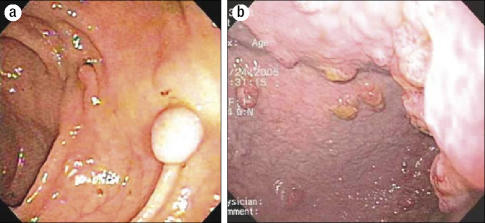
Results of an upper endoscopic exam conducted 6 weeks after the initial study. (a) Polyps were scattered throughout the colon. (b) Atrophic gastric mucosa was present with retention-like polyps.
References
-
- Cronkhite LW, Jr, Canada WJ. Generalized gastrointestinal polyposis; an unusual syndrome of polyposis, pigmentation, alopecia and onychotrophia. N Engl J Med. 1955;252(24):1011–1015. - PubMed
-
- Ward EM, Wolfsen HC. Pharmacological management of Cronkhite-Canada syndrome. Expert Opin Pharmacother. 2003;4(3):385–389. - PubMed
-
- Ward E, Wolfsen HC, Ng C. Medical management of Cronkhite-Canada syndrome. South Med J. 2002;95(2):272–274. - PubMed
-
- Goto A. Cronkhite-Canada syndrome; observation of 180 cases reported in Japan. Nippon Rinsho. 1991;49(12):221–226. - PubMed
-
- Goto A. Cronkhite-Canada syndrome: epidemiological study of 110 cases reported in Japan. Nippon Geka Hokan. 1995;64(1):3–14. - PubMed
LinkOut - more resources
Full Text Sources