


The effect of inotropes on morbidity and mortality in preterm infants with low systemic or organ blood flow
- PMID: 17253539
- PMCID: PMC8860620
- DOI: 10.1002/14651858.CD005090.pub2
The effect of inotropes on morbidity and mortality in preterm infants with low systemic or organ blood flow
Abstract
Background: Low systemic blood flow (SBF) is common in extremely premature infants in the first day after birth and has been associated with peri / intraventricular haemorrhage (PIVH), necrotising enterocolitis (NEC), mortality and developmental impairment.
Objectives: To determine the effect of specific inotropes on morbidity and mortality in preterm infants with low systemic blood flow
Search strategy: Searches were made of The Cochrane Central Register of Controlled Trials (CENTRAL, The Cochrane Library, Issue 1, 2006 ), MEDLINE (1966 - April 2006), EMBASE (1980 - April 2006) and CINAHL (1982 - April 2006), supplemented by searches of abstracts of conference proceedings, citations of reviews and expert informants.
Selection criteria: Random and quasi-random controlled trials of inotropes enrolling preterm infants with low systemic or organ blood flow in the neonatal period.
Data collection and analysis: Independent assessment of trial eligibility, quality and data extraction by each review author. Synthesis of data using relative risk (RR) and weighted mean difference (WMD) using standard methods of the Cochrane Collaboration.
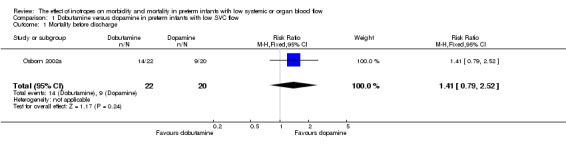
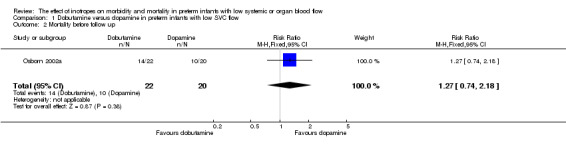
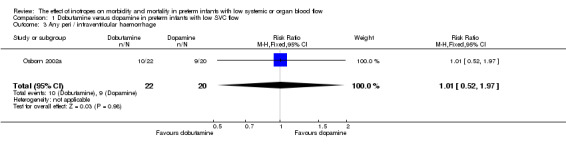
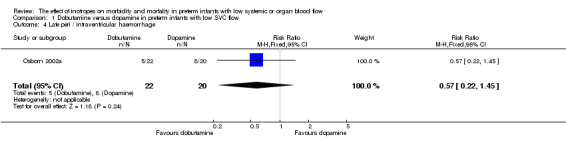
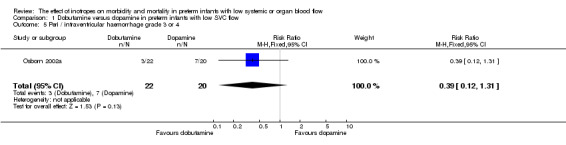
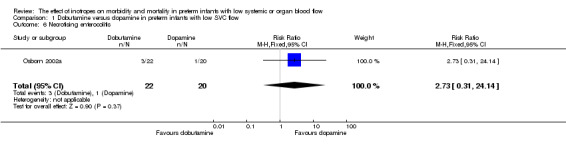
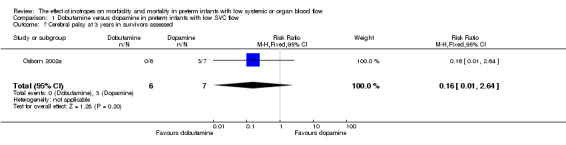
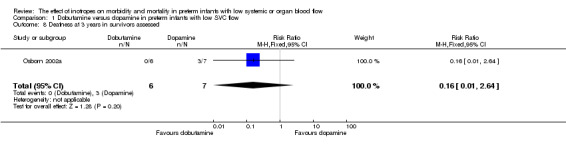
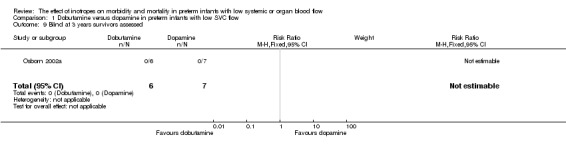
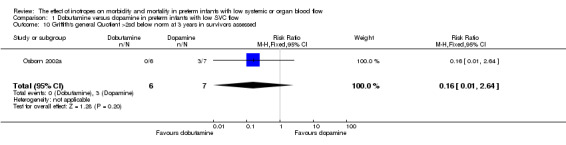
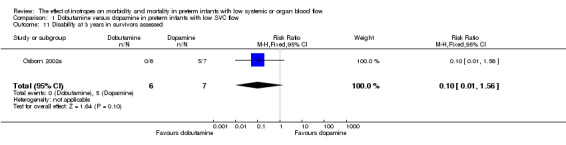
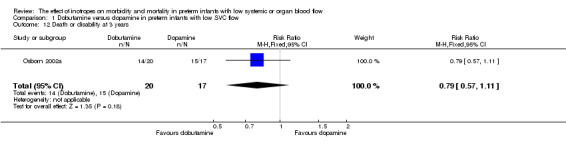
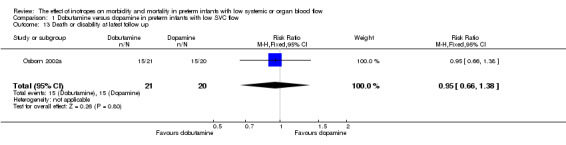
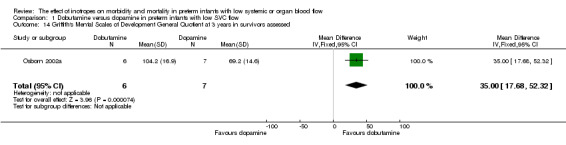
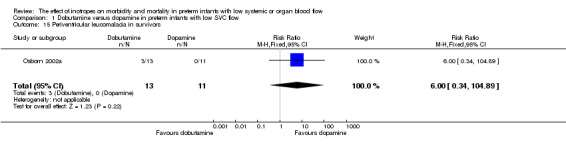
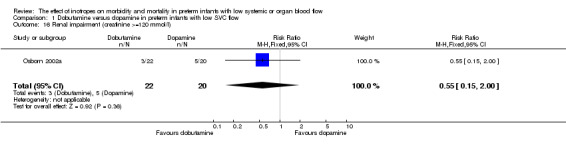
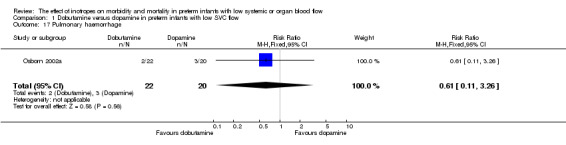
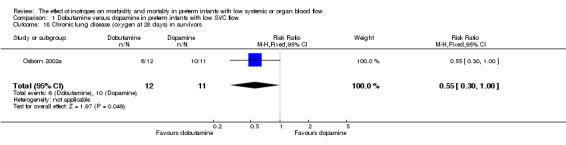
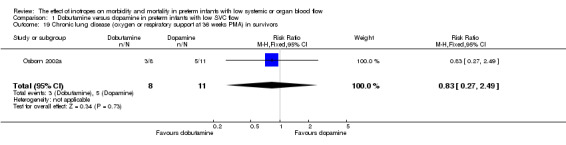
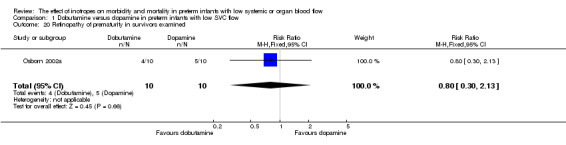
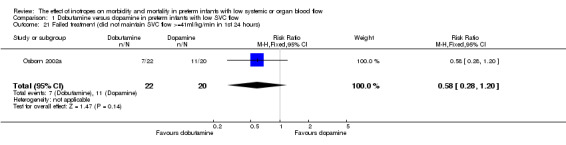
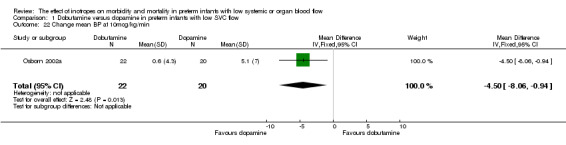
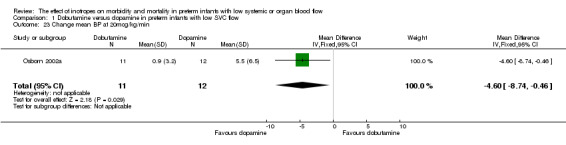
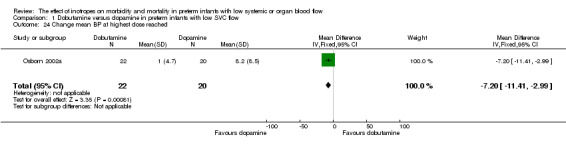
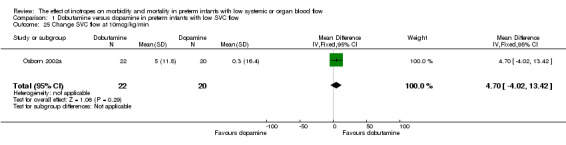
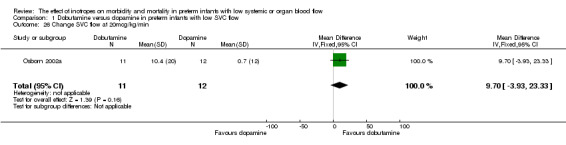
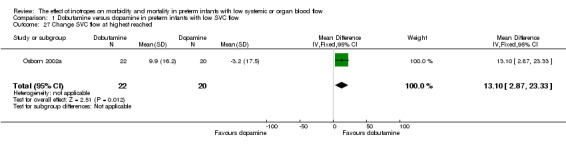
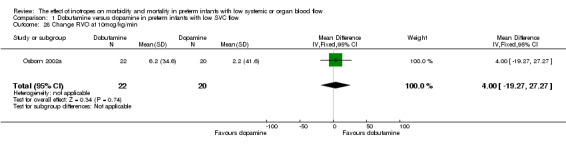
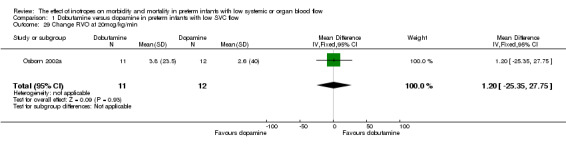
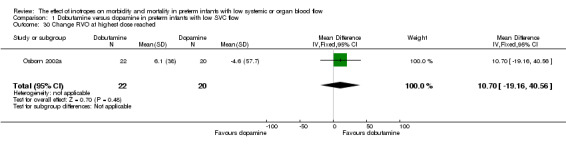
Main results: No studies that compared an inotrope to no treatment in preterm infants with low SBF were found. One study (Osborn 2002a) was found that compared dobutamine versus dopamine. The study was of adequate methodology. It enrolled 42 infants < 30 weeks gestation and < 12 hours after birth with low SVC flow. The trial compared the effect of dobutamine versus dopamine titrated 10 to 20 mug/kg/min with the goal of increasing and maintaining SVC flow > 40 ml/kg/min. No significant difference was reported in mortality to discharge (RR 1.41, 95% CI 0.79, 2.52), PIVH (RR 1.01, 95% 0.52, 1.97), grade 3 or 4 PIVH (RR 0.39, 95% CI 0.12, 1.31) or NEC. At three years, there was no significant difference in cerebral palsy, deafness, Developmental quotient > 2 sd below norm or combined disability (RR 0.10, 95% CI 0.01, 1.56). Surviving infants treated with dobutamine had a significantly higher development quotient (MD 35.00, 95% CI 17.68, 52.32). There was no significant difference in death or disability at the latest time reported (RR 0.95, 95% CI 0.66, 1.38). For secondary outcomes, there was no significant difference in periventricular leucomalacia, renal impairment, pulmonary haemorrhage, retinopathy of prematurity or CLD at 36 weeks. There was no significant difference in treatment failure. Dobutamine produced a significantly greater increase in SVC flow at the highest dose reached (MD 13.10, 95% CI 2.87, 23.33), whereas dopamine produced a significantly greater increase in mean BP at 10 and 20 mug/kg/min and at the highest dose reached (MD -7.20, 95% CI -11.41, -2.99).
Authors' conclusions: In preterm infants with low systemic blood flow, there is some evidence that dobutamine is better than dopamine at increasing and maintaining systemic blood flow. The only eligible trial did not demonstrate any consistent differences in clinical outcomes. However, this study was not sufficiently powered to prove or disprove effects on clinical outcomes. It is unclear what is the most effective strategy for improving the cardiovascular status of immature infants in the first day. Further trials are needed to determine effective strategies for preventing and improving low systemic and organ blood flow.
Conflict of interest statement
The reviewer authors conducted the only included trial of inotropes in infants with low SBF. No funding was received from pharmaceutical companies.
Figures
Update of
References
References to studies included in this review
Osborn 2002a {published and unpublished data}
-
- Osborn DA. Randomized trial of dobutamine versus dopamine in preterm infants with low systemic blood flow ‐ 3 year follow up. Pediatric Research 2005;57:A. - PubMed
-
- Osborn DA, Evans N, Kluckow M. Dopamine but not dobutamine increases left ventricular (LV) stress, but neither improves LV contractility in very preterm infants. Pediatric Research 2002;51:386A.
-
- Osborn DA, Evans N, Kluckow M. Dopamine but not dobutamine increases left ventricular (LV) stress, but neither improves LV contractility in very preterm infants. Proceedings Perinatal Society of Australia and New Zealand 6th Annual Congress. 2002:A145.
-
- Osborn DA, Evans N, Kluckow M. Left ventricular contractility in extremely premature infants in the first day and response to inotropes. Pediatric Research 2007;61:335‐40. - PubMed
-
- Osborn DA, Evans N, Kluckow M. Randomized trial of dobutamine versus dopamine in preterm infants with low systemic blood flow. Journal of Pediatrics 2002;140:183‐91. - PubMed
References to studies excluded from this review
Bourchier 1997 {published data only}
Cason 1999 {published data only}
-
- Cason DL, Amaker D, Carter D, Sutherland D, Bhatia J. Randomized double‐blind trial of dopamine versus epinephrine for treatment of hypotension in premature infants with respiratory distress syndrome. Journal of Investigative Medicine 1999;47:119A.
DiSessa 1981 {published data only}
-
- DiSessa TG, Leitner M, Ti CC, Gluck L, Coen R, Friedman WF. The cardiovascular effects of dopamine in the severely asphyxiated neonate. Journal of Pediatrics 1981;99:772‐6. - PubMed
-
- Leitner MJ, DiSessa TG, Coen RW, Ti C. Cardiovascular effects of low dose dopamine in the severely asphyxiated infant. Pediatric Research 1980;14:447A. - PubMed
Gill 1993 {published data only}
-
- Gill B, Weindling M. Randomised controlled trial to compare plasma protein fraction (PPF) and dopamine in the hypotensive very low birthweight (VLBW) infant. Pediatric Research 1994;35:273 (Abstract A84).
Greenough 1993 {published data only}
-
- Greenough A, Emery EF. Randomized trial comparing dopamine and dobutamine in preterm infants. European Journal of Pediatrics 1993;152:925‐7. - PubMed
Hentschel 1995 {published data only}
-
- Hentschel R, Hensel D, Brune T, Rabe H, Jorch G. Impact on blood pressure and intestinal perfusion of dobutamine or dopamine in hypotensive preterm infants. Biology of the Neonate 1995;68:318‐24. - PubMed
Kawczynski 1996 {published data only}
-
- Kawczynski P, Piotrowski A. Circulatory and diuretic effects of dopexamine infusion in low‐birth‐weight infants with respiratory failure. Intensive Care Medicine 1996;22:65‐70. - PubMed
Klarr 1994 {published data only}
-
- Klarr JM, Faix RG, Pryce CJ, Bhatt‐Mehta V. Randomized, blind trial of dopamine versus dobutamine for treatment of hypotension in preterm infants with respiratory distress syndrome. Journal of Pediatrics 1994;125:117‐22. - PubMed
Lundstrom 2000 {published and unpublished data}
-
- Lundstrom K, Pryds O, Greisen G. The haemodynamic effects of dopamine and volume expansion in sick preterm infants. Early Human Development 2000;57:157‐63. - PubMed
-
- Lundstrom KE. A randomized, controlled study of the influence of dopamine and volume expansion on CBF, LVO and MABP in hypotensive, preterm infants. Proceedings of 14th European Congress of Perinatal Medicine, Helsinki, Finland 1994:500.
Padbury 1990 {published data only}
-
- Padbury JF, Agata Y, Baylen BG, Ludlow JK, Polk D, Habib DM, Martinez AM. Pharmacokinetics of dopamine in critically ill newborn infants. Journal of Pediatrics 1990;117:472‐6. - PubMed
Paradisis 2009 {published data only}
-
- Paradisis M, Evans N, Kluckow M, Osborn D. Randomized trial of milrinone versus placebo for prevention of low systemic blood flow in very preterm infants. Journal of Pediatrics 2009;154:189‐95. - PubMed
Pederson 2009 {published data only}
-
- Pedersen P, Avlund OL, Pedersen BL, Pryds O. Intramuscular adrenaline does not reduce the incidence of respiratory distress and hypoglycaemia in neonates delivered by elective caesarean section at term. Archives of Disease in Childhood. Fetal and Neonatal Edition 2009;94:F164‐7. - PubMed
Pellicer 2005 {published and unpublished data}
-
- Pellicer A, Bravo MC, Madero R, Salas S, Quero J, Cabanas F. Early systemic hypotension and vasopressor support in low birth weight infants: impact on neurodevelopment. Pediatrics 2009;123:1369‐76. - PubMed
-
- Pellicer A, Valverde E, Elorza MD, Madero R, Gaya F, Quero J, Cababnas F. Randomized blinded controlled trial on the effects on brain hemodynamics of dopamine v epinephrine for inotropic support in preterm infants. Pediatric Research 2003;53:Abstract 2364.
-
- Pellicer A, Valverde E, Elorza MD, Madero R, Gaya F, Quero J, et al. Cardiovascular support for low birth weight infants and cerebral hemodynamics: a randomized, blinded, clinical trial. Pediatrics 2005;115:1501‐12. - PubMed
-
- Valverde E, Pellicer A, Madero R, Elorza D, Quero J, Cabañas F. Dopamine versus epinephrine for cardiovascular support in low birth weight infants: analysis of systemic effects and neonatal clinical outcomes. Pediatrics 2006;117:e1213‐22. - PubMed
Phillipos 1996 {published data only}
-
- Phillipos EZ, Barrington KJ, Robertson MA. Dopamine versus epinephrine for inotropic support in the neonate: A randomized double blinded controlled trial. Pediatric Research 1996;39:238A.
Phillipos 2000 {published data only}
-
- Phillipos EZ, Robertson MA. A randomized double blinded controlled trial of dopamine versus epinephrine for inotropic support in premature infants <1750 grams. Pediatric Research 2000;47:425A.
Rennie 1989 {published data only}
Repetto 1999 {published data only}
-
- Repetto JE, Eyal FG, McHargue L, Alpan G. High dose dopamine for the treatment of neonatal hypotension. Pediatric Research 1999;45:221A.
Roze 1993 {published data only}
Wong 2009 {published data only}
-
- Wong FY, Barfield CP, Horne RS, Walker AM. Dopamine therapy promotes cerebral flow‐metabolism coupling in preterm infants. Intensive Care Medicine 2009;35:1777‐82. - PubMed
Additional references
Evans 1996
Higgins 2008
-
- Higgins JPT, Green S, editors. Cochrane Handbook for Systematic Reviews of Interventions Version 5.0.1 [updated September 2008]. The Cochrane Collaboration, 2008. Available from www.cochrane‐handbook.org.
Hunt 2001
-
- Hunt RW, Evans NJ, Rieger I, Kluckow MR. Low superior vena cava flow in the first 24 hours of life and 3 year neurodevelopmental outcome. Pediatric Research 2001;49:336A.
Kluckow 1996
-
- Kluckow M, Evans N. Relationship between blood pressure and cardiac output in preterm infants requiring mechanical ventilation. Journal of Pediatrics 1996;129:506‐12. - PubMed
Kluckow 2000
Kluckow 2000b
Kluckow 2001
-
- Kluckow M, Evans N. Low systemic blood flow and hyperkalemia in preterm infants. Journal of Pediatrics 2001;139:227‐32. - PubMed
Lopez 1997
-
- Lopez SL, Leighton JO, Walther FJ. Supranormal cardiac output in the dopamine‐ and dobutamine‐dependent preterm infant. Pediatric Cardiology 1997;18:292‐6. - PubMed
Meek 1999
Miall‐Allen 1987
Osborn 2001
Osborn 2002b
-
- Osborn D, Evans N, Kluckow M. Left ventricular (LV) contractility and wall stress in very preterm infants in the first day of life. Pediatric Research 2002;51:386A. - PubMed
Osborn 2003
-
- Osborn DA, Evans N, Kluckow M. Hemodynamic and antecedent risk factors of early and late peri/intraventricular hemorrhage in premature infants. Pediatrics 2003;112:33‐9. - PubMed
Osborn 2004a
Osborn 2004b
-
- Osborn D, Evans N, Kluckow M. Diagnosis and treatment of low systemic blood flow in preterm infants. NeoReviews 2004;5:109‐21.
Osborn 2004c
Padbury 1987
-
- Padbury JF, Agata Y, Baylen BG, Ludlow JK, Polk DH, Goldblatt E, Pescetti J. Dopamine pharmacokinetics in critically ill newborn infants. Journal of Pediatrics 1987;110:293‐8. - PubMed
Seri 1998
-
- Seri I, Abbasi S, Wood DC, Gerdes JS. Regional hemodynamic effects of dopamine in the sick preterm neonate. Journal of Pediatrics 1998;133:728‐34. - PubMed
Seri 2001
-
- Seri I. Circulatory support of the sick preterm infant. Seminars in Neonatology 2001;6:85‐95. - PubMed
References to other published versions of this review
Publication types
MeSH terms
Substances
LinkOut - more resources
Full Text Sources
Medical
Miscellaneous
