. 2007 Jan 25:5:1.
doi: 10.1186/1476-7961-5-1.

Immune response modulation by curcumin in a latex allergy model

Affiliations

Immune response modulation by curcumin in a latex allergy model

Viswanath P Kurup et al. Clin Mol Allergy. .

Abstract

Background: There has been a worldwide increase in allergy and asthma over the last few decades, particularly in industrially developed nations. This resulted in a renewed interest to understand the pathogenesis of allergy in recent years. The progress made in the pathogenesis of allergic disease has led to the exploration of novel alternative therapies, which include herbal medicines as well. Curcumin, present in turmeric, a frequently used spice in Asia has been shown to have anti-allergic and inflammatory potential.

Methods: We used a murine model of latex allergy to investigate the role of curcumin as an immunomodulator. BALB/c mice were exposed to latex allergens and developed latex allergy with a Th2 type of immune response. These animals were treated with curcumin and the immunological and inflammatory responses were evaluated.

Results: Animals exposed to latex showed enhanced serum IgE, latex specific IgG1, IL-4, IL-5, IL-13, eosinophils and inflammation in the lungs. Intragastric treatment of latex-sensitized mice with curcumin demonstrated a diminished Th2 response with a concurrent reduction in lung inflammation. Eosinophilia in curcumin-treated mice was markedly reduced, co-stimulatory molecule expression (CD80, CD86, and OX40L) on antigen-presenting cells was decreased, and expression of MMP-9, OAT, and TSLP genes was also attenuated.

Conclusion: These results suggest that curcumin has potential therapeutic value for controlling allergic responses resulting from exposure to allergens.


Figures
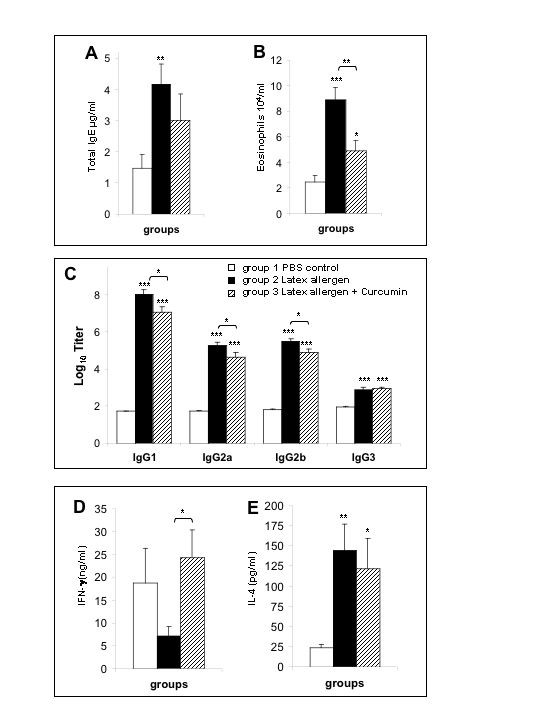
Figure 1
Figure 1
Total serum IgE, peripheral blood eosinophils, latex specific antibodies, and cytokine responses. A. Total serum IgE in nanogram per ml in controls (Group1); latex sensitized mice (Group 2); and latex sensitized mice treated with curcumin (Group 3). B. Peripheral blood eosinophils in the three groups. C. Serum IgG1,2a,2b, and IgG3 latex specific antibodies. The antibody levels were calculated from the O.D. values of at least five two-fold dilutions and log titers calculated using a computerized program. D. IFN-γ production (ng/ml) by antigen-stimulated spleens cells as measured by ELISA. E. IL-4 production (Pg/ml) by antigen-stimulated spleen as measured by ELISA.
Figure 2
Figure 2
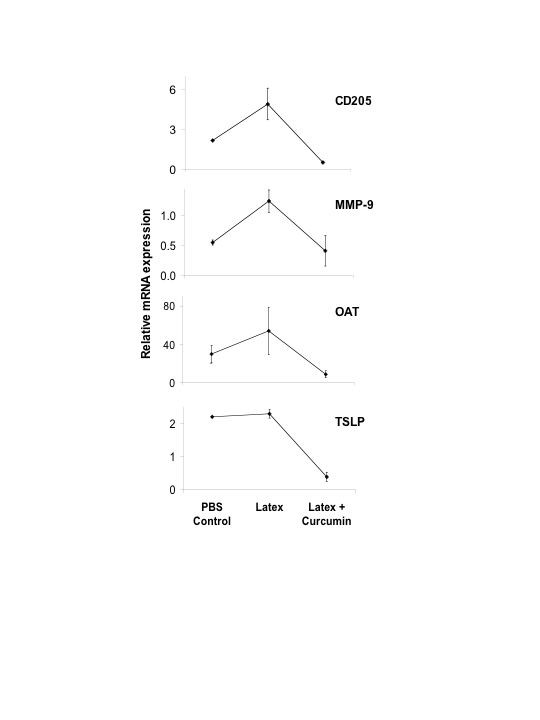
Relative mRNA expression of CD205, MMP-9, OAT, and TSLP in the lungs of control and experimental mice.
Figure 3
Figure 3
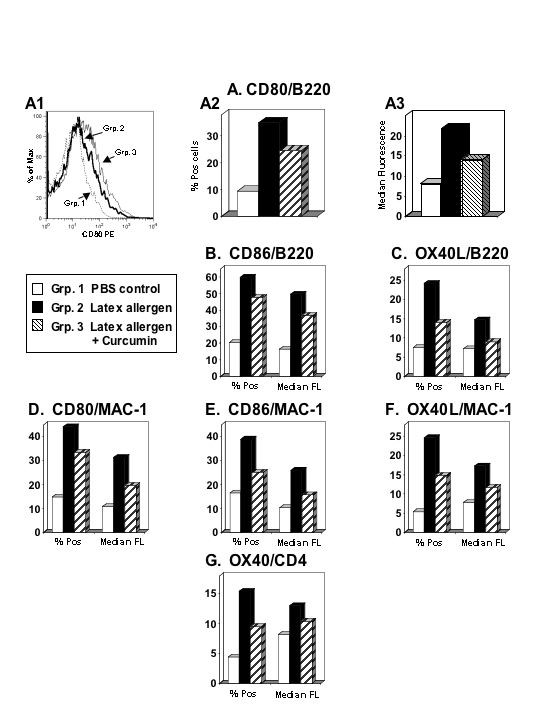
Expression of costimulatory molecules on cells from the lungs of control, latex-sensitized, and latex-sensitized mice treated with curcumin. Lung cells were pooled from mice in each group and analyzed by flow cytometry. Representative histograms comparing CD80 expression on B cells from the three groups tested are shown in panel A1. CD80 expression is shown as percent positive (% Pos) cells in Panel A2, and as median fluorescence (FL) values in Panel A3. The percentages of positive cells and median fluorescence values are shown for CD86 and OX40L on B cells in Panels B and C, respectively. Similarly, CD80, CD86, and OX40L expression on lung macrophages is shown for the three groups in Panels D, E, and F. Percentages of CD4+ T cells expressing OX40 and the median fluorescence values for OX40 are shown in Panel G.
Figure 4
Figure 4
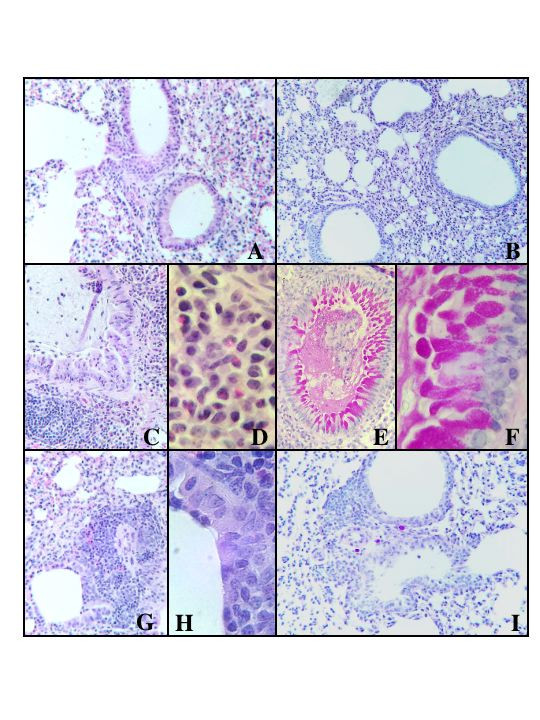
Histology of the lungs studied from control and experimental mice. A. Lungs of the control mice stained by Hematoxylin and eosin (H&E) ×40. B. Lung tissues stained with PAS ×40. C. Latex challenged mice, H&E at ×40. D. Latex challenged mice at ×400. E. Latex challenged mice stained with PAS at ×400. F. Latex challenged mice stained with PAS at ×400. G. Lung section from curcumin treated mice (Group 3), H&E at ×40. H. Lung sections from curcumin treated mice but magnification H&E at ×400. I. Lung section from curcumin treated mice stained with PAS at ×40.
Figure 5
Figure 5
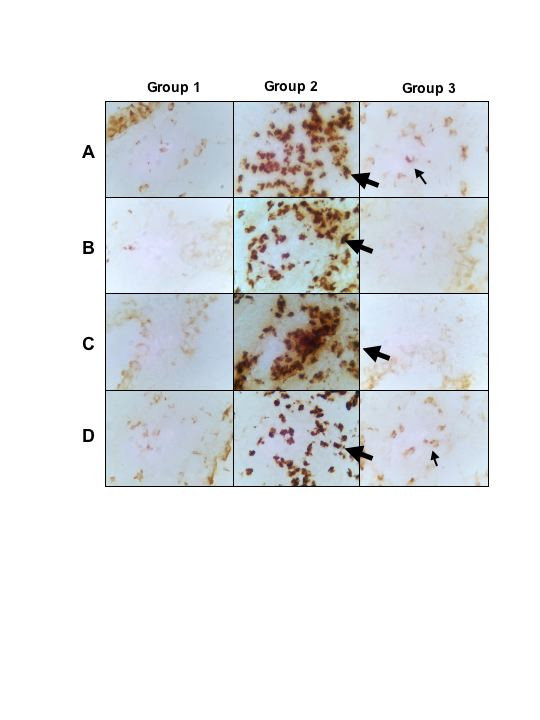
Immunohistochemical staining for IL-4, IL-5, IL-13, and IFN-γ of control mice (Group 1), latex challenged mice (Group 2), and latex challenged treated with curcumin (Group 3). A. IL-4; B. IL-5; C. IL-13; and D. IFN-γ.

References

    1. Bousquet J, Bousquet PJ, Godard P, Daures JP. The public health implications of asthma. Bull World Health Org. 2005;83:548–554. - PMC - PubMed
    1. Masoli M, Fabian D, Holt S, Beasley R. The global burden of asthma: executive summary of the GINA dissemination committee report. Allergy. 2004;59:469–478. doi: 10.1111/j.1398-9995.2004.00526.x. - DOI - PubMed
    1. Verlato G, Corsico A, Villani S, Cerveri I, Migliore E, Accordini S, Carolei A, Piccioni P, Bugiani M, Lo Cascio V, Marinoni A, Poli A, de Marco R. Is the prevalence of adult asthma and allergic rhinitis still increasing? Results of an Italian Study. J Allergy Clin Immunol. 2003;111:1232–1233. doi: 10.1067/mai.2003.1484. - DOI - PubMed
    1. Woolcock AJ, Peat JK. The Rising Trend in Asthma Ciba Foundation Symposium 206. Chichester, UK: Wiley; 1997. Evidence for the increase in asthma worldwide; pp. 122–134. - PubMed
    1. Bousquet J, Ndiaye M, Alt-Khaled N, Annesi-Maesano I, Vignola AM. Management of chronic respiratory and allergic diseases in developing countries. Focus on sub-saharan Africa. Allergy. 2003;58:265–283. doi: 10.1034/j.1398-9995.2003.02005.x. - DOI - PubMed

LinkOut - more resources