


Mosquitoes do senesce: departure from the paradigm of constant mortality
- PMID: 17255238
- PMCID: PMC2408870
Mosquitoes do senesce: departure from the paradigm of constant mortality
Abstract
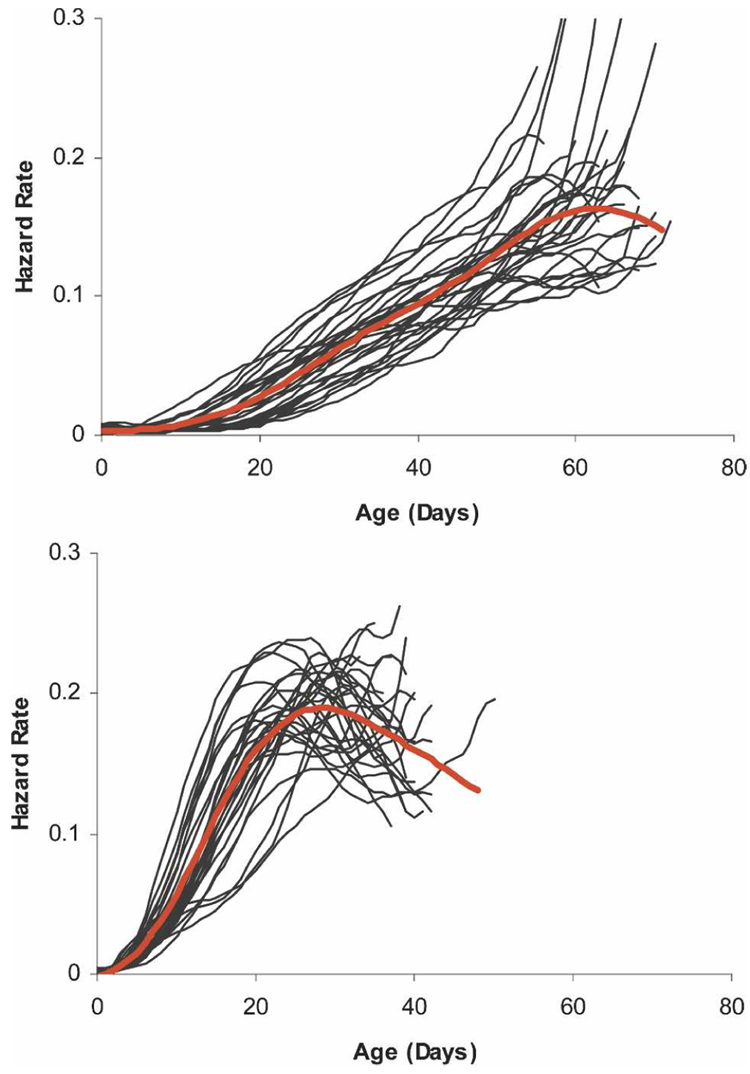
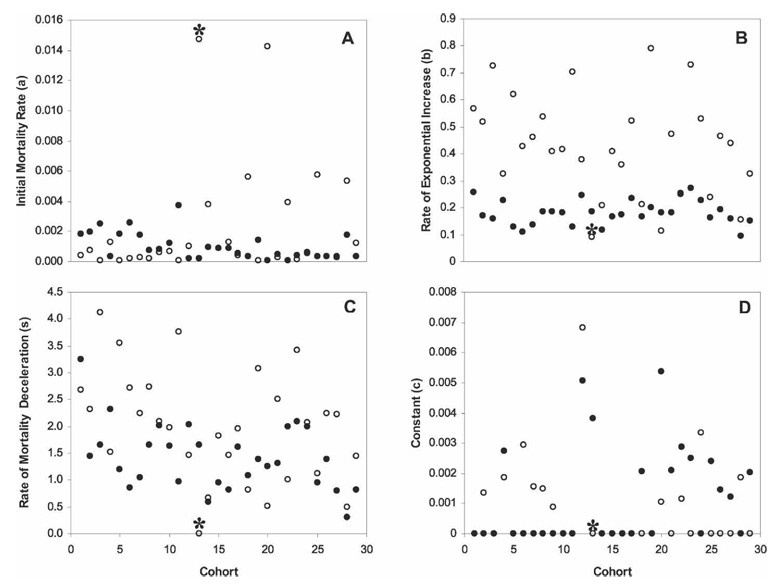
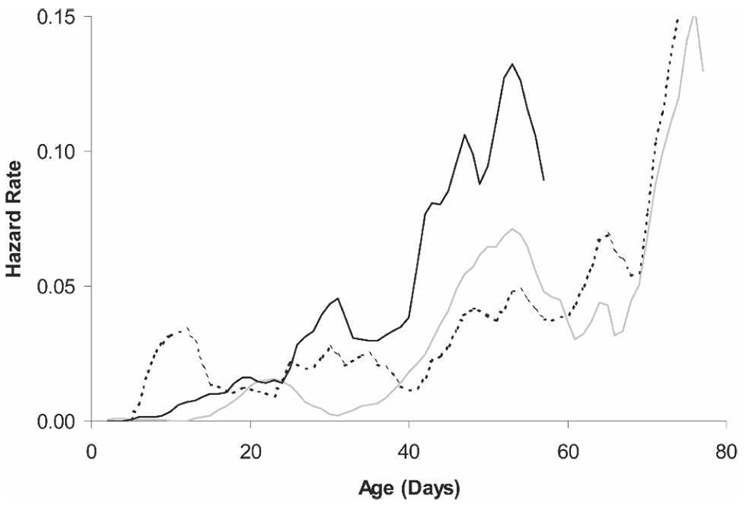
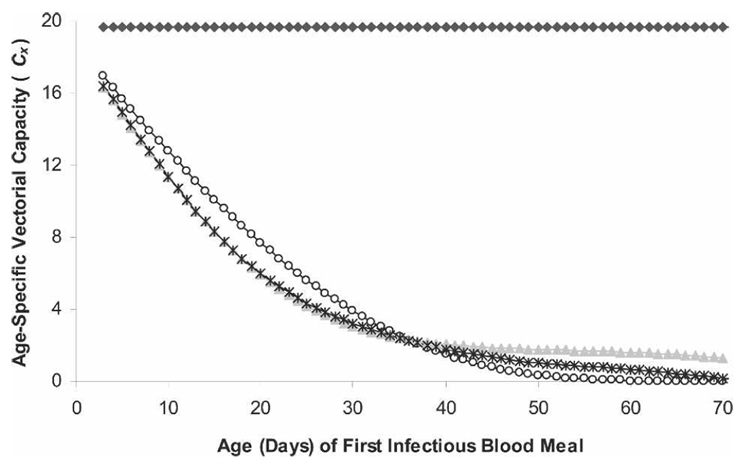
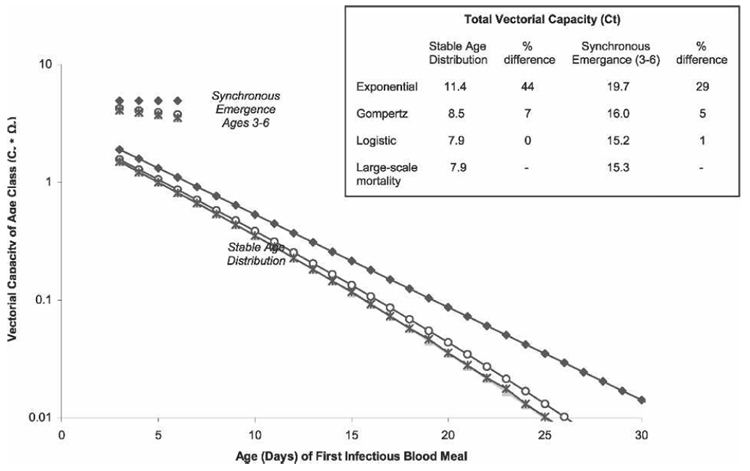
Although variation in mortality is considered by virtually all vector-borne disease specialists to be one of the most important determinants of an arthropod's capacity to transmit pathogens, the operational assumption often is that insect vector mortality is independent of age. Acceptance of the non-senescence assumption leads to the erroneous conclusion that mosquito age is unimportant, results in misleading predictions regarding disease reductions after vector control, and represses study of other aspects of mosquito biology that change with age. We brought large-scale laboratory life table techniques (N > 100,000) to bear on the question of age-dependent mortality in the mosquito vector of dengue virus, Aedes aegypti. Mortality was highly age dependent in both sexes. Mortality was low at young ages (< 10 days old), steadily increased at middle ages, and decelerated at older ages. A newly derived age-dependent model of pathogen transmission shows the importance of young mosquitoes and population age structure to transmission dynamics. Departure from the age-independent mortality paradigm encourages research on overlooked complexities in mosquito biology, the need for innovative methods to study mosquito population dynamics, and the need to study age-dependent changes for an accurate understanding of mosquito biology and pathogen transmission.
Figures
References
-
- Dye C. The analysis of parasite transmission by bloodsucking insects. Annu Rev Entomol. 1992;37:1–19. - PubMed
-
- Clements AN, Paterson GD. The analysis of mortality and survival rates in wild populations of mosquitoes. J Appl Ecol. 1981;18:373–399.
-
- MacDonald G. The analysis of the sporozoite rate. Trop Dis Bull. 1952;49:569–586. - PubMed
-
- Russel PF, Rao TR. Observations on longevity of Anopheles culicifacies imagines. Am J Trop Med. 1942;22:517–533.
-
- Keener GG., Jr Detailed observations on the life history of Anopheles quadrimaculatus. J Natl Malaria Soc. 1945;4:263–270.
Publication types
MeSH terms
Grants and funding
LinkOut - more resources
Full Text Sources
Medical