


Laterality in syrinx muscle morphology of the Japanese quail (Coturnix japonica)
- PMID: 17258241
- PMCID: PMC1862757
- DOI: 10.1016/j.physbeh.2006.12.007
Laterality in syrinx muscle morphology of the Japanese quail (Coturnix japonica)
Abstract
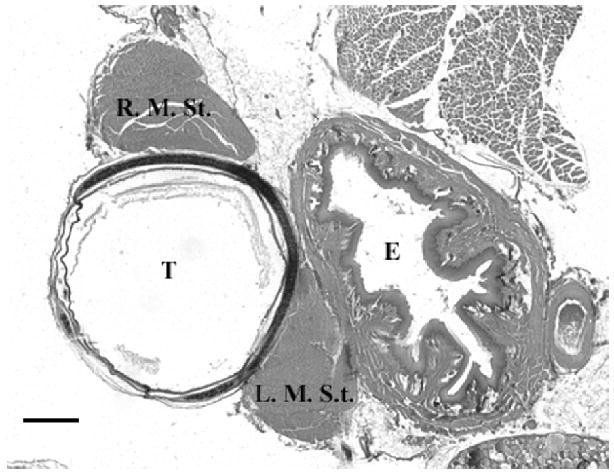
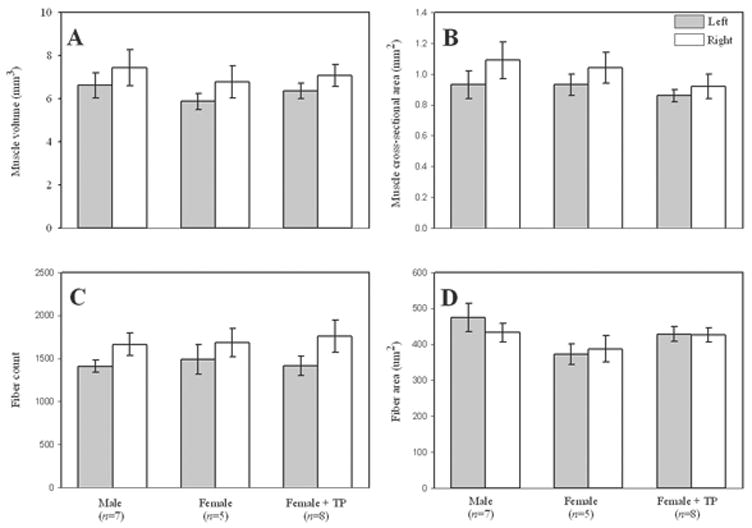
In the Japanese quail, normally only males crow, but treatment of adult females with testosterone (T) facilitates the behavior. The sternotrachealis muscles are thought to adjust the length of the trachea during inspiration and/or expiration and control rigidity of the cartilages of the vocal organ (syrinx) during phonation. These muscles are heavier in males than females, and T increases their mass in females [Balthazart J, Schumacher M, Otttinger MA. Sexual differences in the japanese quail: Behavior, morphology, and intracellular metabolism of testosterone. Gen Comp Endocrinol 1983; 51:191-207., Schumacher M, Balthazart J. The effects of testosterone and its metabolites on sexual behavior and morphology in male and female Japanese quail. Physiol Behav 1983; 30:335-339.]. To investigate sex differences in morphology and potential effects of T in more detail, we examined several components of male, female, and T-treated female quail syrinx. No group effects were detected on overall tracheal size, size of the tracheal lumen, quantity of cartilage, overall muscle volume, or cross-sectional muscle area. However, the area and estimated volume of the muscles were greater on the right than left, due to increased fiber number. The similarity across groups suggests that if the sternotrachealis muscles are critical for crowing, morphology in females is sufficient, and the sex difference in behavior has another source. In contrast, these muscles may not play as large a role as previously hypothesized. If the increased number of fibers on the right has a functional consequence, it likely reflects one similar in the two sexes, for example a common role in the vocalizations they each produce--the male's crow and the female's cricket call.
Figures
References
-
- Balthazart J, Schumacher M, Otttinger MA. Sexual differences in the japanese quail: Behavior, morphology, and intracellular metabolism of testosterone. Gen Comp Endocrinol. 1983;51:191–207. - PubMed
-
- Schumacher M, Balthazart J. The effects of testosterone and its metabolites on sexual behavior and morphology in male and female japanese quail. Physiol Behav. 1983;30:335–339. - PubMed
-
- Goller F, Larsen ON. New perspectives on mechanisms of sound generation in songbirds. J Comp Physiol A. 2002;188:841–850. - PubMed
-
- King AS, McLelland J. Birds: Their structure and function. London: Bailliere Tindall; 1984. Respiratory system, chapter 7; pp. 110–144.
-
- King AS, McLelland J. Functional anatomy of the syrinx. In: King AS, McLelland J, editors. Form and function in birds. London: Academic Press; 1989. pp. 105–192.
Publication types
MeSH terms
Substances
Grants and funding
LinkOut - more resources
Full Text Sources
Miscellaneous
