. 2007 Mar 15;15(6):2453-67.
doi: 10.1016/j.bmc.2006.12.027. Epub 2006 Dec 20.

N-thiolated beta-lactams: Studies on the mode of action and identification of a primary cellular target in Staphylococcus aureus

Affiliations

N-thiolated beta-lactams: Studies on the mode of action and identification of a primary cellular target in Staphylococcus aureus

Kevin D Revell et al. Bioorg Med Chem. .

Abstract

This study focuses on the mechanism of action of N-alkylthio beta-lactams, a new family of antibacterial compounds that show promising activity against Staphylococcus and Bacillus microbes. Previous investigations have determined that these compounds are highly selective towards these bacteria, and possess completely unprecedented structure-activity profiles for a beta-lactam antibiotic. Unlike penicillin, which inhibits cell wall crosslinking proteins and affords a broad spectrum of bacteriocidal activity, these N-thiolated lactams are bacteriostatic in their behavior and act through a different mechanistic mode. Our current findings indicate that the compounds react rapidly within the bacterial cell with coenzyme A (CoA) through in vivo transfer of the N-thio group to produce an alkyl-CoA mixed disulfide species, which then interferes with fatty acid biosynthesis. Our studies on coenzyme A disulfide reductase show that the CoA thiol-redox buffer is not perturbed by these compounds; however, the lactams appear to act as prodrugs. The experimental evidence that these beta-lactams inhibit fatty acid biosynthesis in bacteria, and the elucidation of coenzyme A as a primary cellular target, offers opportunities for the discovery of other small organic compounds that can be developed as therapeutics for MRSA and anthrax infections.


Figures

Figure 1
Figure 1
Structures of N-alkylthio β-lactams and penicillins, two different families of β-lactam antibiotics.
Figure 2
Figure 2
Structure of N-alkylthio 2-oxazolidinone antibiotics.
Figure 3
Figure 3
Comparison of bioactivities of lactam 1 and penicillin G toward MRSA in the absence (a) versus presence (b) of bacterial penicillinase. In (a), when no penicillinase is present, lactam 1 and penicillin each produces large zones of growth inhibition. However, when penicillinase is present in the growth media (b), penicillin G is completely devoid of activity while lactam 1 retains its full activity.
Figure 4
Figure 4
Scanning electron microscope images of S. aureus cultured on agar in the presence of (a) no antibiotic, (b) lactam 1, and (c) penicillin G. These images show that cells which survive explosure to N-thiolated lactam 1 (b) look normal in morphology and clustering behavior, while those treated with penicillin (c) suffer severe damage indicative of inhibition of cell wall biosynthesis.
Figure 5
Figure 5
Light microscopy of S. aureus exposed to (a) no antibiotic, (b) lactam 1, and (c) penicillin G. Staphylococci which appear purple after Gram-staining (a, b) have intact cell walls; those which stain pink (c) have deformed cell walls.
Figure 6
Figure 6
Supercoiled DNA treated with lactam 1 at 5–100 μM. Plasmid pBR322 (0.5 μg) was incubated with lactam 1 at 37°C in sodium phosphate buffer (50 mM, pH 7.4) for 24 hrs and analyzed by agarose gel electrophoresis (ethidium bromide staining). Lane 1: marker. Lane 2: pBR322. Lane 3: pBR322 + DMSO. Lane 4. pBR322 + 5 μM 1. Lane 5: pBR322 + 10 μM 1. Lane 6: pBR322 + 25 μM 1. Lane 7: pBR322 + 50 μM 1. Lane 8: pBR322 + 100 μM 1. Lane 9: marker.
Figure 7
Figure 7
Gel electrophoresis analysis of super-coiled DNA treated with N-thiolated lactam 1 in the absence or presence of thiols. Plasmid pBR322 (0.5μg) was incubated with lactam 1 at 37°C in sodium phosphate buffer (50 mM, pH 7.2) for 24 hrs and analyzed by agarose gel electrophoresis (ethidium bromide staining). Restriction digests conducted with EcoR1 were performed at 37°C for 1 hr. Lane 1: pBR322 + 100 μM 1. Lane 2: pBR322 + 100 μM glutathione. Lane 3: pBR322 + 100 μM glutathione + 100 μM 1. Lane 4: pBR322 + 100 μM DTT. Lane 5: pBR322 + 100 μM DTT + 100 μM 1. Lane 6: pBR322 + 100 μM 2-mercaptoethanol. Lane 7: pBR322 + 100 μM 2-mercaptoethanol + 100 μM 1. Lane 8: linearized pBR322 (EcoR1digest). Lane 9: pBR322 + EcoR1 + 100 μM 1. Lane 10: pBR322 + DMSO. Lane 11: pBR322 + EcoR1 + DMSO.
Figure 8
Figure 8
The rate of radiolabeled thymidine incorporation into growing S. aureus cells (relative to an untreated control) for ciprofloxacin (CIP) and lactam 1.
Figure 9
Figure 9
The rate of radiolabeled uridine incorporation into growing S. aureus cells (relative to an untreated control) in the presence of rifamicin and lactam 1.
Figure 10
Figure 10
The rate of radiolabeled isoleucine incorporation into growing S. aureus cells (relative to an untreated control) in the presence of chloramphenicol (CHL), lactam 1, and DMSO.
Figure 11
Figure 11
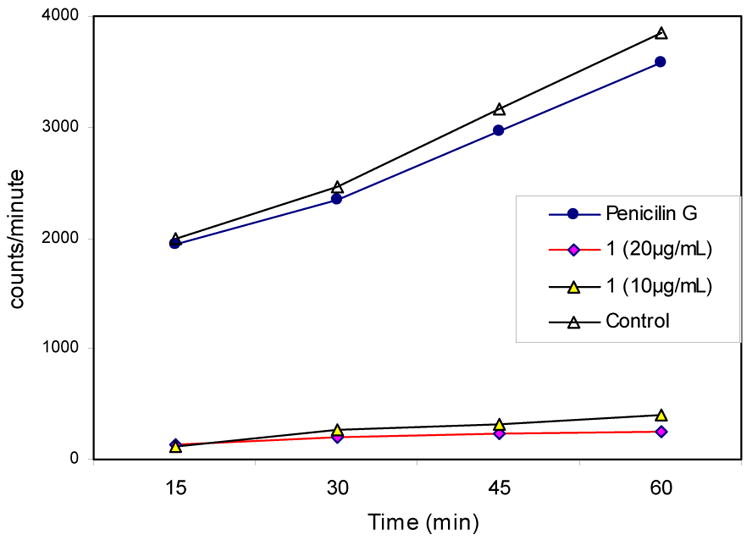
Effect of N-alkylthio β-lactam 1 on fatty acid synthesis. Measurement of uptake of radiolabeled acetate. Incidence of radiation versus time for S. aureus treated with: penicillin G (2 μg/mL, 2xMIC), lactam 1 (20 μg/mL, 2xMIC), (c) compound 1 (10 μg/mL, 1xMIC), (d) DMSO control in the presence of 3H acetate.
Figure 12
Figure 12
Electrophilic sulfur-transfer reagents.
Figure 13
Figure 13
1H NMR spectra of (a) lactam 1 prior to inoculation of S. aureus and (b) lactam 1 following incubation with S. aureus for 24 hours. The N-H signal noted in (b) is indicative of a thio-transfer reaction.
Figure 14
Figure 14
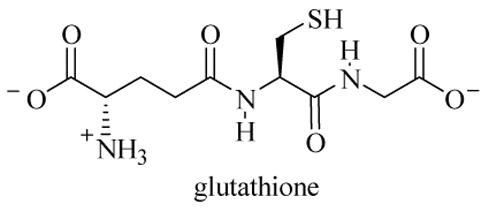
Structure of glutathione.
Figure 15
Figure 15
Effect of glutathione (GSH) on the antimicrobial properties of N-thiolated β-lactams 1–3 against S. aureus. Each 6-mm well contains 20 μg of the indicated β-lactam, and the center well contains 1 mg of glutathione. The neutralizing effect of glutathione on the lactams is apparent from the indented regions of growth inhibition after 24 hours of incubation.
Figure 16
Figure 16
Comparison of bioactivities of N-methylthio lactam 1, N-ethylthio lactam 4, and N-sec-butylthio lactam 5 against S. aureus in the presence of glutathione. In (a), each well contains 20 μg of the lactam and 20 μg of glutathione. In b, 50 μg of glutathione is added to each well containing 20 μg of the lactam. Growth inhibition was checked after 24 hours of incubation.
Figure 18
Figure 18
Structure of allicin, the active constituent from crushed garlic.
Scheme 1
Scheme 1
Probable reaction pathways of N-thiolated β-lactams with nucleophiles.
Scheme 2
Scheme 2
Potential nucleophilic attack on the alkyl residue of the N-alkylthio side chain.
Scheme 3
Scheme 3
Thio-transfer from the lactam 1 to a nucleophilic reactant present in the lysate of cultured S. aureus.
Scheme 4
Scheme 4
Identification of primary cellular target in S. aureus using resin-bound lactam 6.
Scheme 5
Scheme 5
A generalized thiol redox buffer. The thiol-disulfide equilibrium is responsible for absorbing reactive oxygen species (ROS) generated in the cell by oxidative stress, and is closely maintained by an enzyme, disulfide reductase.
Scheme 6
Scheme 6
Mode of action of CoA disulfide reductase.
Scheme 7
Scheme 7
A possible result of transferring the alkylthio residue from the lactam to CoA, leading to the disruption of the CoA disulfide reductase.
Scheme 8
Scheme 8
Formation of mixed CoA disulfides 8a-c.
Scheme 9
Scheme 9
Disulfide capping of the active site cysteine in CoA disulfide reductase.

References

    1. Turos E, Konaklieva MI, Ren RXF, Shi H, Gonzalez J, Dickey S, Lim D. Tetrahedron. 2000;56:8193. 2000.
    1. Turos E, Long TE, Konaklieva MI, Coates C, Shim JY, Dickey S, Lim DV, Cannons A. Bioorg Med Chem Lett. 2002;12:2229. - PubMed
    1. Coates C, Long TE, Turos E, Dickey S, Lim DV. Bioorg Med Chem Lett. 2003;11:193. - PubMed
    1. Long TE, Turos E, Konaklieva MI, Blum AL, Amry A, Baker EA, Suwandi LS, McCain MD, Rahman MF, Dickey S, Lim DV. Bioorg Med Chem. 2003;11:1859. - PubMed
    1. Turos E, Coates C, Shim JY, Wang Y, Roettgers JM, Long TE, Reddy GSK, Ortiz A, Culbreath M, Dickey S, Lim DV, Alonso E, Gonzalez J. Bioorg Med Chem. 2005;13:6289. - PubMed

Publication types

MeSH terms