Effect of reducing caffeine intake on birth weight and length of gestation: randomised controlled trial
- PMID: 17259189
- PMCID: PMC1804137
- DOI: 10.1136/bmj.39062.520648.BE
Effect of reducing caffeine intake on birth weight and length of gestation: randomised controlled trial
Abstract
Objective: To estimate the effect of reducing caffeine intake during pregnancy on birth weight and length of gestation.
Design: Randomised double blind controlled trial.
Setting: Denmark.
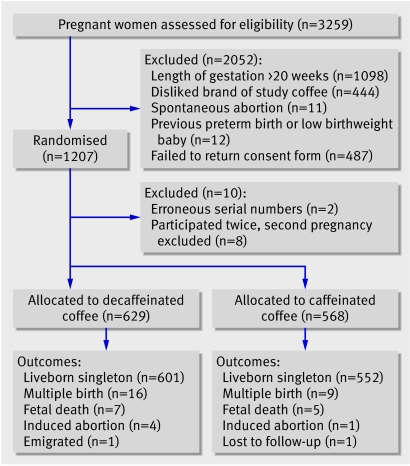
Participants: 1207 pregnant women drinking at least three cups of coffee a day, recruited before 20 weeks' gestation.
Interventions: Caffeinated instant coffee (568 women) or decaffeinated instant coffee (629 women).
Main outcome measures: Birth weight and length of gestation.
Results: Data on birth weight were obtained for 1150 liveborn singletons and on length of gestation for 1153 liveborn singletons. No significant differences were found for mean birth weight or mean length of gestation between women in the decaffeinated coffee group (whose mean caffeine intake was 182 mg lower than that of the other group) and women in the caffeinated coffee group. After adjustment for length of gestation, parity, prepregnancy body mass index, and smoking at entry to the study the mean birth weight of babies born to women in the decaffeinated group was 16 g (95% confidence interval -40 to 73) higher than those born to women in the caffeinated group. The adjusted difference (decaffeinated group-caffeinated group) of length of gestation was -1.31 days (-2.87 to 0.25).
Conclusion: A moderate reduction in caffeine intake in the second half of pregnancy has no effect on birth weight or length of gestation.
Trial registration: Clinical Trials NCT00131690 [ClinicalTrials.gov].
Conflict of interest statement
Republished in
-
[Caffeine and birth weight--randomised double blind trial].Ugeskr Laeger. 2007 Sep 24;169(39):3300-2. Ugeskr Laeger. 2007. PMID: 17953891 Danish.
Comment in
-
Coffee and pregnancy.BMJ. 2007 Feb 24;334(7590):377. doi: 10.1136/bmj.39122.395058.80. BMJ. 2007. PMID: 17322215 Free PMC article.
References
-
- Knight CA, Knight I, Mitchell DC, Zepp JE. Beverage caffeine intake in US consumers and subpopulations of interest: estimates from the Share of Intake Panel survey. Food Chem Toxicol 2004;42(12):1923-30. - PubMed
-
- Aldridge A, Bailey J, Neims AH. The disposition of caffeine during and after pregnancy. Semin Perinatol 1981;5:310-4. - PubMed
-
- Aldridge A, Aranda JV, Neims AH. Caffeine metabolism in the newborn. Clin Pharmacol Ther 1979;25:447-53. - PubMed
-
- Kirkinen P, Jouppila P, Koivula A, Vuori J, Puukka M. The effect of caffeine on placental and fetal blood flow in human pregnancy. Am J Obstet Gynecol 1983;147(8):939-42. - PubMed
-
- Weathersbee PS, Lodge JR. Caffeine: its direct and indirect influence on reproduction. J Reprod Med 1977;19:55-63. - PubMed
Publication types
MeSH terms
Substances
Associated data
LinkOut - more resources
Full Text Sources
Medical