


Se(VI) reduction and the precipitation of Se(0) by the facultative bacterium Enterobacter cloacae SLD1a-1 are regulated by FNR
- PMID: 17261520
- PMCID: PMC1828800
- DOI: 10.1128/AEM.02542-06
Se(VI) reduction and the precipitation of Se(0) by the facultative bacterium Enterobacter cloacae SLD1a-1 are regulated by FNR
Abstract
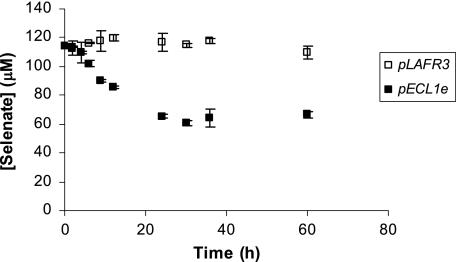
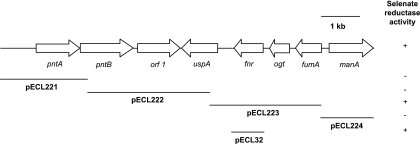
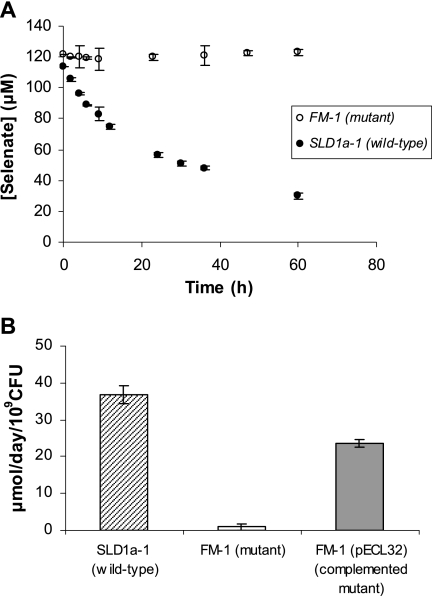
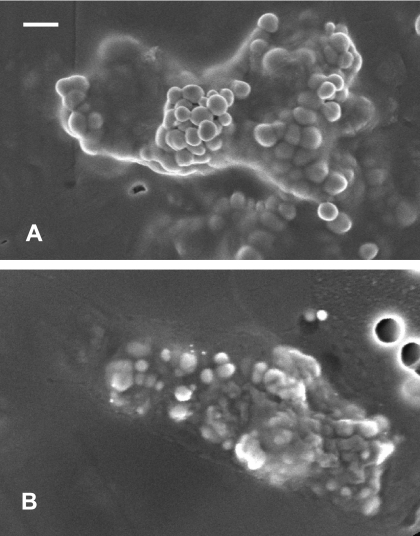
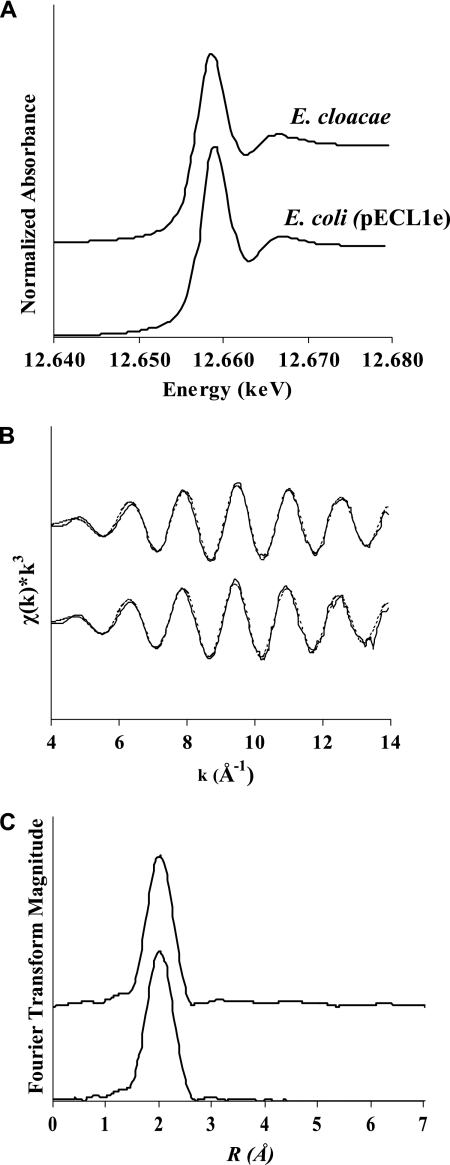
The fate of selenium in the environment is controlled, in part, by microbial selenium oxyanion reduction and Se(0) precipitation. In this study, we identified a genetic regulator that controls selenate reductase activity in the Se-reducing bacterium Enterobacter cloacae SLD1a-1. Heterologous expression of the global anaerobic regulatory gene fnr (fumarate nitrate reduction regulator) from E. cloacae in the non-Se-reducing strain Escherichia coli S17-1 activated the ability to reduce Se(VI) and precipitate insoluble Se(0) particles. Se(VI) reduction by E. coli S17-1 containing the fnr gene occurred at rates similar to those for E. cloacae, with first-order reaction constants of k = 2.07 x 10(-2) h(-1) and k = 3.36 x 10(-2) h(-1), respectively, and produced elemental selenium particles with identical morphologies and short-range atomic orders. Mutation of the fnr gene in E. cloacae SLD1a-1 resulted in derivative strains that were deficient in selenate reductase activity and unable to precipitate elemental selenium. Complementation by the wild-type fnr sequence restored the ability of mutant strains to reduce Se(VI). Our findings suggest that Se(VI) reduction and the precipitation of Se(0) by facultative anaerobes are regulated by oxygen-sensing transcription factors and occur under suboxic conditions.
Figures
References
-
- Bébien, M., J. Kirsch, V. Méjean, and A. Verméglio. 2002. Involvement of a putative molybdenum enzyme in the reduction of selenate by Escherichia coli. Microbiology 148:3865-3872. - PubMed
-
- Constantinidou, C., J. L. Hobman, L. Griffiths, M. D. Patel, C. W. Penn, J. A. Cole, and T. W. Overton. 2006. A reassessment of the FNR regulon and transcriptomic analysis of the effects of nitrate, nitrite, NarXL, and NarQP as Escherichia coli K-12 adapts from aerobic to anaerobic growth. J. Biol. Chem. 281:4802-4815. - PubMed
-
- Dennis, J. J., and G. J. Zylstra. 1998. Improved antibiotic-resistance cassettes through restriction site elimination using Pfu DNA polymerase PCR. BioTechniques 25:772-776. - PubMed
-
- Deverel, S. J., J. L. Fio, and N. M. Dubrovsky. 1994. Distribution and mobility of selenium in groundwater in the western San Joaquin Valley of California, p. 157-184. In W. T. Frankenberger and S. Benson (ed.), Selenium in the environment. Marcel Dekker, Inc., New York, NY.
Publication types
MeSH terms
Substances
Associated data
- Actions
LinkOut - more resources
Full Text Sources
