


Age-related factors affecting the postyield energy dissipation of human cortical bone
- PMID: 17266142
- PMCID: PMC1994146
- DOI: 10.1002/jor.20337
Age-related factors affecting the postyield energy dissipation of human cortical bone
Abstract
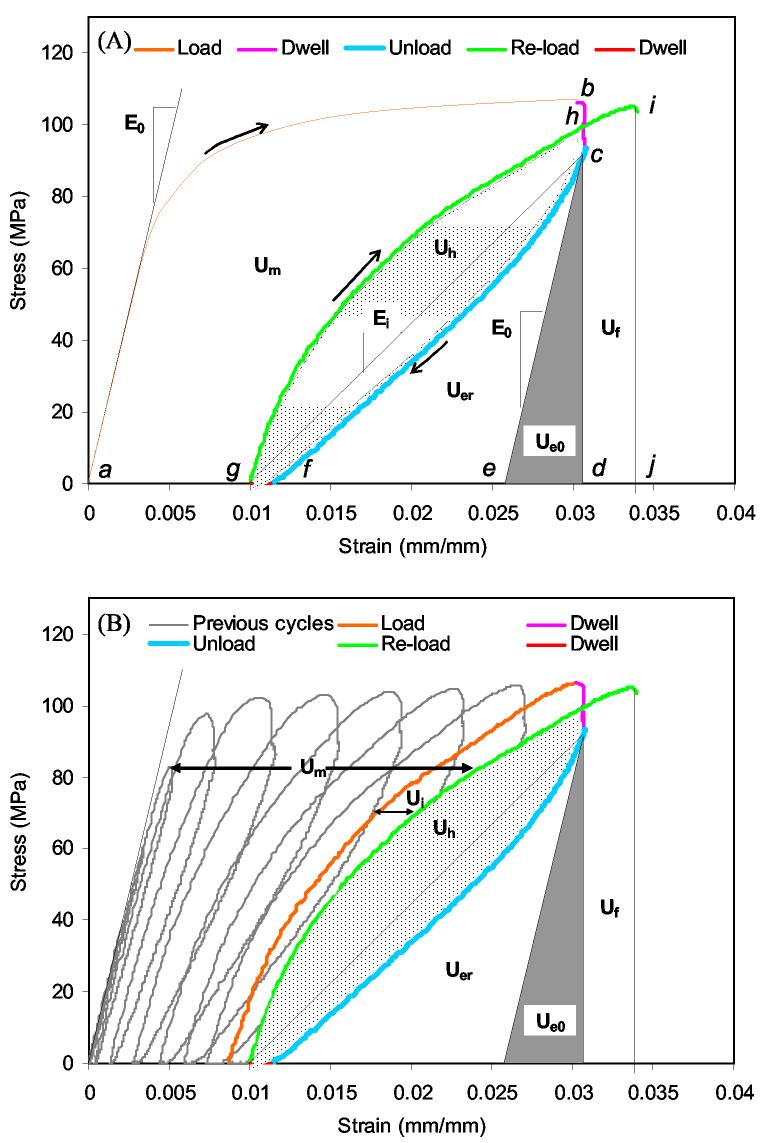
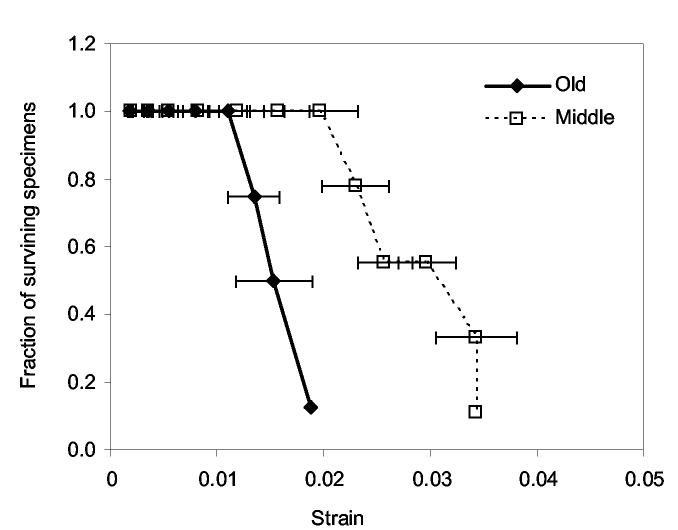
The risk of bone fracture depends in part on tissue quality, not just the size and mass. This study assessed the postyield energy dissipation of cortical bone in tension as a function of age and composition. Specimens were prepared from tibiae of human cadavers in which male and female donors were divided into two age groups: middle aged (51 to 56 years, n = 9) and elderly (72 to 90 years, n = 8). By loading, unloading, and reloading a specimen with rest periods inserted in between, tensile properties at incremental strain levels were assessed. In addition, postyield toughness was estimated and partitioned as plastic strain energy related to permanent deformation, released elastic strain energy related to stiffness loss, and hysteresis energy related to viscous behavior. Porosity, mineral and collagen content, and collagen crosslinks of each specimen were also measured to determine the micro- and ultrastructural properties of the tissue. Age affected all the energy terms plus strength but not elastic stiffness. The postyield energy terms were correlated with porosity, pentosidine (a marker of nonenzymatic crosslinks), and collagen content, all of which varied significantly with age. General linear models suggested that pentosidine concentration and collagen content provided the best explanation of the age-related decrease in the postyield energy dissipation. Among them, pentosidine concentration had the greatest contribution to plastic strain energy and was the best explanatory variable of damage accumulation.
(c) 2007 Orthopaedic Research Society.
Figures
References
-
- Schnitzler CM. Bone quality: a determinant for certain risk factors for bone fragility. Calcif Tissue Int. 1993;53(Suppl 1):S27–S31. - PubMed
-
- van der Meulen MC, Jepsen KJ, Mikic B. Understanding bone strength: size isn't everything. Bone. 2001;29:101–104. - PubMed
-
- Schuit SC, van der Klift M, Weel AE, et al. Fracture incidence and association with bone mineral density in elderly men and women: the Rotterdam Study. Bone. 2004;34:195–202. - PubMed
-
- Crabtree NJ, Kroger H, Martin A, et al. Improving risk assessment: hip geometry, bone mineral distribution and bone strength in hip fracture cases and controls. The EPOS study. European Prospective Osteoporosis Study. Osteoporos Int. 2002;13:48–54. - PubMed
-
- Pulkkinen P, Partanen J, Jalovaara P, et al. Combination of bone mineral density and upper femur geometry improves the prediction of hip fracture. Osteoporos Int. 2004;15:274–280. - PubMed
Publication types
MeSH terms
Substances
Grants and funding
LinkOut - more resources
Full Text Sources
Medical
