


Human TBX1 missense mutations cause gain of function resulting in the same phenotype as 22q11.2 deletions
- PMID: 17273972
- PMCID: PMC1821102
- DOI: 10.1086/511993
Human TBX1 missense mutations cause gain of function resulting in the same phenotype as 22q11.2 deletions
Abstract
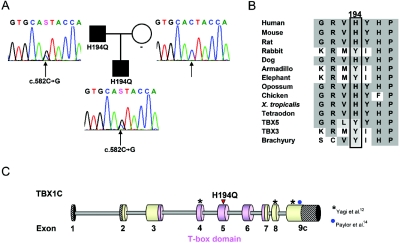
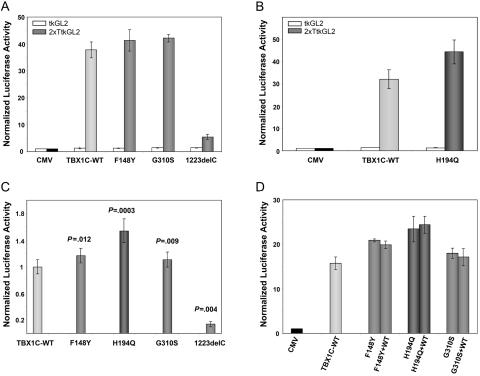
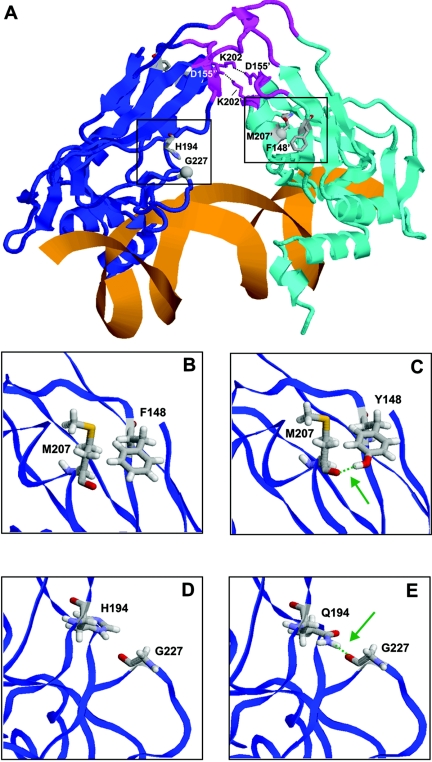
Deletion 22q11.2 syndrome is the most frequent known microdeletion syndrome and is associated with a highly variable phenotype, including DiGeorge and Shprintzen (velocardiofacial) syndromes. Although haploinsufficiency of the T-box transcription factor gene TBX1 is thought to cause the phenotype, to date, only four different point mutations in TBX1 have been reported in association with six of the major features of 22q11.2 deletion syndrome. Although, for the two truncating mutations, loss of function was previously shown, the pathomechanism of the missense mutations remains unknown. We report a novel heterozygous missense mutation, H194Q, in a familial case of Shprintzen syndrome and show that this and the two previously reported missense mutations result in gain of function, possibly through stabilization of the protein dimer DNA complex. We therefore conclude that TBX1 gain-of-function mutations can result in the same phenotypic spectrum as haploinsufficiency caused by loss-of-function mutations or deletions.
Figures
References
Web Resources
-
- GenBank, http://www.ncbi.nlm.nih.gov/Genbank/ (for TBX1C [accession numbers NT_011519.10 and NM_080647.1], TBX3 [accession numbers NT_009775 and NM_016569], TBX5 [accession numbers NT_009775 and NM_000192.3], and Brachyury [accession numbers NT_007422 and NM_003181.2])
-
- Online Mendelian Inheritance in Man (OMIM), http://www.ncbi.nlm.nih.gov/Omim/ (for DGS and VCFS)
-
- SWISS-MODEL, http://swissmodel.expasy.org/
References
-
- McDonald-McGinn DM, Tonnesen MK, Laufer-Cahana A, Finucane B, Driscoll DA, Emanuel BS, Zackai EH (2001) Phenotype of the 22q11.2 deletion in individuals identified through an affected relative: cast a wide FISHing net! Genet Med 3:23–29 - PubMed
-
- Wilson DI, Cross IE, Wren C (1994) Minimum prevalence of chromosome 22q11 deletions. Am J Hum Genet Suppl 55:A169
-
- Rauch A, Hoyer J, Guth S, Zweier C, Kraus C, Becker C, Zenker M, Huffmeier U, Thiel C, Ruschendorf F, et al (2006) Diagnostic yield of various genetic approaches in patients with unexplained developmental delay or mental retardation. Am J Med Genet A 140:2063–2074 - PubMed
Publication types
MeSH terms
Substances
Associated data
- Actions
- Actions
- Actions
- Actions
- Actions
- Actions
- Actions
Grants and funding
LinkOut - more resources
Full Text Sources
Medical
Molecular Biology Databases
