


Review
doi: 10.1186/bcr1633.
HER2 therapy. HER2 (ERBB2): functional diversity from structurally conserved building blocks
Affiliations
- PMID: 17274834
- PMCID: PMC1851388
- DOI: 10.1186/bcr1633
Item in Clipboard
Review
HER2 therapy. HER2 (ERBB2): functional diversity from structurally conserved building blocks
Breast Cancer Res.
2007.
Abstract
EGFR-type receptor tyrosine kinases achieve a broad spectrum of cellular responses by utilizing a set of structurally conserved building blocks. Based on available crystal structures and biochemical information, significant new insights have emerged into modes of receptor control, its deregulation in cancer, and the nuances that differentiate the four human receptors. This review gives an overview of current models of the control of receptor activity with a special emphasis on HER2 and HER3.
Figures
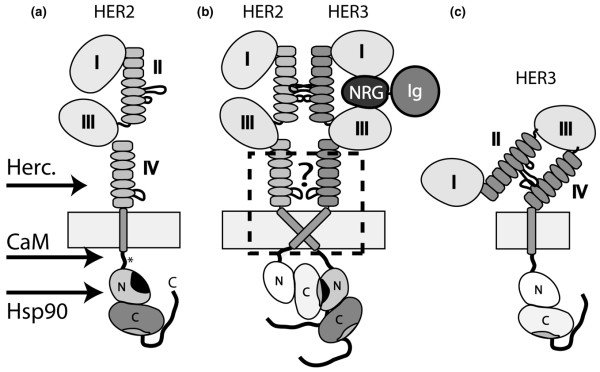
Schematic representation of domains, conformations, and sites of interaction in HER2 and HER3. (a) Domain structure of monomeric HER2, indicating ECDs I to IV with the primary and secondary dimerization loop in the fifth and sixth module of domain II, a single transmembrane span, the cytoplasmic juxtamembrane segment (* indicates the site of PKC-mediated threonine phosphorylation), the amino- and carboxyl-terminal lobe of the kinase domain, and the carboxyl-terminal tail carrying most adapter binding sites. The sites targeted by Herceptin (Herc.), calmodulin (CaM), and Hsp90 are indicated with arrows. (b) Model of HER2-HER3 heterodimer with bound ligand. NRG indicates the EGF-like domain of neuregulin, bound between domains I and III, and Ig indicates the location of the immunoglobulin-like amino-terminal domain of neuregulins. The receptor dimer is stabilized by reciprocal interactions between domains II of both receptors. The physical separation of domains IV in the diagram does not necessarily indicate physical distance but is meant to emphasize that based on experimental data, and in contrast to transmembrane span packing, domain IV interactions do not contribute significantly to dimer stabilization. The exact nature of interactions by both components (boxed with dashed lines) is not clear at this point. The indicated interactions of the cytoplasmic kinase domains summarize the recently proposed mode of allosteric activation based on EGFR structures [38]. (c) HER3 in the closed/locked conformation, stabilized by an intramolecular tether involving the primary dimerization loop in domain II and its structural equivalent in domain IV. ECD, extracellular domain; EGFR, epidermal growth factor receptor; HER, human epidermal growth factor receptor; PKC, protein kinase C.
References
-
- Rubin I, Yarden Y. The basic biology of HER2. AnnOncol. 2001;(12 Suppl 1):S3–S8. - PubMed
Publication types
MeSH terms
Substances
Grants and funding
LinkOut - more resources
Full Text Sources
Other Literature Sources
Medical
Research Materials
Miscellaneous
