Comparative Study
. 2007 Jan;86(1):140-9.
doi: 10.1016/j.pbb.2006.12.018. Epub 2007 Jan 9.

Sex differences in (+)-amphetamine- and (+)-methamphetamine-induced behavioral response in male and female Sprague-Dawley rats

Affiliations
Comparative Study

Sex differences in (+)-amphetamine- and (+)-methamphetamine-induced behavioral response in male and female Sprague-Dawley rats

Alessandra Milesi-Hallé et al. Pharmacol Biochem Behav. 2007 Jan.

Abstract

(+)-Methamphetamine (METH) and (+)-amphetamine (AMP) are structurally similar drugs that are reported to induce similar pharmacological effects in rats of the same sex. Because pharmacokinetic data suggest female rats should be more affected than males, the current studies sought to test the hypothesis that the behavioral and temporal actions of METH and AMP should be greater in female Sprague-Dawley rats than in males. Using a dosing regimen designed to reduce the possibility of tolerance and sensitization, rats were administered 1.0 and 3.0 mg/kg intravenous drug doses. Distance traveled, rearing events and focal stereotypies (e.g., head weaving, sniffing) were measured. Female rats traveled significantly greater distances and displayed a greater number of rearing events than males after both doses. Analysis of stereotypy ratings after 3.0 mg/kg revealed that focal stereotypies were more pronounced and lasted longer in females. The second study compared the potencies of METH and AMP in inducing locomotor activity and focal stereotypies in each sex. No differences in potency were found when METH and AMP effects were compared within males or females. In summary, these studies showed female rats displayed greater and longer-lasting locomotor activity and more stereotypic behaviors, supporting earlier evidence of significant sexual dimorphism in pharmacokinetics.


Figures
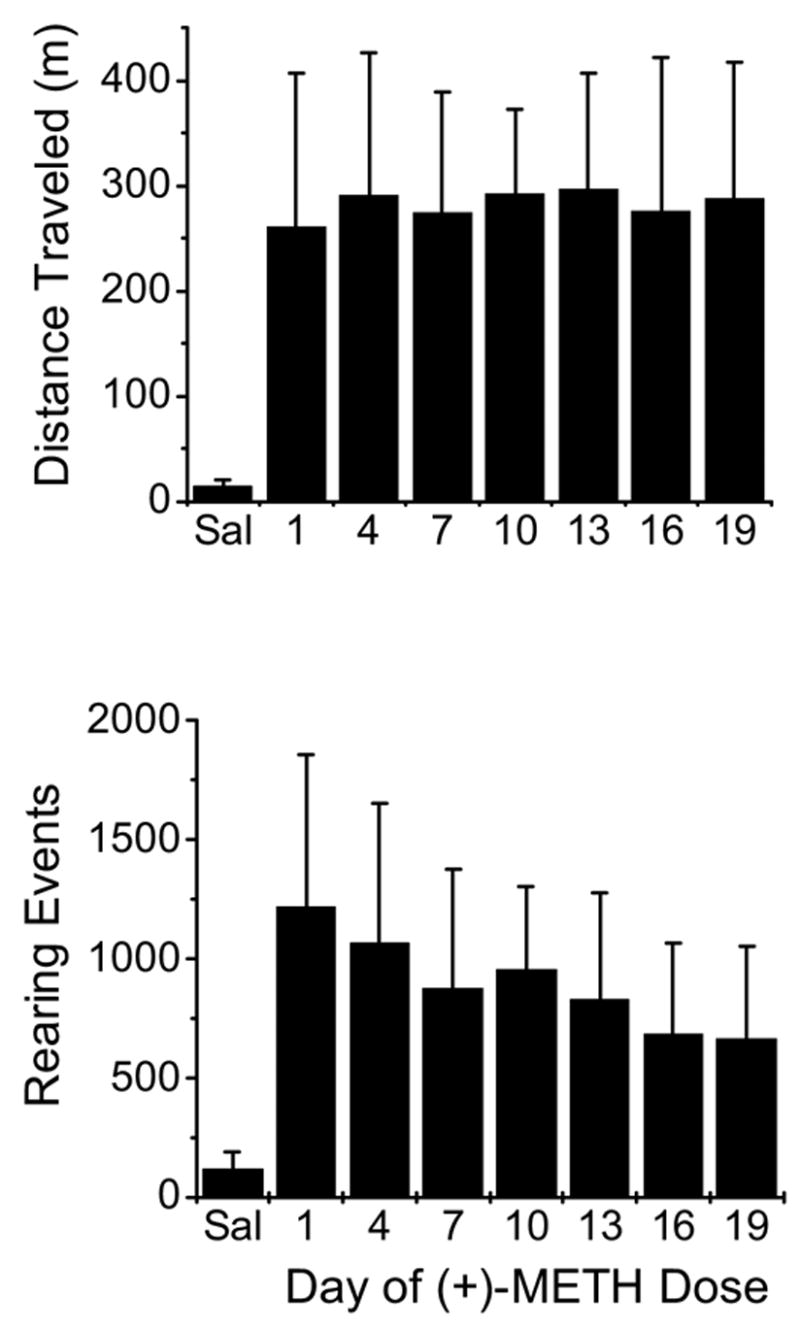
Figure 1
Figure 1
Distance traveled (upper panel) and rearing events (lower panel) in male rats administered 1 mg/kg iv METH once daily every three days for 19 consecutive days. This chronic dosing schedule was used in preliminary studies to determine if our dosing regimen would produce either sensitization or tolerance to METH. Saline was given before METH administration to obtain baseline locomotor activity. Neither locomotor activity nor rearing events were statistically different on any of the treatment days. However, the rearing behavior showed a downward trend over multiple METH doses (suggesting a mild tolerance).
Figure 2
Figure 2
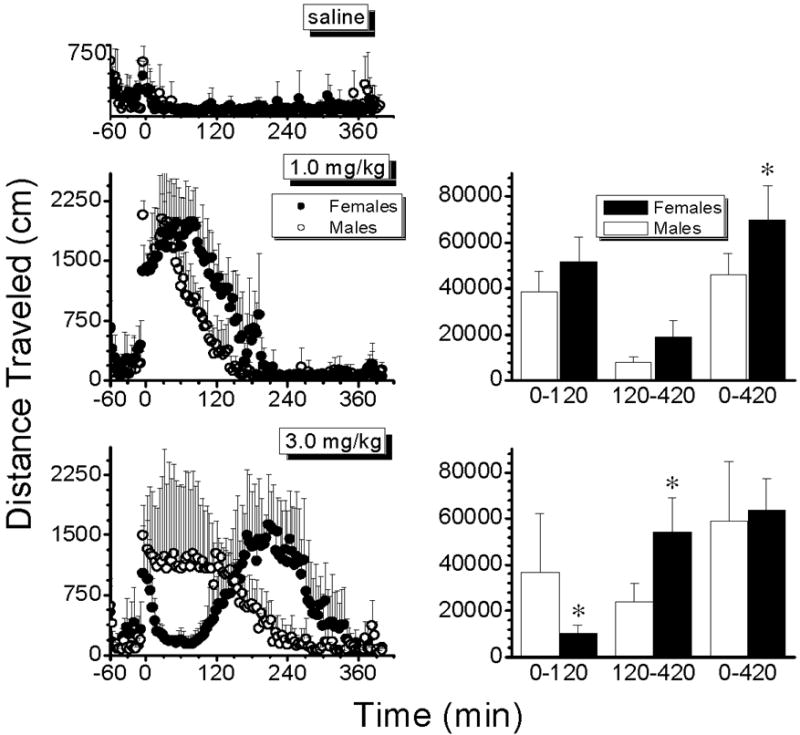
Left panel: Average values for distance traveled by males (open circles) and females (closed circles) after saline (top graph) or 1.0 (left middle graph) and 3.0 mg/kg AMP (left lower graph). Each point represents the cumulative distance (in cm) traveled in 4-min intervals for a total duration of 420 min. Right panel: Bar graphs represent the average values for distance traveled by males (open bars) and females (solid bars) in specific time intervals from 0 to 120 min, 120 to 420 min and 0 to 420 min, after 1.0 (upper right graph) and 3.0 mg/kg AMP (lower right graph). Data are represented as mean ± S.D (n=4 per group). *P<0.05 when compared to male values.
Figure 3
Figure 3
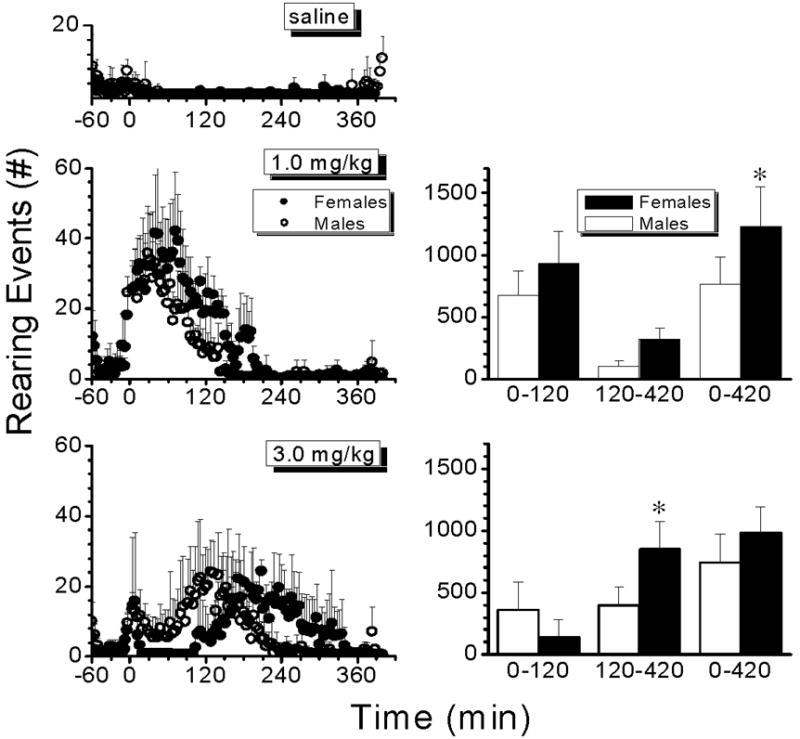
Left panel: Average number of rearing events by males (open circles) and females (closed circles) after saline (top) or 1.0 (middle) and 3.0 mg/kg AMP (lower panel). Each point represents the number of rearing events in 4-min intervals for a total duration of 420 min. Right panel: Bar graphs represent the total distance traveled by males (open bars) and females (solid bars) in specific time intervals from 0 to 120 min, 120 to 420 min and 0 to 420 min, after 1.0 (upper graph) and 3.0 mg/kg AMP (lower graph). Data are represented as mean ± S.D (n=4 per group). * P<0.05 when compared to male values.
Figure 4
Figure 4
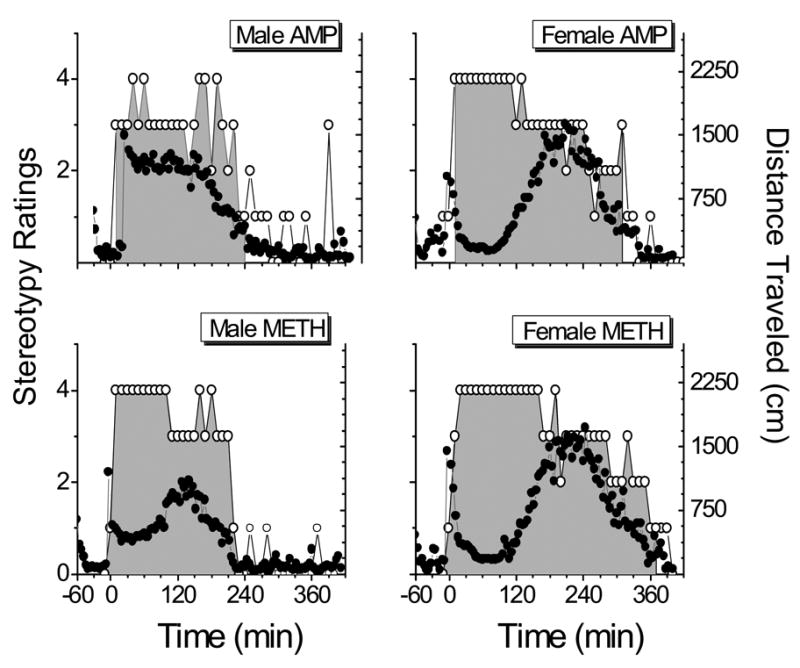
Relationship between distance traveled and stereotypy ratings after AMP (upper row) and METH (lower row) administration (3.0 mg/kg iv bolus) in male rats (left panel) and female rats (right panel). Stereotypy ratings for the 1.0 mg/kg dose are not shown because they were an insignificant part of the behavioral response. Open circles represent ratings observed throughout the behavioral session, according to the stereotypy rating scale detailed in the “Results” section. Gray shaded area represents the duration of stereotypic behavior. Black circles show the distance traveled (in cm) by rats throughout the duration of the behavioral session. Data for METH effects (distance traveled) are from Milesi-Hallé et al., 2005. METH-induced stereotyped behavior was analyzed for the current studies.
Figure 5
Figure 5
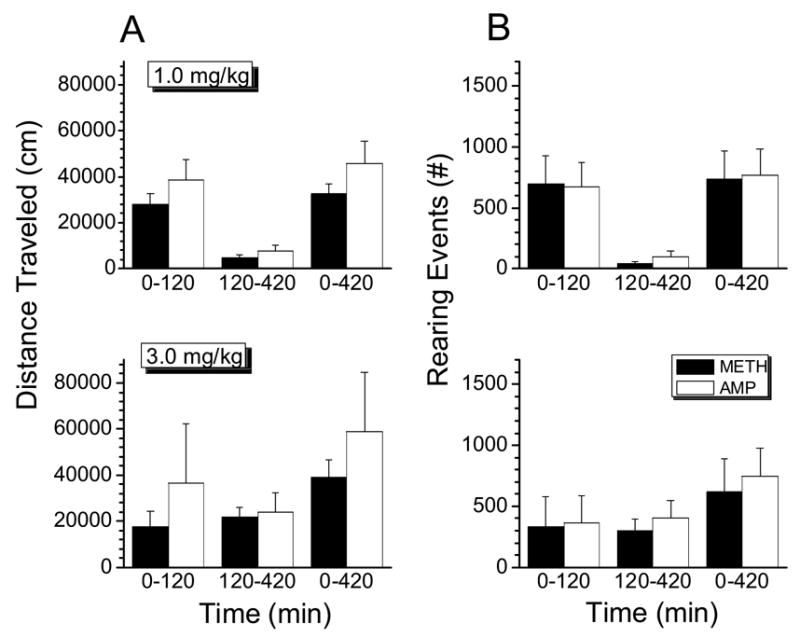
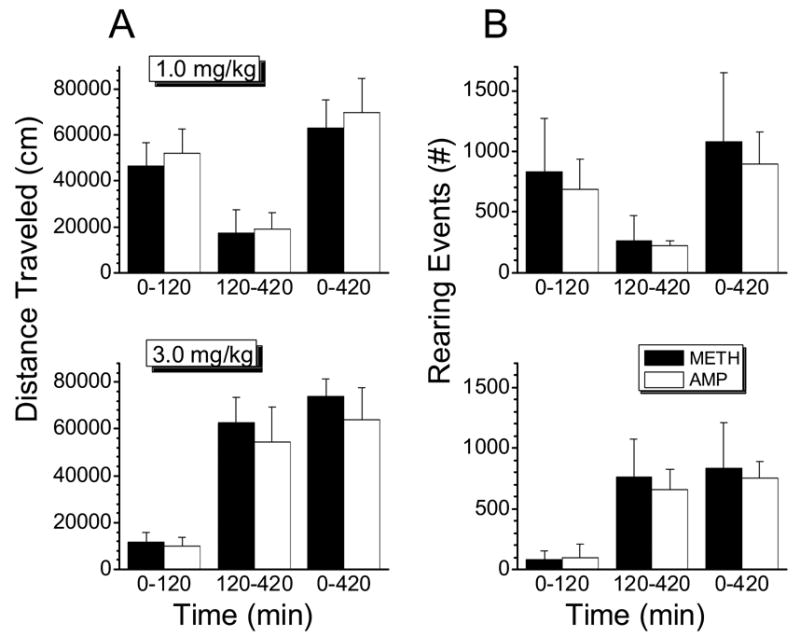
Left panel: Total distance traveled by males during specific time intervals from 0 to 120 min, 120 to 420 min and 0 to 420 min, after 1.0 (top graph) or 3.0 mg/kg (lower graph) doses of METH or AMP. Data are represented as mean +1 S.D. (n=4 rats per group). Right panel: Total number of rearing events observed in males during specific time intervals from 0 to 120 min, 120 to 420 min and 0 to 420 min, after 1.0 (top graph) or 3.0 mg/kg (lower graph) doses of METH or AMP. Data are represented as mean +1 S.D. (n=4 rats per group). Data for METH effects (distance traveled and rearing) are from Milesi-Hallé et al., 2005.
Figure 6
Figure 6
Left panel: Total distance traveled by females during specific time intervals from 0 to 120 min, 120 to 420 min and 0 to 420 min, after 1.0 (top graph) or 3.0 mg/kg (lower graph) doses of METH or AMP. Data are represented as mean +1 S.D. (n=4 rats per group). Right panel: Total number of rearing events observed in females during specific time intervals from 0 to 120 min, 120 to 420 min and 0 to 420 min, after 1.0 (top graph) or 3.0 mg/kg (lower graph) doses of METH or AMP. Data are represented as mean +1 S.D. (n=4 rats per group). Data for METH effects (distance traveled and rearing) are from Milesi-Hallé et al., 2005.

References

    1. Albertson TE, Derlet RW, Van Hoozen BE. Methamphetamine and the expanding complications of amphetamines. West J Med. 1999;170:214–219. - PMC - PubMed
    1. Beatty WW, Holzer GA. Sex differences in stereotyped behavior in the rat. Pharmacol Biochem Behav. 1978;9:777–783. - PubMed
    1. Becker JB, Robinson TE, Lorenz KA. Sex differences and estrous cycle variations in amphetamine-elicited rotational behavior. Eur J Pharmacol. 1982;80:65–72. - PubMed
    1. Becker JB. Gender differences in dopaminergic function in striatum and nucleus accumbens. Pharmacol Biochem Behav. 1999;64:803–812. - PubMed
    1. Bisagno V, Ferguson D, Luine VN. Chronic D-amphetamine induces sexually dimorphic effects on locomotion, recognition memory, and brain monoamines. Pharmacol Biochem Behav. 2003;74:859–867. - PubMed

Publication types