


Review
doi: 10.1016/j.smim.2006.12.005.
Epub 2007 Feb 2.
Regulation of lupus-related autoantibody production and clinical disease by Toll-like receptors
Affiliations
- PMID: 17276080
- PMCID: PMC2709770
- DOI: 10.1016/j.smim.2006.12.005
Item in Clipboard
Review
Regulation of lupus-related autoantibody production and clinical disease by Toll-like receptors
Semin Immunol.
2007 Feb.
Abstract
Autoantigens that contain DNA, RNA, or self-IgG are preferred targets for autoantibodies in systemic lupus erythematosus (SLE). B cells promote SLE pathogenesis by producing autoantibodies, activating autoreactive T cells, and secreting cytokines. We discuss how certain autoreactive B cells are selectively activated, with emphasis on the roles of key Toll-like receptors (TLRs). Although TLR7, which recognizes ssRNA, promotes autoimmune disease, TLR9, which recognizes DNA, unexpectedly regulates disease, despite being required for the secretion of anti-chromatin autoantibodies. We describe positive feedback loops involving B cells, T cells, DCs, and soluble mediators, and how these networks are regulated by TLR signals.
Figures
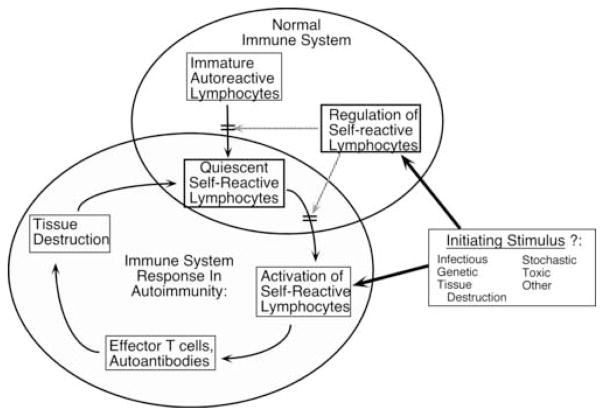
Normally, the immune system (upper right large ellipse) generates autoreactive lymphocytes via the stochastic rearrangement of receptors, but tolerance mechanisms now known to include clonal deletion and receptor editing, prevent the maturation of some of these. However, some of these autoreactive cells will develop and mature, where they are normally held in check by a variety of peripheral tolerance mechanisms. One or more initiating stimuli or preconditions (such as genetic predisposition) can subvert either central or peripheral regulation of autoreactive cells, allowing them to be activated. Chronic autoimmunity will ensue if these lymphocytes generate effector functions, cause tissue injury and inflammation and autoantigen release that is able to promote further activation of autoreactive lymphocytes. It is envisioned that an initial insult could thus be converted to a self-sustaining autoimmune condition, with endogenous stimuli proving sufficient to provide dynamic and continuous activation of autoreactive lymphocytes.
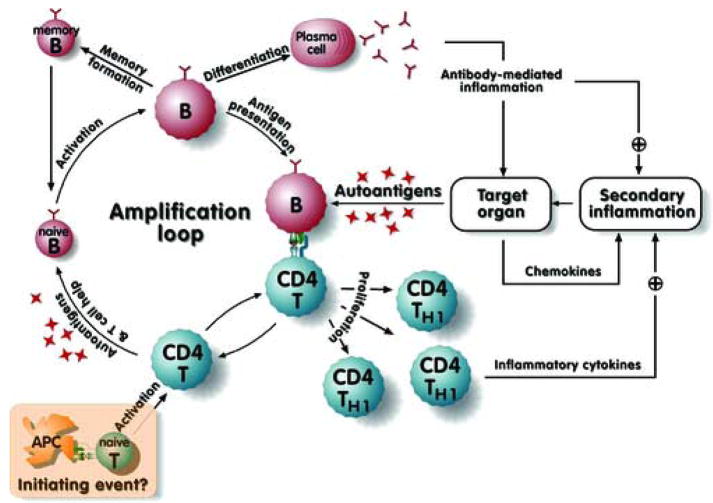
This model was originally proposed in a slightly modified form in Chan et al. [12], and was kindly adapted and redrawn by T. Winkler (Erlangen, GE). A primary amplification loop occurs when B cells activate autoreactive T cells, which in turn can help autoreactive B cells proliferate, differentiate and secrete autoantibody. Whether the initiating antigen-presenting cell for autoreactive T cells is a B cell or a dendritic cell is unspecified, though recent evidence suggests B cells can perform this function as well [34]. Activated T cells can also be pathogenic via direct cytotoxicity and cytokine release, factors that were underappreciated in lupus at the time the model was suggested. Autoantigen release and target organ inflammation are proposed to provide positive feedback for further activation of self-reactive lymphocytes. In addition, antibody-mediated effector function will both damage organs and promote further inflammation.
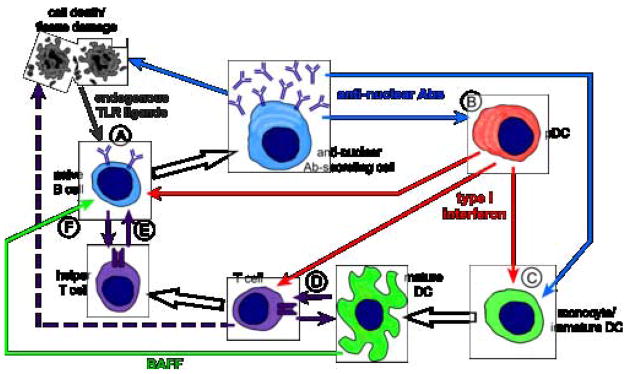
(A) Endogenous DNA- and RNA-containing antigens (gray arrow) released by apoptotic and necrotic cells activate TLRs within autoreactive B cells, allowing differentiation to anti-nuclear antibody-secreting cells. Autoantibodies produced by these cells (blue arrows) can have direct pathogenic effects, releasing additional endogenous TLR ligands and promoting autoreactive B cell activation (B cell autonomous activation cycle). (B) Autoantibody immune complexes activate pDCs, inducing production of IFN-I (red arrows). IFN-I then acts upon B cells to promote antibody secretion (B cell-pDC activation cycle). (C) Autoantibody immune complexes induce maturation of monocytes or immature DCs into effective antigen presenting cells. IFN-I produced by pDCs can also facilitate myeloid DC activation. (D) Mature DCs activate cognate T cells (purple arrows) to produce autoreactive effector T cells, and IFN-I promotes T cell polarization to inflammatory TH1 effectors. Activated T cells may have direct cytotoxic effects on host tissues (dashed arrow). (E) Activated helper T cells provide additional stimulation to autoreactive B cells (purple arrows) for efficient antibody production (B cell-DC-T cell activation cycle). B cells can also reciprocally present antigen to cognate T cells (B cell-T cell activation cycle). (F) Cytokines such as BAFF produced by activated dendritic cells (green arrow) promote autoreactive B cell survival and antibody secretion (B cell-DC activation cycle).
References
-
- Bluestone JA, Abbas AK. Natural versus adaptive regulatory T cells. Nature Reviews Immunology. 2003;3:253–7. - PubMed
-
- von Herrath MG, Harrison LC. Antigen-induced regulatory T cells in autoimmunity. Nature Reviews Immunology. 2003;3:223–32. - PubMed
-
- Mizoguchi A, Bhan AK. A case for regulatory B cells. J Immunol. 2006;176:705–10. - PubMed
-
- Johansson M, Arlestig L, Moller B, Rantapaa-Dahlqvist S. Association of a PDCD1 polymorphism with renal manifestations in systemic lupus erythematosus. Arthritis Rheum. 2005;52:1665–9. - PubMed
-
- Lauwerys BR, Wakeland EK. Genetics of lupus nephritis. Lupus. 2005;14:2–12. - PubMed
Publication types
MeSH terms
Substances
Grants and funding
LinkOut - more resources
Full Text Sources
Other Literature Sources
Medical
