. 2007 Nov;17(11):2713-24.
doi: 10.1093/cercor/bhl180. Epub 2007 Feb 5.

Distinct and convergent visual processing of high and low spatial frequency information in faces

Affiliations

Distinct and convergent visual processing of high and low spatial frequency information in faces

Pia Rotshtein et al. Cereb Cortex. 2007 Nov.

Abstract

We tested for differential brain response to distinct spatial frequency (SF) components in faces. During a functional magnetic resonance imaging experiment, participants were presented with "hybrid" faces containing superimposed low and high SF information from different identities. We used a repetition paradigm where faces at either SF range were independently repeated or changed across consecutive trials. In addition, we manipulated which SF band was attended. Our results suggest that repetition and attention affected partly overlapping occipitotemporal regions but did not interact. Changes of high SF faces increased responses of the right inferior occipital gyrus (IOG) and left inferior temporal gyrus (ITG), with the latter response being also modulated additively by attention. In contrast, the bilateral middle occipital gyrus (MOG) responded to repetition and attention manipulations of low SF. A common effect of high and low SF repetition was observed in the right fusiform gyrus (FFG). Follow-up connectivity analyses suggested direct influence of the MOG (low SF), IOG, and ITG (high SF) on the FFG responses. Our results reveal that different regions within occipitotemporal cortex extract distinct visual cues at different SF ranges in faces and that the outputs from these separate processes project forward to the right FFG, where the different visual cues may converge.


Figures
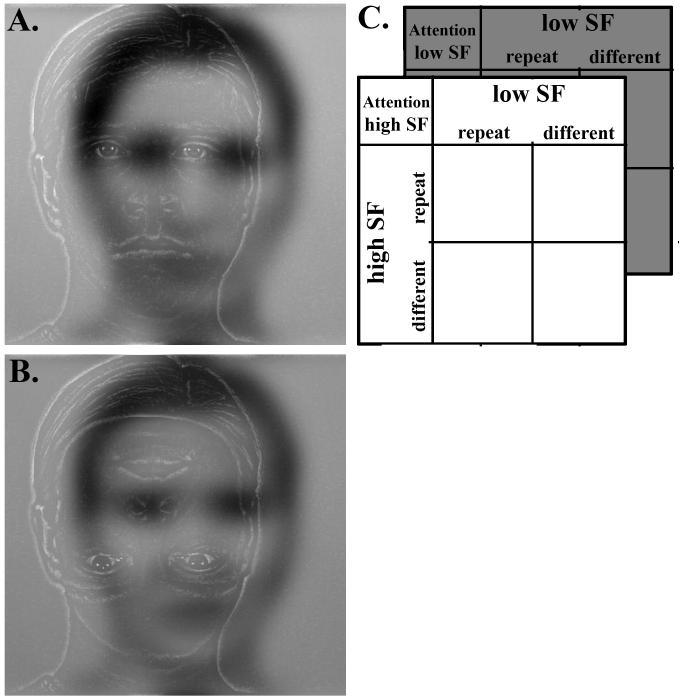
Figure 1
Figure 1. stimuli and experimental design
a) Example of a hybrid stimulus used in the experiment. Each hybrid contained two partly overlapping filtered faces. In this example, the face offset to the right is the low SF face, and the face on the left is the high SF face. The offset direction for each SF filtered face was randomized and counterbalanced across conditions. In this example, the high and low SF faces were scaled to match in contrast. b) Example for ‘oddball’ inverted target stimulus in the high SF attention condition. Note that only the inner features are inverted. In this example, the contrast of the high SF face was maximized while the contrast of the low SF had its original values c) Experimental design. There were 2 (attention: to Low SF or high SF) × 2 (low SF: repeat or differ) × 2 (high SF: repeat or differ) factors.
Figure 2
Figure 2. Voxel-based SPM analysis results
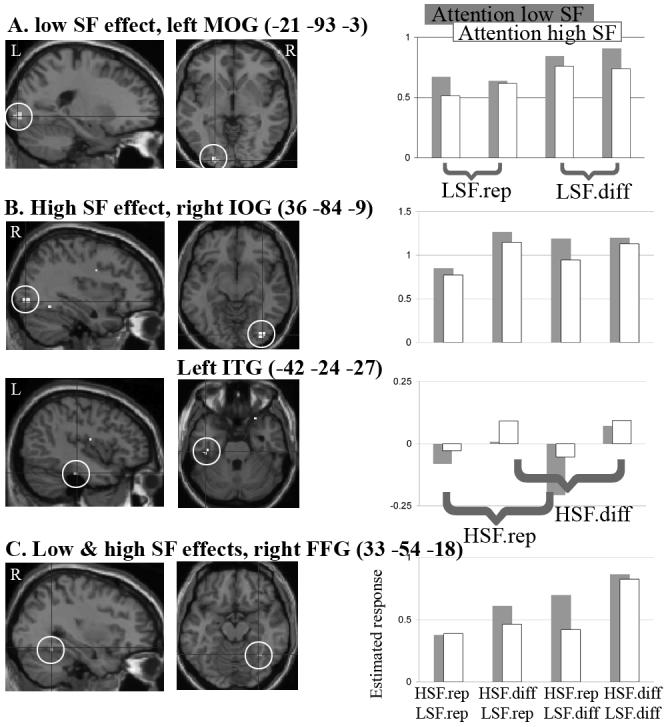
On the left, statistical parametric maps (SPMs) depicting regions sensitive to (a) low SF changes versus repetition (lsf.diff minus lsf.rep), (b) high SF change versus repetition (hsf.diff minus hsf.rep), and (c) both high and low SF information in faces (conjunction of the two former contrasts). The SPMs are shown at a conventional threshold of P < 0.001, uncorrected, and overlaid on sagital and axial T1 images of one of our participants. The histograms show the parameter estimates for the different experimental conditions, taken from the maxima voxel marked with a circle (exact coordinates are given above each histogram, in MNI space); x-axis depicts the 8 experimental conditions, grey bars for attending low SF and white bars for attending high SF, the full condition labeling can be found at the bottom of the last plot; y-axis depicts the estimated response size (SPM ‘beta values’), averaged SEM for all plots was 0.11, ranging from 0.06 to 0.17. Acronyms: LSF/HSF: low/high SF; rep: repeat; diff: different.
Figure 3
Figure 3. Dynamic causal model results
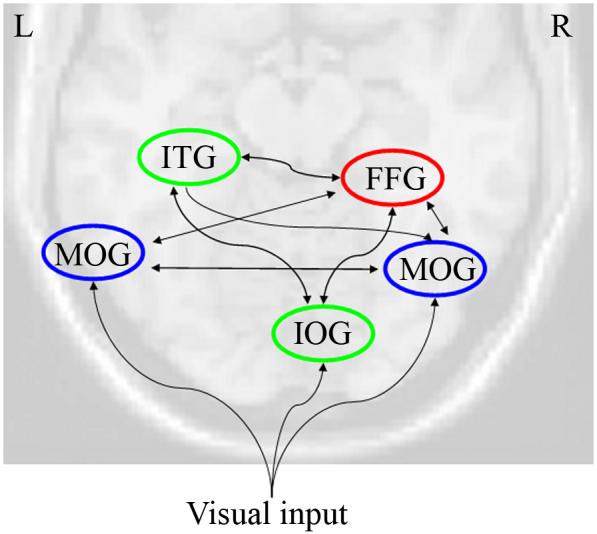
The five ROIs that were used in the DCM are schematically overlaid on an axial slice of occipital cortex. ROIs primarily sensitive to low SF face repetitions are marked in blue, those sensitive to high SF face repetitions marked in green, and those processing both high and low SF are marked in red. Black arrows describe intrinsic connections that were observed throughout the experiment (independent of repetition and attention manipulations; see text for statistical values). All these connections were excitatory, i.e., positive.

References

    1. Ashburner J, Friston KJ. Rigid body transformation. In: Frackowiak RS, Friston KJ, Frith C, Dolan RJ, Price C, Zeki S, Ashburner J, Penny W, editors. Human Brain Function. 2nd addition Academic Press; 2003a.
    1. Ashburner J, Friston KJ. Spatial normalization using basis functions. In: Frackowiak RS, Friston KJ, Frith C, Dolan RJ, Price C, Zeki S, Ashburner J, Penny W, editors. Human Brain Function. 2nd edition Academic Press; 2003b.
    1. Avidan G, Harel M, Hendler T, Ben-Bashat D, Zohary E, Malach R. Contrast sensitivity in human visual areas and its relationship to object recognition. J Neurophysiol. 2002;87:3102–3116. - PubMed
    1. Bar M. A cortical mechanism for triggering top-down facilitation in visual object recognition. J Cogn Neurosci. 2003;15:600–609. - PubMed

    1. Bar M, Kassam KS, Ghuman AS, Boshyan J, Schmidt AM, Dale AM, Hamalainen MS, Marinkovic K, Schacter DL, Rosen BR, Halgren E. Top-down facilitation of visual recognition. Proc Natl Acad Sci U S A. 2006;103:449–454. - PMC - PubMed

Publication types