


Highly variable patterns of linkage disequilibrium in multiple soybean populations
- PMID: 17287533
- PMCID: PMC1855121
- DOI: 10.1534/genetics.106.069740
Highly variable patterns of linkage disequilibrium in multiple soybean populations
Abstract
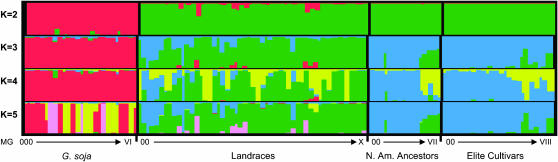
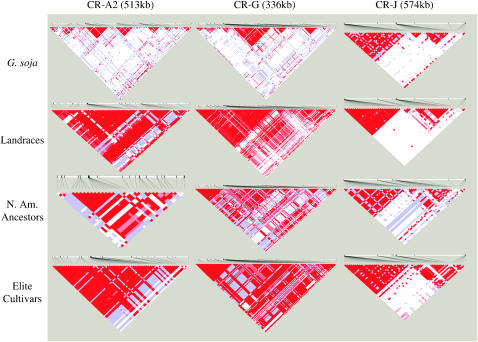
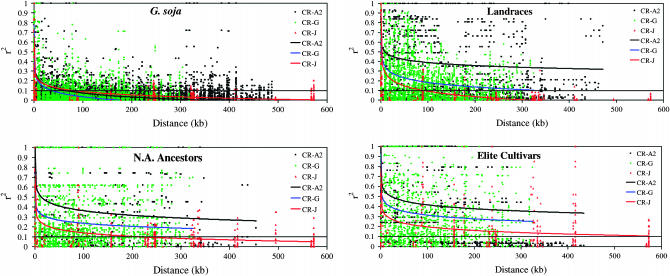
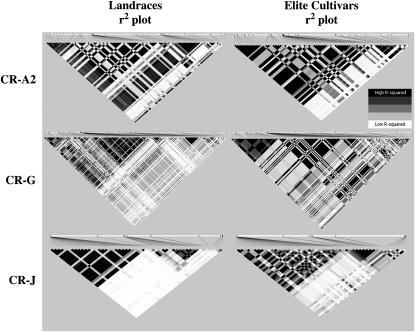
Prospects for utilizing whole-genome association analysis in autogamous plant populations appear promising due to the reported high levels of linkage disequilibrium (LD). To determine the optimal strategies for implementing association analysis in soybean (Glycine max L. Merr.), we analyzed the structure of LD in three regions of the genome varying in length from 336 to 574 kb. This analysis was conducted in four distinct groups of soybean germplasm: 26 accessions of the wild ancestor of soybean (Glycine soja Seib. et Zucc.); 52 Asian G. max Landraces, the immediate results of domestication from G. soja; 17 Asian Landrace introductions that became the ancestors of North American (N. Am.) cultivars, and 25 Elite Cultivars from N. Am. In G. soja, LD did not extend past 100 kb; however, in the three cultivated G. max groups, LD extended from 90 to 574 kb, likely due to the impacts of domestication and increased self-fertilization. The three genomic regions were highly variable relative to the extent of LD within the three cultivated soybean populations. G. soja appears to be ideal for fine mapping of genes, but due to the highly variable levels of LD in the Landraces and the Elite Cultivars, whole-genome association analysis in soybean may be more difficult than first anticipated.
Figures
References
-
- Barrett, J. C., B. Fry, J. Maller and M. J. Daly, 2005. Haploview: analysis and visualization of LD and haplotype maps. Bioinformatics 21: 263–265. - PubMed
-
- Carter, T. E., R. Nelson, C. H. Sneller and Z. Cui, 2004. Genetic diversity in soybean, pp. 303–416 in Soybeans: Improvement, Production, and Uses, edited by H. R. Boerma and J. E. Specht. American Society of Agronomy, Crop Science Society of America, Soil Science Society of America, Madison, WI.
Publication types
MeSH terms
LinkOut - more resources
Full Text Sources
Other Literature Sources
Research Materials
Miscellaneous
