. 2007 Feb 9:5:2.
doi: 10.1186/1476-7961-5-2.

Assessment of allergen cross-reactivity

Affiliations

Assessment of allergen cross-reactivity

Rob C Aalberse. Clin Mol Allergy. .

Abstract

The prediction of allergen cross-reactivity is currently largely based on linear sequence data, but will soon include 3D information on homology among surface exposed residues. To evaluate procedures for these predictions, we need ways to quantitatively assess actual cross-reactivity between two allergens. Three parameters are mentioned: 1) the fraction of the epitopes that is cross-reactive; 2) the fraction of IgE that is cross-reactive; 3) the relative affinity of the interaction between IgE and the two allergens. This editorial briefly compares direct binding protocols with the often more appropriate reciprocal inhibition protocols. The latter type of protocol provides information on symmetric versus asymmetric cross-reactivity, and thus on the distinction between complete (= sensitising) allergens versus incomplete, cross-reacting allergens. The need to define the affinity threshold of the assay and a caveat on the use of serum pools are also discussed.


Figures
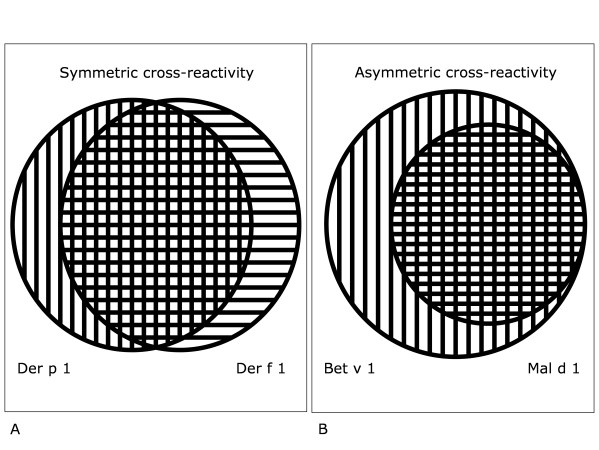
Figure 1
Figure 1
Symmetric (figure 1A) versus asymmetric (figure 1B) cross-reactivity. Symmetric cross-reactivity (figure 1A) occurs between major allergens from related grasses or dust mites. Asymmetric cross-reactivity (figure 1B) is usually found for example between the birch allergen Bet v 1 (outer circle) and the related protein from apple, Mal d 1 (inner circle). Bet v 1 completely inhibits IgE binding to Mal d 1, but Mal d 1 only partially inhibits IgE binding to Bet v 1 (see also figures 2 and 3).
Figure 2
Figure 2
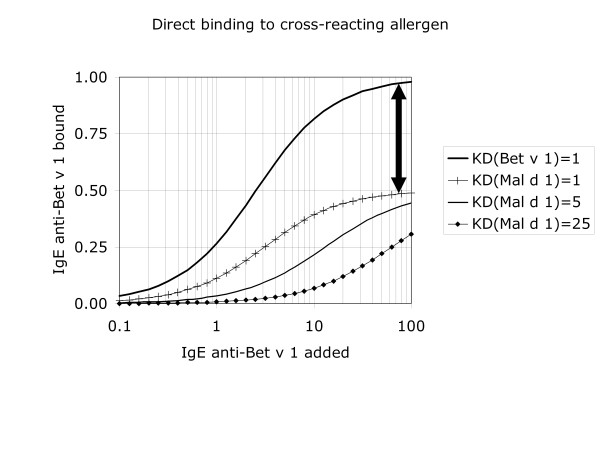
If a serum with cross-reactive antibody to the birch allergen Bet v 1 is incubated with Bet v 1 on the solid-phase, the binding curve is different in two ways: 1) it rises to a higher level and 2) it is shifted to the left compared to the binding observed with the cross-reactive apple allergen Mal d 1 on the solid phase. The first observation reflects that only a fraction of the epitopes is cross-reactive (in this example: 50%, as indicated by the vertical arrow). The second observation reflects that only a fraction of the antibodies is cross-reactive, but also that the affinity is usually lower for the cross-reactive allergen (Mal d 1) compared to the sensitising allergen (Bet v 1). In these model calculations, the concentration of Bet v 1 epitopes is set at 1; 50% of these epitopes are assumed have a cross-reactive homologue in Mal d 1; 40% of the IgE antibodies are assumed to be cross-reactive. The upper curve represents binding to Bet v 1, assuming a dissociation constant KD equal to 1. The next 3 curves represent binding to Mal d 1 at decreasing affinities (KD equal to 1, 5 and 25, respectively. Note that this type of experiment does not prove cross-reactivity. The observed binding could in theory also be due to co-sensitization. This can be investigated by inhibition assays (see figure 3).
Figure 3
Figure 3
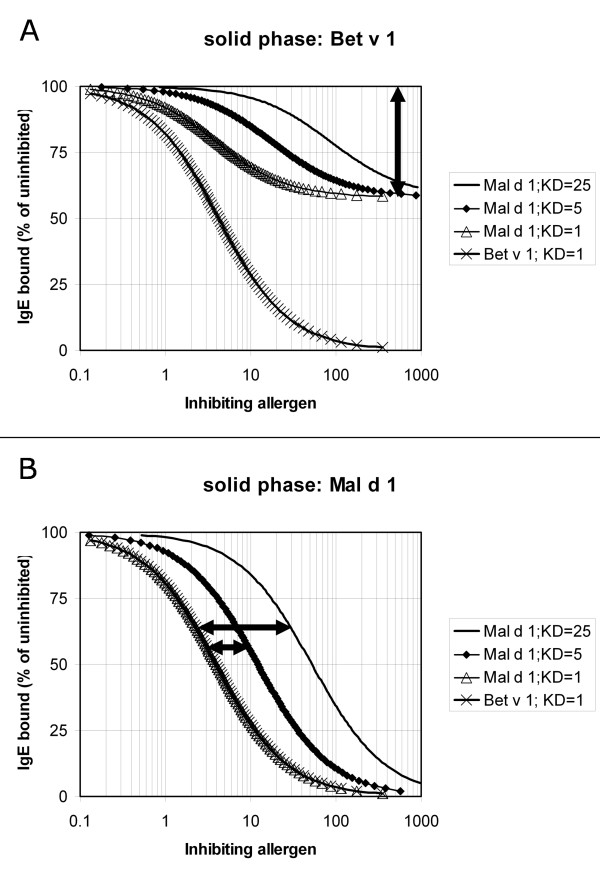
Model calculations illustrating the use of cross-inhibition to demonstrate cross-reactivity and to distinguish the primary sensitising birch allergen Bet v 1 from the cross-reactive (incomplete, non-sensitizing) apple allergen Mal d 1. The type of experiment shown in figure 3A indicates what percentage of the IgE antibodies is cross-reactive (in this example: 40%, as indicated by the vertical arrow). The type of experiment shown in figure 3B shows that Bet v 1 inhibits all antibodies to Mal d 1 and provides a crude estimate of the relative affinity of the interaction of the IgE antibodies with the two allergens (if the concentration of the antibody as well as the solid-phase allergen is equal to or below the KD of the IgE-allergen interaction), as indicated by the two horizontal arrows. The parameter setting correspond to those used in figure 2, using an IgE concentration of 1, which corresponds to values for uninhibited binding of IgE of 0.2660 for IgE binding to Bet v 1 in figure 3A (KD = 1), and for IgE binding to Mal d 1 of 0.0077, 0.0341 and 0.1118 (KD = 25, 5 or 1, respectively) in figure 3B.

References

    1. Westwood GS, Huang SW, Keyhani NO. Molecular and immunological characterization of allergens from the entomopathogenic fungus Beauveria bassiana. Clin Mol Allergy. 2006;4:12. doi: 10.1186/1476-7961-4-12. - DOI - PMC - PubMed
    1. Aalberse RC, Van Ree R. Crossreactive carbohydrate determinants. Clin Rev Allergy Immunol. 1997;15:375–87. - PubMed
    1. Allergenicity of genetically modified foods, a joint FAO/WHO consultation on foods derived from biotechnology. Rome, Italy; http://www.who.int/entity/foodsafety/publications/biotech/en/ec_jan2001.pdf 22–25 January 2001.
    1. Aalberse RC, Akkerdaas J, Van Ree R. Cross-reactivity of IgE antibodies to allergens. Allergy. 2001;56:478–90. doi: 10.1034/j.1398-9995.2001.056006478.x. - DOI - PubMed
    1. Aalberse RC, Kleine Budde I, Stapel SO, Van Ree R. Structural aspects of cross-reactivity and its relation to antibody affinity. Allergy. 2001;56:27–9. doi: 10.1034/j.1398-9995.2001.00909.x. - DOI - PubMed

LinkOut - more resources