


The memory that's right and the memory that's left: event-related potentials reveal hemispheric asymmetries in the encoding and retention of verbal information
- PMID: 17291547
- PMCID: PMC2758159
- DOI: 10.1016/j.neuropsychologia.2006.12.014
The memory that's right and the memory that's left: event-related potentials reveal hemispheric asymmetries in the encoding and retention of verbal information
Abstract
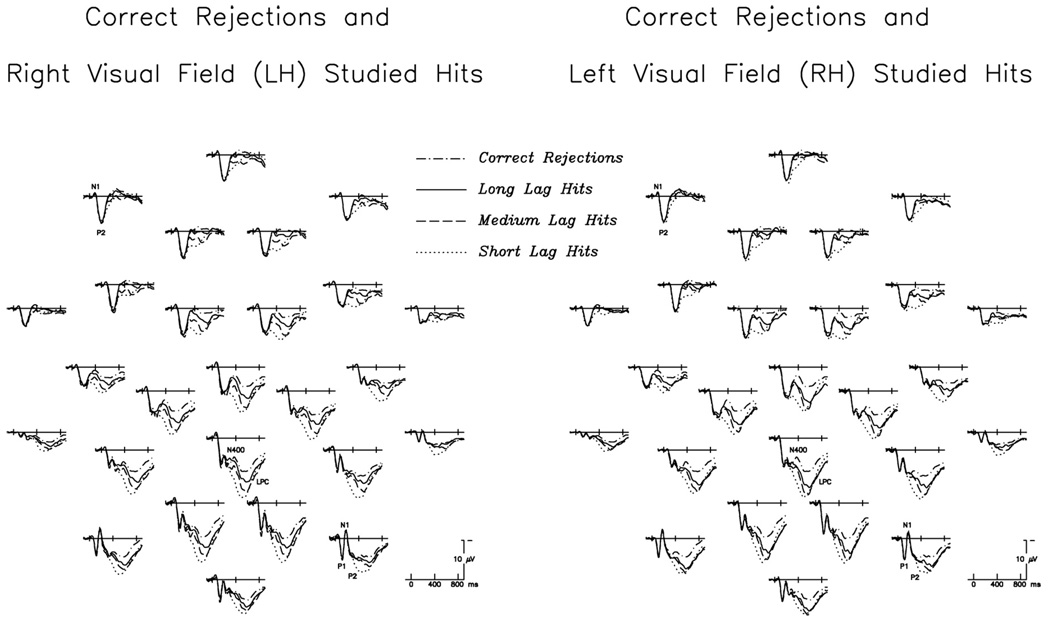
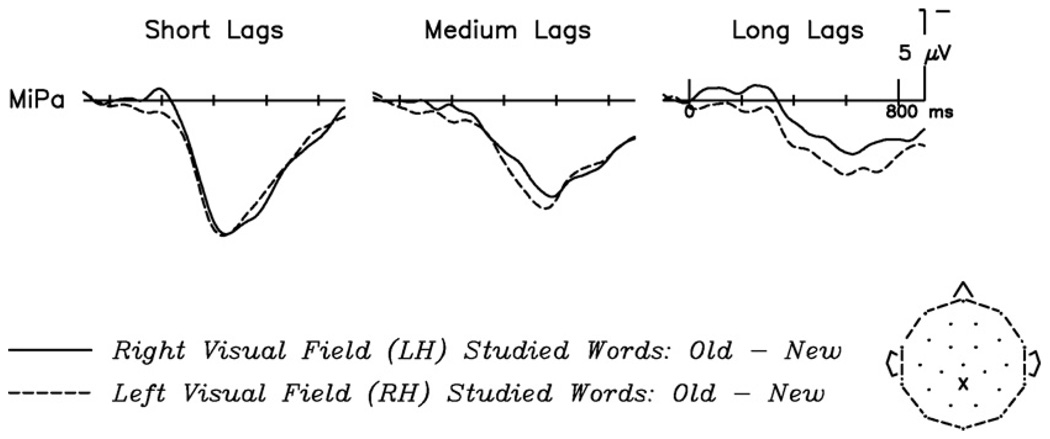
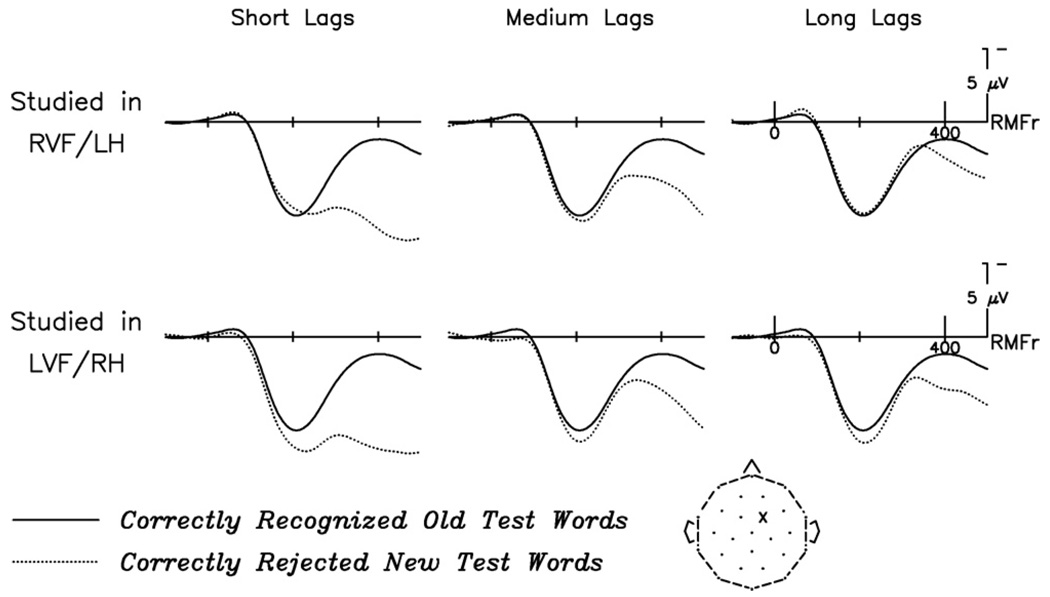
We examined the nature and timecourse of hemispheric asymmetries in verbal memory by recording event-related potentials (ERPs) in a continuous recognition task. Participants made overt recognition judgments to test words presented in central vision that were either novel (new words) or had been previously presented in the left or right visual field (old words). An ERP memory effect linked to explicit retrieval revealed no asymmetries for words repeated at short and medium retention intervals, but at longer repetition lags (20-50 intervening words) this 'old/new effect' was more pronounced for words whose study presentation had been biased to the right hemisphere (RH). Additionally, a repetition effect linked to more implicit recognition processes (P2 amplitude changes) was observed at all lags for words preferentially encoded by the RH but was not observed for left hemisphere (LH)-encoded words. These results are consistent with theories that the RH encodes verbal stimuli more veridically whereas the LH encodes in a more abstract manner. The current findings provide a critical link between prior work on memory asymmetries, which has emphasized general LH advantages for verbal material, and on language comprehension, which has pointed to an important role for the RH in language processes that require the retention and integration of verbal information over long time spans.
Figures
References
-
- Berrini R, Capitani E, Della Sala S, Spinnler H. Interaction between lateralization of memory and probe stimulus in the recognition of verbal and spatial visual stimuli. Neuropsychologia. 1984;22:517–520. - PubMed
-
- Berrini R, Della Sala S, Spinnler H, Sterzi R, Vallar G. In eliciting hemisphere asymmetries which is more important: The stimulus input side or the recognition side? A tachistoscopic study on normals. Neuropsychologia. 1982;20:91–94. - PubMed
-
- Bevilacqua L, Capitani E, Luzzatti C, Spinnler HR. Does the hemisphere stimulated play a specific role in delayed recognition of complex abstract patterns? A tachistoscopic study. Neuropsychologia. 1979;17:93–97. - PubMed
-
- Bihrle AM, Brownell HH, Powelson JA, Gardner H. Comprehension of humorous and nonhumorous materials by left and right brain-damaged patients. Brain and Cognition. 1986;5:399–411. - PubMed
-
- Blanchet S, Desgranges B, Denise P, Lechevalier B, Eustache F, Faure S. New questions on the hemispheric encoding/retrieval asymmetry (HERA) model assessed by divided visual-field tachistoscopy in normal subjects. Neuropsychologia. 2001;39:502–509. - PubMed
Publication types
MeSH terms
Grants and funding
LinkOut - more resources
Full Text Sources
