


The effect of codeine on the Urge-to-Cough response to inhaled capsaicin
- PMID: 17292647
- PMCID: PMC3131054
- DOI: 10.1016/j.pupt.2006.10.012
The effect of codeine on the Urge-to-Cough response to inhaled capsaicin
Abstract
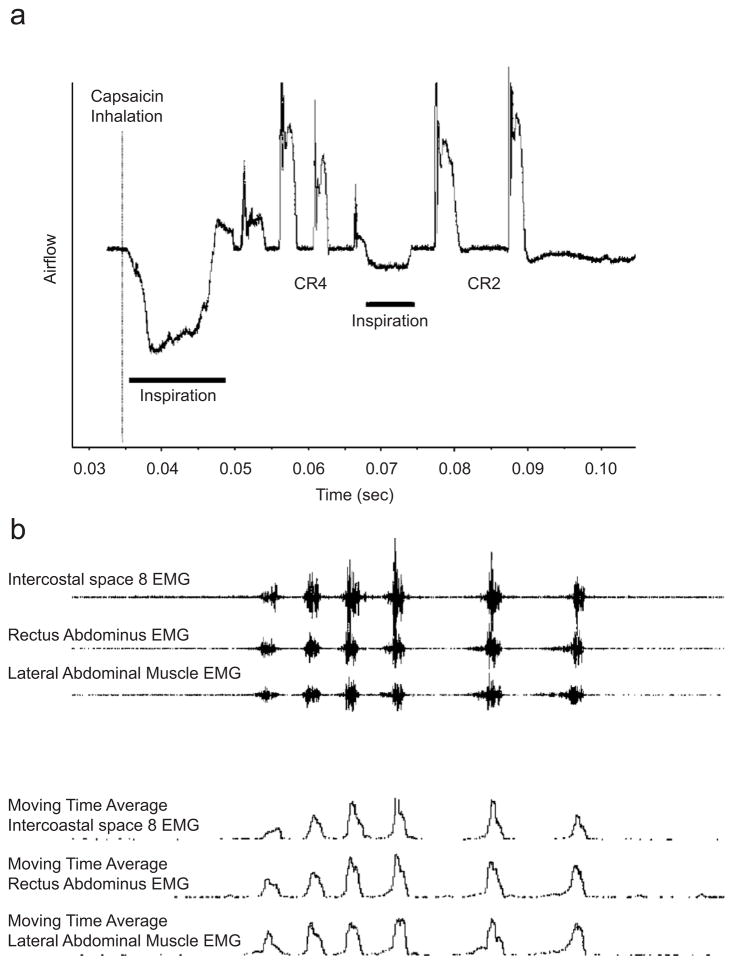
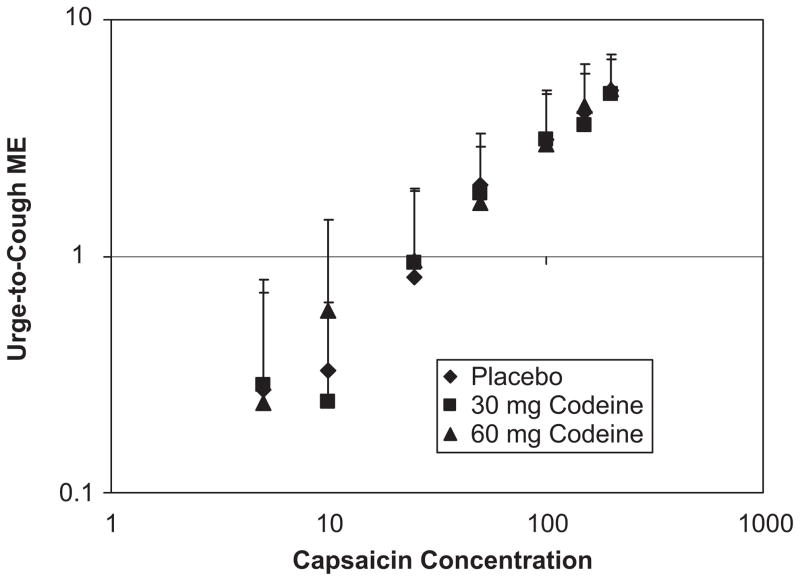
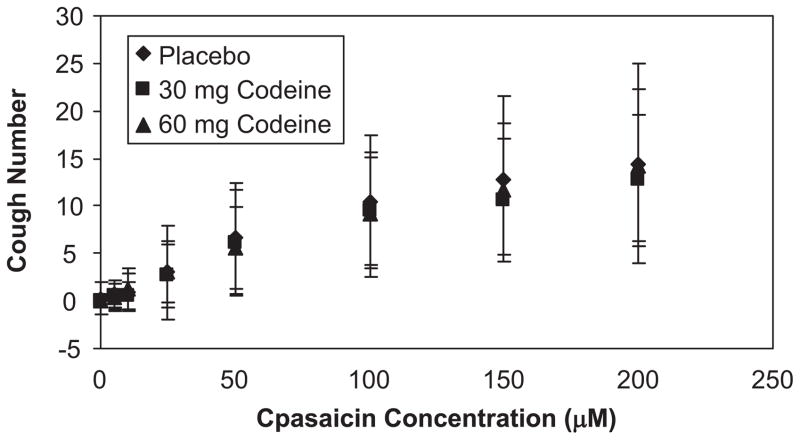
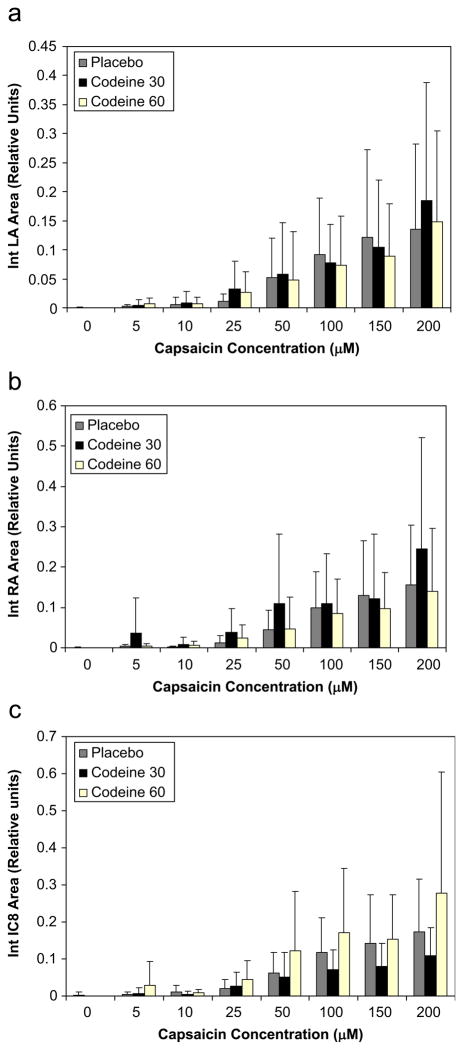
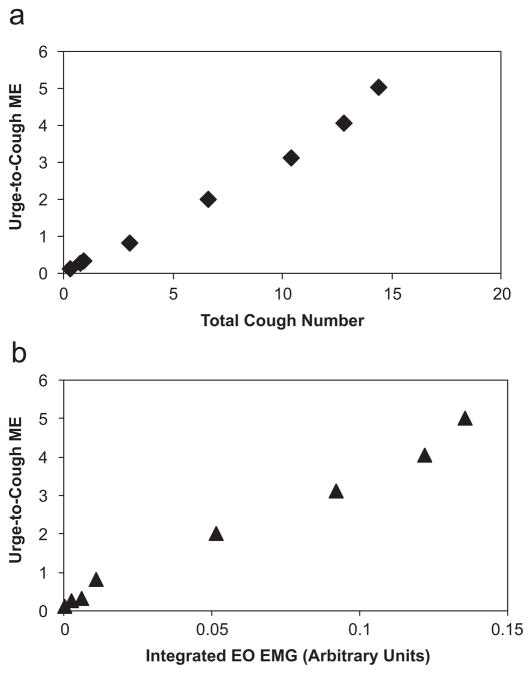
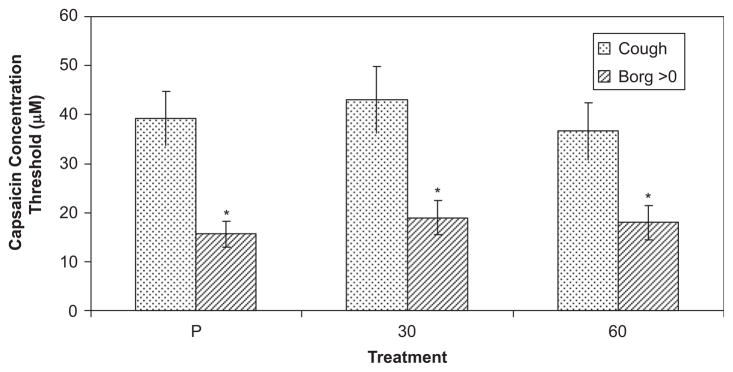
We have shown previously in normal subjects that a sensory measure, the Urge-to-Cough rating, increases at concentrations of inhaled capsaicin that are lower than those necessary to elicit reflex cough. This finding suggests that the Urge-to-Cough may represent an index of the cough response. Research on cough in the human has most often employed challenge with inhaled capsaicin to induce reflex cough. Current measures of cough sensitivity in the human provide no information regarding the intensity of cough. The influence of codeine on cough perceptual sensitivity and the relationship to cough intensity with capsaicin-induced cough in normal subjects has not been evaluated. This study determined the effect of codeine on capsaicin-induced cough perceptual sensitivity and motor response in normal subjects in a double-blind, placebo-controlled, crossover study. This approach investigated the relevance of cough sensitivity, intensity, and sensory modalities in the assessment of cough suppression in humans. This study consisted of three experimental trials: administration of placebo, 30 mg codeine and 60 mg codeine. The study was double-blinded. The order of the three trials was randomized. Respiratory motor pattern was recorded with EMGs from the rectus abdominis, lateral abdominal muscles and eighth intercostal space. The subjects leaned into a fume hood to inspire deeply for 2 s once through a mouthpiece connected to the nebulizer. A modified Borg scale was used to estimate their Urge-to-Cough. The experimental trial consisted of eight test solutions of 0-200 microM capsaicin. Each solution was presented three times in a randomized block order for a total of 24 presentations. The lowest capsaicin concentration to elicit a cough was determined. The lowest capsaicin concentration to elicit an Urge-to-Cough greater than zero was identified. The Urge-to-Cough sensitivity was determined from the log-log slope. For placebo, the Urge-to-Cough was zero with inhalation of the vehicle and no coughs were observed. The threshold capsaicin concentration for subjects to report an Urge-to-Cough was 15.6 microM (+/-2.6 SEM). The capsaicin concentration threshold for eliciting a cough was significantly greater, 39.3 microM (+/-5.6 SEM). As the capsaicin concentration increased, the magnitude estimation of the Urge to-Cough increased. The slope of the log-log relationship for the Urge-to-Cough was 0.94 (+/-0.07 SEM). As the capsaicin concentration increased, the number and intensity of the coughs increased. The administration of 30 and 60 mg codeine had no significant effect on the threshold capsaicin concentration for the Urge-to-Cough. There was also no significant codeine effect on the slope of the log-log Urge-to-Cough relationship. Thirty and sixty milligram codeine had no significant effect on the relationship between the capsaicin concentration and the number and intensity of the coughs. The results of this study demonstrate that the threshold for a subject to perceive an Urge-to-Cough was less than the capsaicin concentration that elicits the cough motor response. There was a direct relationship between the sensory intensity (magnitude estimation of the Urge-to-Cough) and the cough number and intensity. Thus, as the sense of an Urge-to-Cough increased the cough motor response increased. Neither the 30 nor 60 mg codeine affected the perceptual or motor sensitivity to capsaicin-induced cough. These results showed that the initial threshold for responding to capsaicin-induced cough is the perception of an Urge-to-Cough, followed by a motor cough response if the capsaicin is increased above the perceptual threshold. As the capsaicin concentration increases, both the perceptual need to cough and the cough motor response increase. The response of subjects to inhalation of capsaicin consisted of both a sensory component leading to perception of an Urge-to-Cough and motor cough behavior.
Figures

References
-
- Davenport PW, Sapienza CM, Bolser DC. Psychophysical assessment of the Urge-to-Cough. Eur Respir Rev. 2002;12:249–53.
-
- Widdicombe J, Fontana G. Cough: what’s in a name? Eur Respir J. 2006 July;:2810–5. - PubMed
-
- Choudry NB, Fuller RW. Sensitivity of the cough reflex in patients with chronic cough. Eur Respir J. 1992;5:296–300. - PubMed
-
- Choudry NB, Fuller RW, Pride NB. Sensitivity of the human cough reflex: Effect of inflammatory mediators prostaglandin E2, bradykinin, and histamine. Am Rev Respir Dis. 1989;140:137–41. - PubMed
-
- Fuller RW, Karlsson J-A, Choudry NB, Pride NB. Effect of inhaled and systemic opiates on responses to inhaled capsaicin in humans. J Appl Physiol. 1988;65:1125–30. - PubMed
Publication types
MeSH terms
Substances
Grants and funding
LinkOut - more resources
Full Text Sources
Medical
