


Channel opening by anesthetics and GABA induces similar changes in the GABAA receptor M2 segment
- PMID: 17293408
- PMCID: PMC1852347
- DOI: 10.1529/biophysj.106.094490
Channel opening by anesthetics and GABA induces similar changes in the GABAA receptor M2 segment
Abstract
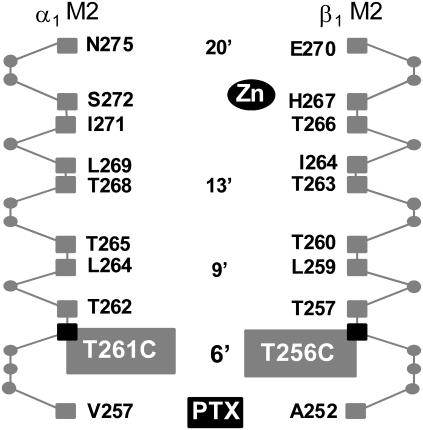
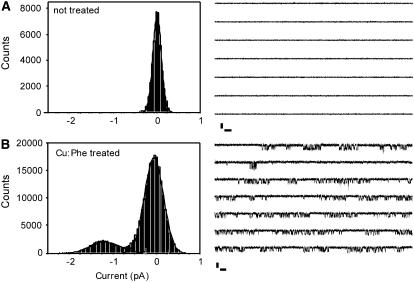
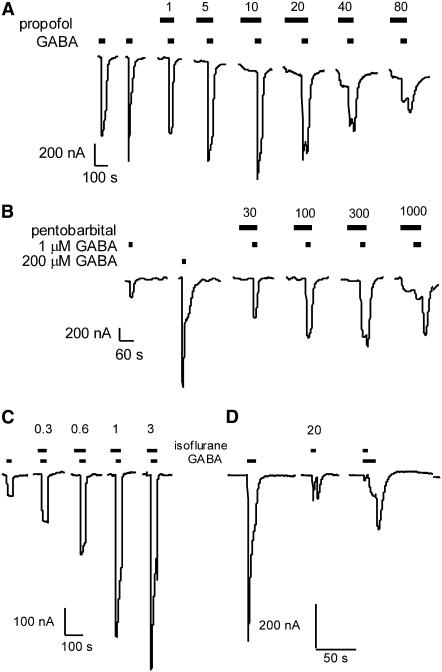
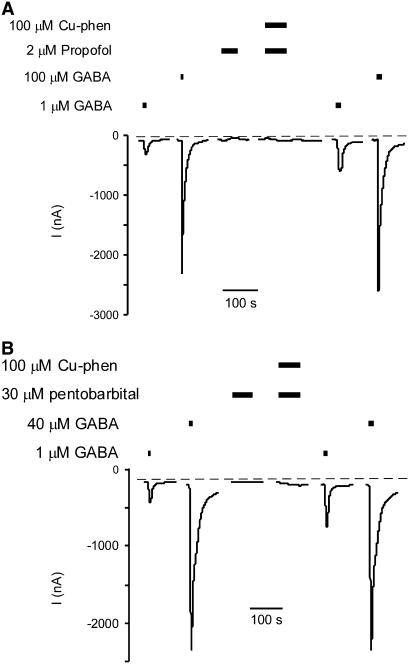
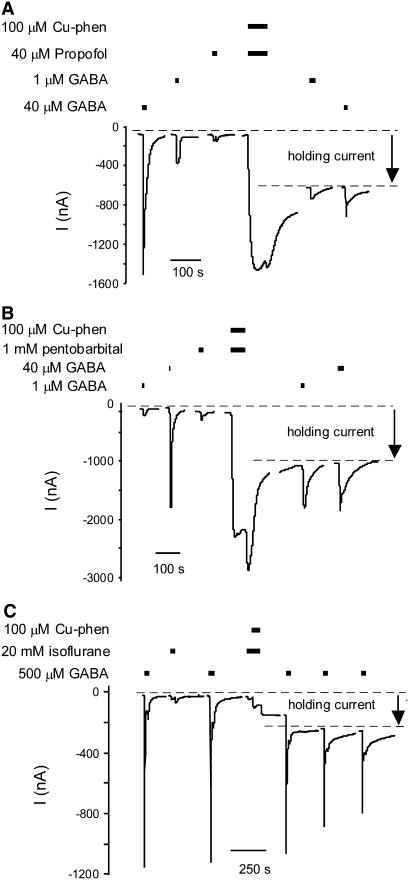
For many general anesthetics, their molecular basis of action involves interactions with GABA(A) receptors. Anesthetics produce concentration-dependent effects on GABA(A) receptors. Low concentrations potentiate submaximal GABA-induced currents. Higher concentrations directly activate the receptors. Functional effects of anesthetics have been characterized, but little is known about the conformational changes they induce. We probed anesthetic-induced conformational changes in the M2 membrane-spanning, channel-lining segment using disulfide trapping between engineered cysteines. Previously, we showed that oxidation by copper phenanthroline in the presence of GABA of the M2 6' cysteine mutants, alpha(1)T261Cbeta(1)T256C and alpha(1)beta(1)T256C resulted in formation of an intersubunit disulfide bond between the adjacent beta-subunits that significantly increased the channels' spontaneous open probability. Oxidation in GABA's absence had no effect. We examined the effect on alpha(1)T261Cbeta(1)T256C and on alpha(1)beta(1)T256C of oxidation by copper phenanthroline in the presence of potentiating and directly activating concentrations of the general anesthetics propofol, pentobarbital, and isoflurane. Oxidation in the presence of potentiating concentration of anesthetics had little effect. Oxidation in the presence of directly activating anesthetic concentrations significantly increased the channels' spontaneous open probability. We infer that activation by anesthetics and GABA induces a similar conformational change at the M2 segment 6' position that is related to channel opening.
Figures
References
-
- Rudolph, U., and B. Antkowiak. 2004. Molecular and neuronal substrates for general anaesthetics. Nat. Rev. Neurosci. 5:709–720. - PubMed
-
- Jurd, R., M. Arras, S. Lambert, B. Drexler, R. Siegwart, F. Crestani, M. Zaugg, K. E. Vogt, B. Ledermann, B. Antkowiak, and U. Rudolph. 2003. General anesthetic actions in vivo strongly attenuated by a point mutation in the GABA(A) receptor β3 subunit. FASEB J. 17:250–252. - PubMed
-
- Franks, N. P., and W. R. Lieb. 1998. Which molecular targets are most relevant to general anaesthesia? Toxicol. Lett. 100–101:1–8. - PubMed
-
- Evers, A. S., and J. H. Steinbach. 1999. Double-edged swords: volatile anesthetics both enhance and inhibit ligand-gated ion channels. Anesthesiology. 90:1–3. - PubMed
-
- Hemmings, H. C., Jr., M. H. Akabas, P. A. Goldstein, J. R. Trudell, B. A. Orser, and N. L. Harrison. 2005. Emerging molecular mechanisms of general anesthetic action. Trends Pharmacol. Sci. 26:503–510. - PubMed
Publication types
MeSH terms
Substances
Grants and funding
LinkOut - more resources
Full Text Sources
Other Literature Sources
