. 2007 May;75(5):2441-50.
doi: 10.1128/IAI.01635-06. Epub 2007 Feb 12.

Physiological osmotic induction of Leptospira interrogans adhesion: LigA and LigB bind extracellular matrix proteins and fibrinogen

Affiliations

Physiological osmotic induction of Leptospira interrogans adhesion: LigA and LigB bind extracellular matrix proteins and fibrinogen

Henry A Choy et al. Infect Immun. 2007 May.

Abstract

Transmission of leptospirosis occurs through contact of mucous membranes and abraded skin with freshwater contaminated by pathogenic Leptospira spp. Exposure to physiological osmolarity induces leptospires to express high levels of the Lig surface proteins containing imperfect immunoglobulin-like repeats that are shared or differ between LigA and LigB. We report that osmotic induction of Lig is accompanied by 1.6- to 2.5-fold increases in leptospiral adhesion to immobilized extracellular matrix and plasma proteins, including collagens I and IV, laminin, and especially fibronectin and fibrinogen. Recombinant LigA-unique and LigB-unique repeat proteins bind to these same host ligands. We found that the avidity of LigB in binding fibronectin is comparable to that of the Staphylococcus aureus FnBPA D repeats. Both LigA- and LigB-unique repeats interact with the amino-terminal fibrin- and gelatin-binding domains of fibronectin, which are also recognized by fibronectin-binding proteins mediating the adhesion of other microbial pathogens. In contrast, repeats common to both LigA and LigB do not bind these host proteins, and nonrepeat sequences in the carboxy-terminal domain of LigB show only weak interaction with fibronectin and fibrinogen. A functional role for the binding activity of LigA and LigB is suggested by the ability of the recombinants to inhibit leptospiral adhesion to fibronectin by 28% and 21%, respectively. The binding of LigA and LigB to multiple ligands present in different tissues suggests that these adhesins may be involved in the initial colonization and dissemination stages of leptospirosis. The characterization of the Lig adhesin function should aid the design of Lig-based vaccines and serodiagnostic tests.


Figures
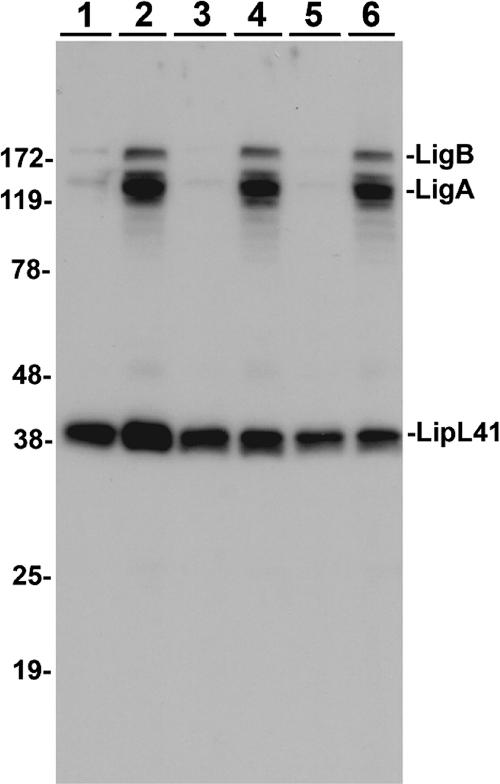
FIG. 1.
FIG. 1.
Osmotic induction of Lig expression. Total protein of ∼1 × 10⁸ leptospires recovered from overnight cultures of low-passage-number Leptospira interrogans Fiocruz L1-130 grown in standard EMJH medium (odd-numbered lanes) or induced with physiological osmolarity in EMJH plus 120 mM NaCl (even-numbered lanes) was resolved by SDS-10% PAGE and analyzed by immunoblotting. LigA and LigB were detected with a Lig-specific rabbit antiserum. For reference, a noninduced protein, LipL41, was also assayed. The results from three independent experiments shown here illustrate the uniformly strong induction of LigA and LigB expression in the cultures used in this study.
FIG. 2.
FIG. 2.
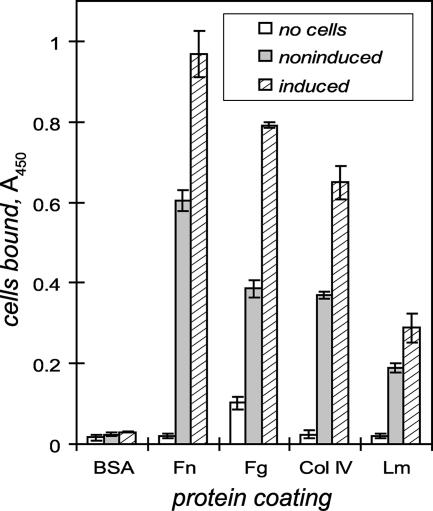
Physiological osmolarity induces Leptospira adhesion to host proteins. Leptospiral binding was measured by an ELISA using microtiter wells coated with 1 μg of fibronectin (Fn), fibrinogen (Fg), collagen type IV (Col IV), or laminin (Lm). BSA was used to measure nonspecific adsorption of bacteria. Serum-free EMJH medium alone (no cells) or Leptospira interrogans Fiocruz L1-130 (3 × 10⁸ cells) grown overnight in EMJH alone (noninduced) or in EMJH plus 120 mM NaCl (induced) was added for 1 h at 30°C. Leptospires bound to host proteins were detected with a LipL32-specific antiserum and horseradish peroxidase conjugated to a secondary antibody. Adhesion to all four proteins was enhanced by increased osmolarity (P < 0.01 by Student's t test). Means and standard deviations from triplicate wells are shown.
FIG. 3.
FIG. 3.
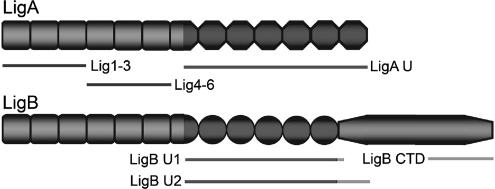
Cloning of LigA and LigB recombinant proteins. The structures of LigA and LigB are shown with the immunoglobulin-like repeats that occur in both proteins (squares), those that are specific to each (equilateral octagons for LigA, circles for LigB), and the nonrepeat CTD in LigB (elongated octagon). Short sequences linking the repeats are not shown. The Lig subclones used in this study are shown with lines delimiting their sequences within the native proteins. The primers used to amplify their coding sequences from L. interrogans Fiocruz L1-130 genomic DNA are listed in Table 1.
FIG. 4.
FIG. 4.
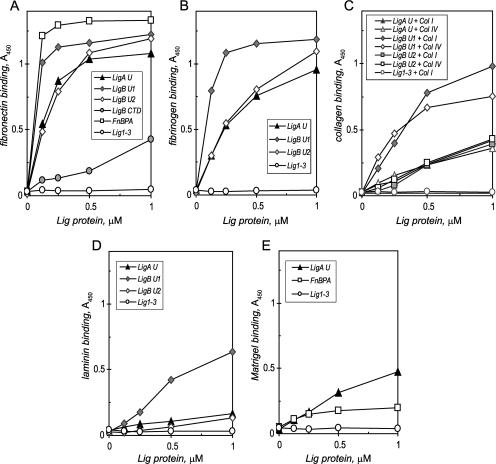
LigA and LigB bind to extracellular matrix and plasma proteins. For each ligand, an ELISA was used to measure binding. After a 1-h incubation at 37°C, the bound recombinant protein was washed and detected with a monoclonal antibody to its histidine tag along with horseradish peroxidase conjugated to a goat antibody to mouse IgG. (A) Measurement of the abilities of the unique repeats of LigA U and LigB U, the shared repeats in Lig1-3, and LigB CTD to bind to 1 μg immobilized fibronectin. The S. aureus FnBPA D repeats served as a positive reference. (B) LigA and LigB bind to fibrinogen. The abilities of the unique repeats of LigA U and LigB U and the shared repeats in Lig1-3 to bind to 1 μg immobilized fibrinogen were measured. (C) LigA and LigB bind to collagen. The abilities of the unique repeats of LigA U and LigB U and the shared repeats in Lig1-3 to bind to 1 μg immobilized collagen type I or IV were measured. Lig1-3 also did not bind collagen type IV. (D) LigA and LigB bind to laminin. The abilities of the unique repeats of LigA U and LigB U and the shared repeats in Lig1-3 to bind to 1 μg immobilized laminin were measured. (E) LigA binds to biologically active matrix. The abilities of the unique repeats of LigA U and the shared repeats in Lig1-3 to bind to 100 μg of Matrigel were measured. The S. aureus FnBPA D repeats were also tested.
FIG. 5.
FIG. 5.
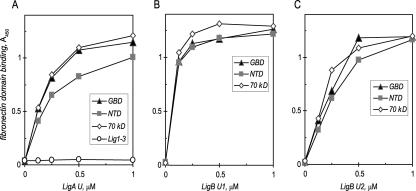
LigA and LigB interact with the amino-terminal domains of fibronectin. An ELISA was used to identify the fibronectin domains involved in binding by the unique repeats in LigA U (A), LigB U1 (B), or LigB U2 (C). After a 1-h incubation at 37°C with 1 μg immobilized proteolytic fragments of fibronectin that included either the GBD, the NTD, or the 70-kDa fragment containing both the GBD and the NTD, bound recombinant Lig protein was measured as for Fig. 4. Lig1-3 did not bind any fibronectin fragments (shown for GBD in panel A).
FIG. 6.
FIG. 6.
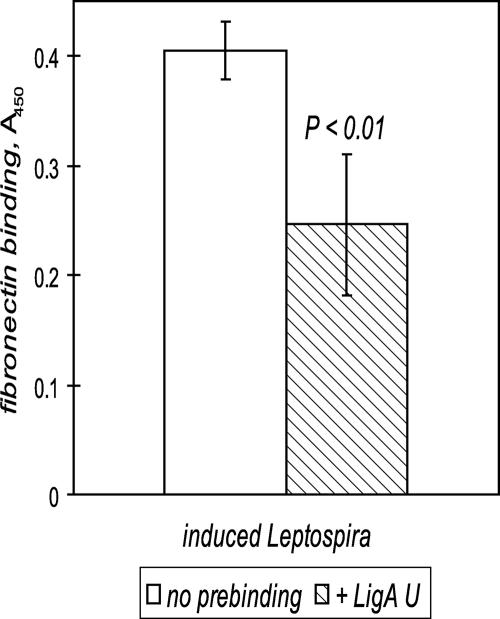
Recombinant LigA U inhibits osmotically induced fibronectin binding. Fibronectin adhesion by osmotically induced L. interrogans was measured by an ELISA with a LipL32-specific antiserum after the immobilized fibronectin had been incubated with PBS or LigA U. Fibronectin binding by noninduced leptospires was subtracted to reflect the level of adhesion due to exposure to physiological osmolarity, which induced binding 2.4-fold in this representative experiment, increasing the absorbance from 0.285 ± 0.048 to 0.690 ± 0.026 (mean ± standard deviation for triplicates; P < 0.001). Prebound LigA U (1 μM) reduced the level of induced adhesion by 39% (from an absorbance of 0.405 ± 0.026 without Lig to an absorbance of 0.246 ± 0.065 with Lig [P < 0.01]).

References

    1. Ballard, S. A., M. Williamson, B. Adler, T. Vinh, and S. Faine. 1986. Interactions of virulent and avirulent leptospires with primary cultures of renal epithelial cells. J. Med. Microbiol. 21:59-67. - PubMed
    1. Barbosa, A. S., P. A. Abreu, F. O. Neves, M. V. Atzingen, M. M. Watanabe, M. L. Vieira, Z. M. Morais, S. A. Vasconcellos, and A. L. Nascimento. 2006. A newly identified leptospiral adhesin mediates attachment to laminin. Infect. Immun. 74:6356-6364. - PMC - PubMed
    1. Bharti, A. R., J. E. Nally, J. N. Ricaldi, M. A. Matthias, M. M. Diaz, M. A. Lovett, P. N. Levett, R. H. Gilman, M. R. Willig, E. Gotuzzo, and J. M. Vinetz. 2003. Leptospirosis: a zoonotic disease of global importance. Lancet Infect. Dis. 3:757-771. - PubMed
    1. Brown, E. L., J. H. Kim, E. S. Reisenbichler, and M. Höök. 2005. Multicomponent Lyme vaccine: three is not a crowd. Vaccine 23:3687-3696. - PubMed
    1. Cameron, C. E., N. L. Brouwer, L. M. Tisch, and J. M. Kuroiwa. 2005. Defining the interaction of the Treponema pallidum adhesin Tp0751 with laminin. Infect. Immun. 73:7485-7494. - PMC - PubMed

Publication types

Substances

LinkOut - more resources