Effects of practitioner education, practitioner payment and reimbursement of patients' drug costs on smoking cessation in primary care: a cluster randomised trial
- PMID: 17297068
- PMCID: PMC2598437
- DOI: 10.1136/tc.2006.016253
Effects of practitioner education, practitioner payment and reimbursement of patients' drug costs on smoking cessation in primary care: a cluster randomised trial
Abstract
Objective: To evaluate new strategies to enhance the promotion of smoking cessation in general practice.
Design: Cluster randomised trial, 2x2 factorial design.
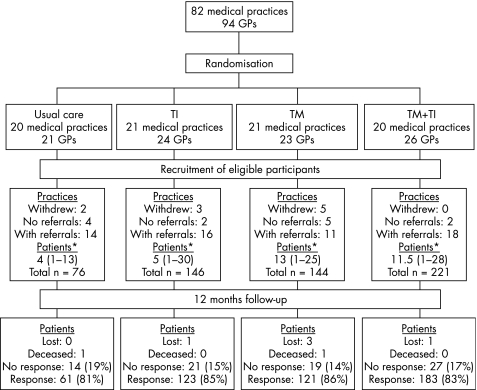
Setting: 82 medical practices in Germany, including 94 general practitioners.
Participants: 577 patients who smoked at least 10 cigarettes per day (irrespective of their intention to stop smoking) and were aged 36-75 years.
Interventions: Provision of a 2-h physician group training in smoking cessation methods and direct physician payments for every participant not smoking 12 months after recruitment (TI, training+incentive); provision of the same training and direct participant reimbursements for pharmacy costs associated with nicotine replacement therapy or bupropion treatment (TM, training+medication).
Main outcome measure: Self-reported smoking abstinence obtained at 12 months follow-up and validated by serum cotinine.
Results: In intention-to-treat analysis, smoking abstinence at 12 months follow-up was 3% (2/74), 3% (5/144), 12% (17/140) and 15% (32/219) in the usual care, and interventions TI, TM and TI+TM, respectively. Applying a mixed logistic regression model, no effect was identified for intervention TI (odds ratio (OR) 1.26, 95% confidence interval (CI) 0.65 to 2.43), but intervention TM strongly increased the odds of cessation (OR 4.77, 95% CI 2.03 to 11.22).
Conclusion: Providing cost-free effective drugs to patients along with improved training opportunities for general practitioners could be an effective measure to achieve successful promotion of smoking cessation in general practice.
Conflict of interest statement
Competing interests: None.
References
-
- Helgason A R, Lund K E. General practitioners' perceived barriers to smoking cessation—results from four Nordic countries. Scand J Public Health 200230141–147. - PubMed
-
- McLeod D, Somasundram R, Howden‐Chapman P.et al Promotion of smoking cessation by New Zealand general practitioners: a description of current practice. N Z Med J 2000113480–485. - PubMed
-
- Young J M, Ward J E. Implementing guidelines for smoking cessation advice in Australian general practice: opinions, current practice, readiness to change and perceived barriers. Fam Pract 20011814–20. - PubMed
-
- Twardella D, Brenner H. Lack of training as a central barrier to the promotion of smoking cessation: a survey among general practitioners in Germany. Eur J Public Health 200515140–145. - PubMed
Publication types
MeSH terms
Substances
LinkOut - more resources
Full Text Sources
Medical