


Exposure to intermittent nociceptive stimulation under pentobarbital anesthesia disrupts spinal cord function in rats
- PMID: 17297638
- PMCID: PMC3222461
- DOI: 10.1007/s00213-007-0707-1
Exposure to intermittent nociceptive stimulation under pentobarbital anesthesia disrupts spinal cord function in rats
Abstract
Rationale: Spinal cord plasticity can be assessed in spinal rats using an instrumental learning paradigm in which subjects learn an instrumental response, hindlimb flexion, to minimize shock exposure. Prior exposure to uncontrollable intermittent stimulation blocks learning in spinal rats but has no effect if given before spinal transection, suggesting that supraspinal systems modulate nociceptive input to the spinal cord, rendering it less susceptible to the detrimental consequences of uncontrollable stimulation.
Objective: The present study examines whether disrupting brain function with pentobarbital blocks descending inhibitory systems that normally modulate nociceptive input, making the spinal cord more sensitive to the adverse effect of uncontrollable intermittent stimulation.
Materials and methods: Male Sprague-Dawley rats received uncontrollable intermittent stimulation during pentobarbital anesthesia after (experiment 1) or before (experiment 2) spinal cord transection. They were then tested for instrumental learning at a later time point. Experiment 3 examined whether these manipulations affected nociceptive (thermal) thresholds.
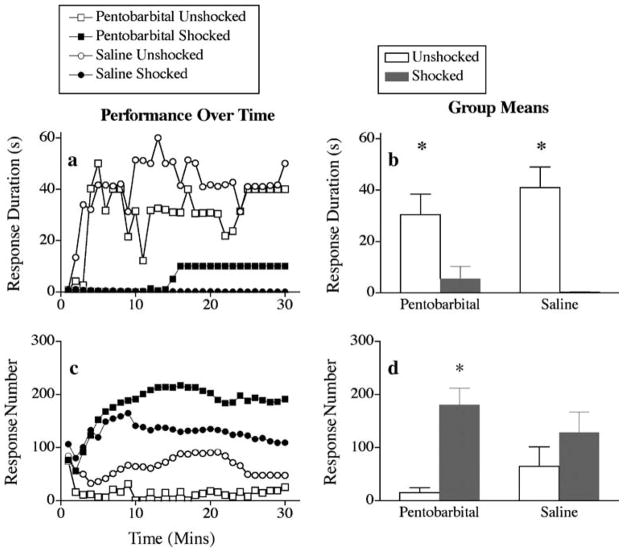
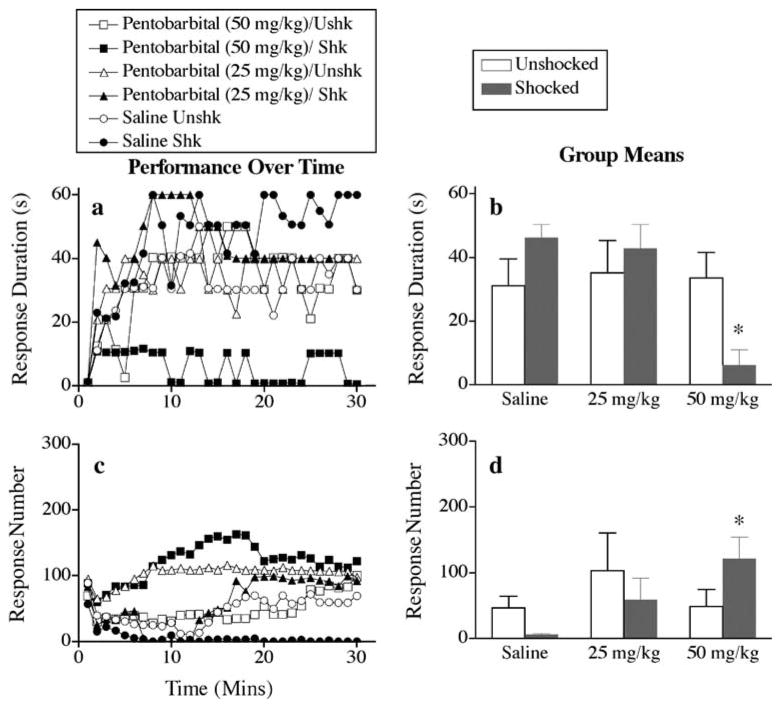
Results: Experiment 1 showed that pentobarbital had no effect on the induction of the learning deficit after spinal cord transection. Experiment 2 showed that intact rats anesthetized during uncontrollable intermittent stimulation failed to learn when later transected and tested for instrumental learning. Experiment 3 found that uncontrollable intermittent stimulation induced an antinociception in intact subjects that was blocked by pentobarbital.
Conclusions: The results suggest a surgical dose of pentobarbital (50 mg/kg) suppresses supraspinal (experiment 2) but not spinal (experiment 1) systems that modulate nociceptive input to the spinal cord by blocking the antinociception that is induced by this input (experiment 3).
Figures

References
-
- Akil H, Liebeskind JC. Monoaminergic mechanisms of stimulation-produced analgesia. Brain Res. 1975;94:279–296. - PubMed
-
- Asana T, Ogasawara N. Chloride-dependent stimulation of GABA and benzodiazepine binding by pentobarbital. Brain Res. 1981;225:212–216. - PubMed
-
- Basbaum AI, Fields HL. The origin of descending pathways in the dorsolateral funiculus of the spinal cord of the cat and rat: further studies on the anatomy of pain modulation. J Comp Neurol. 1979;187:513–532. - PubMed
-
- Basbaum AI, Fields HL. Endogenous pain control system: brainstem spinal pathways and endorphin circuitry. Ann Rev Neurosci. 1984;7:309–398. - PubMed
-
- Basbaum AI, Marley NJE, O’Keefe J, Clanton CH. Reversal of morphine and stimulus-produced analgesia by subtotal spinal cord lesions. Pain. 1977;3:43–56. - PubMed
Publication types
MeSH terms
Substances
Grants and funding
LinkOut - more resources
Full Text Sources
