. 2007 Feb 20;104(8):2867-72.
doi: 10.1073/pnas.0611493104. Epub 2007 Feb 13.

Receptors of the protein C activation and activated protein C signaling pathways are colocalized in lipid rafts of endothelial cells

Affiliations

Receptors of the protein C activation and activated protein C signaling pathways are colocalized in lipid rafts of endothelial cells

Jong-Sup Bae et al. Proc Natl Acad Sci U S A. .

Abstract

Ever-increasing evidence in the literature suggests that the antiinflammatory and cytoprotective properties of activated protein C (APC) are mediated through its endothelial protein C receptor (EPCR)-dependent cleavage of protease-activated receptor 1 (PAR-1) on endothelial cells. However, recent results monitoring the cleavage rate of PAR-1 on human umbilical vein endothelial cells, transfected with an alkaline phosphatase-PAR-1 fusion reporter construct, have indicated that the catalytic activity of thrombin toward PAR-1 is several orders of magnitude higher than that of APC. Because thrombin is required for generation of APC, and because it also functions in the proinflammatory pathways through the activation of PAR-1, it has been difficult to understand how APC can elicit protective cellular responses through the activation of PAR-1 when thrombin is present. In this study we provide a plausible answer to this question by demonstrating that the critical receptors required for both protein C activation (thrombomodulin and EPCR) and APC cellular signaling (EPCR and PAR-1) pathways are colocalized in the membrane lipid rafts in endothelial cells. We further show that the APC cleavage of PAR-1 on cells transfected with a PAR-1 cleavage reporter construct is not sensitive to the cofactor function of EPCR. Thus, the colocalization of EPCR and PAR-1 in lipid rafts is a key requirement for the cellular signaling activity of APC. Thrombomodulin colocalization with these receptors on the same membrane microdomain can also recruit thrombin to activate the EPCR-bound protein C, thereby eliciting PAR-1 signaling events that are involved in the APC protective pathways.


Conflict of interest statement

The authors declare no conflict of interest.

Figures
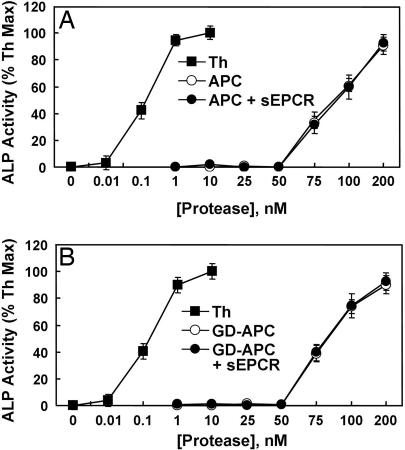
Fig. 1.
Fig. 1.
Thrombin and APC concentration dependence of PAR-1 cleavage on endothelial cells transfected with the PAR-1 cleavage reporter construct. (A) PAR-1 cleavage by various concentrations of either thrombin (■) or APC in the absence (○) and presence (●) of a saturating concentration of sEPCR (500 nM) was monitored by an alkaline phosphatase assay as described in Materials and Methods. (B) The same as in A except that Gla-domainless APC was used in the cleavage reaction. The activities with APC are normalized to percentage maximal activity observed with 10 nM thrombin (Th).
Fig. 2.
Fig. 2.
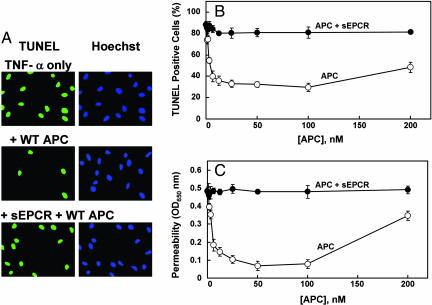
Antiapoptotic and cytoprotective activities of APC in TNF-α-induced apoptosis and permeability assays in EA.hy926 cells. (A) Confluent monolayers of EA.hy926 cells were treated with APC (10 nM) in either the absence or presence of a saturating concentration sEPCR (500 nM) for 24 h followed by induction of apoptosis with TNF-α (10 ng/ml) for 4 h. The cells were fixed with paraformaldehyde and incubated with the TUNEL reaction mixture followed by Hoechst 33342 to stain the apoptotic cells (green) and the total number of nuclei (blue), respectively. (B) The same as above except the number of apoptotic cells is expressed as the percentage of TUNEL-positive cells of the total number of nuclei (P < 0.001) as a function of various concentrations of APC in the absence (○) and presence (●) of sEPCR. (C) The APC concentration dependence of inhibition of thrombin-induced permeability in the absence (○) and presence (●) of sEPCR was monitored from the flux of Evans blue-bound albumin across EA.hy926 cells as described in Materials and Methods.
Fig. 3.
Fig. 3.
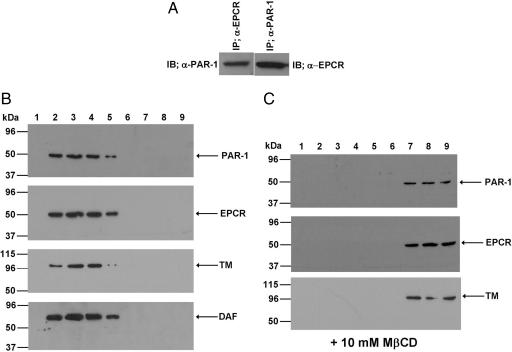
Coimmunoprecipitation of EPCR and PAR-1 and immunoblotting of lipid rafts derived from EA.hy926 cells with anti-PAR-1, anti-EPCR, and anti-TM antibodies. (A) Immunoblots of total cellular proteins immunoprecipitated with either anti-EPCR or anti-PAR-1 antibody. (B) SDS/PAGE and immunoblotting of membrane fractions prepared by discontinuous sucrose gradient ultracentrifugation with antibodies directed to PAR-1, EPCR, TM, and decay-accelerating factor (DAF). (C) The same as in B except that the fractions were derived from EA.hy926 cells treated with 10 mM MβCD.
Fig. 4.
Fig. 4.
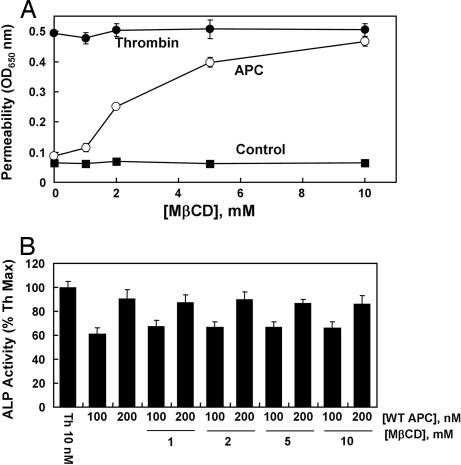
Effect of different concentrations of MβCD on the protective activity of APC in thrombin-induced permeability assay and on the PAR-1 cleavage rate in cells transfected with the PAR-1 cleavage reporter. (A) EA.hy926 cells were treated with the indicated concentrations of MβCD before evaluating the barrier protective effect of APC (○) in a thrombin-induced permeability assay. Controls are cells treated with thrombin only (●) and cells not treated with either thrombin or APC (■). (B) The rate of PAR-1 cleavage by APC (100 and 200 nM) monitored by ALP activity on EA.hy926 cells transiently transfected with the PAR-1 cleavage reporter at different concentrations of MβCD (1–10 mM) as described in the legend of Fig. 1.

References

    1. Esmon CT. Thromb Haemostasis. 1993;70:29–35. - PubMed
    1. Stenflo J. Semin Thromb Hemostasis. 1984;10:109–121. - PubMed
    1. Walker FJ, Fay PJ. FASEB J. 1992;6:2561–2567. - PubMed
    1. Dahlback B. Thromb Haemostasis. 1991;66:49–61. - PubMed
    1. Griffin JH, Evatt B, Zimmerman TS, Kleiss AJ, Wideman C. J Clin Invest. 1981;68:1370–1373. - PMC - PubMed

Publication types

MeSH terms

LinkOut - more resources