


Simple sequence repeats in zebra finch (Taeniopygia guttata) expressed sequence tags: a new resource for evolutionary genetic studies of passerines
- PMID: 17300727
- PMCID: PMC1804275
- DOI: 10.1186/1471-2164-8-52
Simple sequence repeats in zebra finch (Taeniopygia guttata) expressed sequence tags: a new resource for evolutionary genetic studies of passerines
Abstract
Background: Passerines (perching birds) are widely studied across many biological disciplines including ecology, population biology, neurobiology, behavioural ecology and evolutionary biology. However, understanding the molecular basis of relevant traits is hampered by the paucity of passerine genomics tools. Efforts to address this problem are underway, and the zebra finch (Taeniopygia guttata) will be the first passerine to have its genome sequenced. Here we describe a bioinformatic analysis of zebra finch expressed sequence tag (EST) Genbank entries.
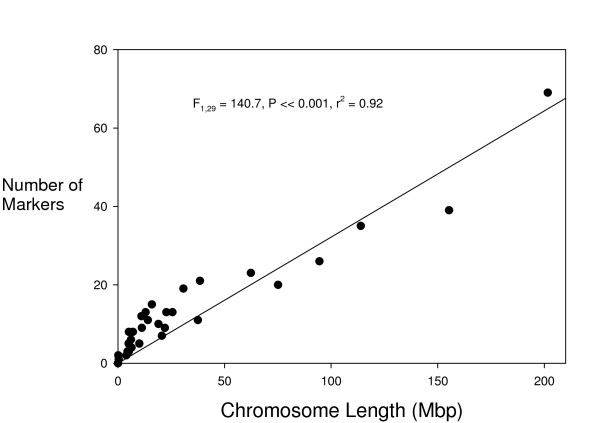
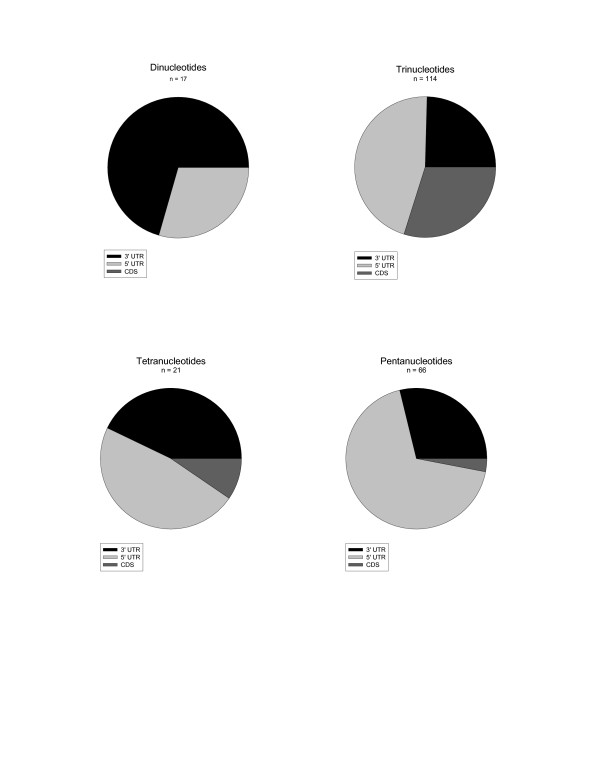
Results: A total of 48,862 ESTs were downloaded from GenBank and assembled into contigs, representing an estimated 17,404 unique sequences. The unique sequence set contained 638 simple sequence repeats (SSRs) or microsatellites of length > or =20 bp and purity > or =90% and 144 simple sequence repeats of length > or =30 bp. A chromosomal location for the majority of SSRs was predicted by BLASTing against assembly 2.1 of the chicken genome sequence. The relative exonic location (5' untranslated region, coding region or 3' untranslated region) was predicted for 218 of the SSRs, by BLAST search against the ENSEMBL chicken peptide database. Ten loci were examined for polymorphism in two zebra finch populations and two populations of a distantly related passerine, the house sparrow Passer domesticus. Linkage was confirmed for four loci that were predicted to reside on the passerine homologue of chicken chromosome 7.
Conclusion: We show that SSRs are abundant within zebra finch ESTs, and that their genomic location can be predicted from sequence similarity with the assembled chicken genome sequence. We demonstrate that a useful proportion of zebra finch EST-SSRs are likely to be polymorphic, and that they can be used to build a linkage map. Finally, we show that many zebra finch EST-SSRs are likely to be useful in evolutionary genetic studies of other passerines.
Figures
References
-
- Bennett P, Owens I. Evolutionary Ecology of Birds. Oxford: Oxford University Press; 2002.
-
- Lack D. Ecological adaptations for breeding in birds. London: Methuen; 1968.
-
- Grant PR, Grant BR. Quantitative genetic variation in populations of Darwin's Finches. In: Mousseau TA, Sinervo B, Endler J, editor. Adaptive Genetic Variation in the Wild. Oxford: Oxford University Press; 2000. pp. 3–40.
-
- Griffith SC, Owens IPF, Burke T. Environmental determination of a sexually selected trait. Nature. 1999;400:358–360. doi: 10.1038/22536. - DOI
Publication types
MeSH terms
Grants and funding
LinkOut - more resources
Full Text Sources
Research Materials
