


Usefulness of the UCSD performance-based skills assessment (UPSA) for predicting residential independence in patients with chronic schizophrenia
- PMID: 17303168
- PMCID: PMC2696336
- DOI: 10.1016/j.jpsychires.2006.12.008
Usefulness of the UCSD performance-based skills assessment (UPSA) for predicting residential independence in patients with chronic schizophrenia
Abstract
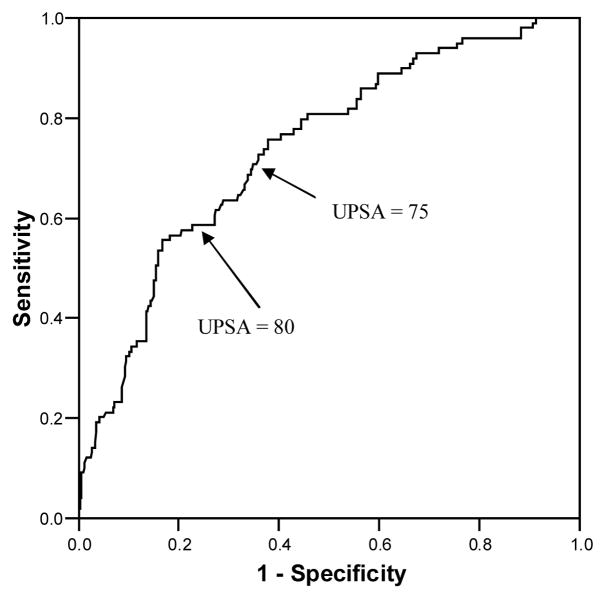
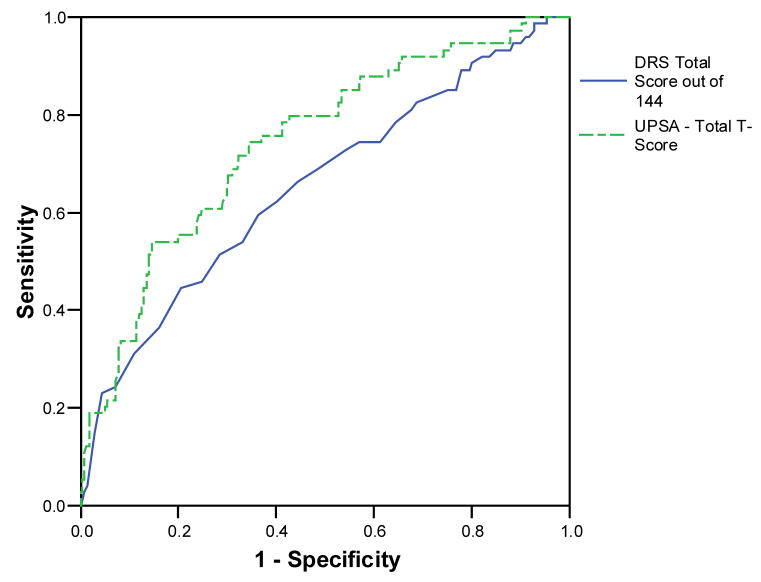
The objective of this study was to examine the sensitivity and specificity of a performance-based measure of functional capacity, the UCSD Performance-based Skills Assessment (UPSA), for the prediction of independent living status in patients with chronic schizophrenia-related conditions. A sample of 434 adults with schizophrenia or schizoaffective disorder was administered the UPSA and assessed for independent living status. Participants were classified as "independent" if they were living alone in an apartment, house, or single-resident occupancy (e.g., hotel room) and non-independent if they resided in a care facility (e.g., Board-and-Care home, Skilled Nursing Facility). Receiver Operator Characteristic (ROC) curves were calculated with the UPSA and Mattis' Dementia Rating Scale (DRS) scores as predictor variables and residential independence as the state variable. Of the 434 participants, 99 (23%) were living independently at the time of assessment. The discriminant validity of the UPSA was adequate (ROC area under the curve=0.74; 95% CI: 0.68-0.79), with greatest dichotomization for the UPSA at a cutoff score of 75 (68% accuracy, 69% sensitivity, 66% specificity), or 80 (68% accuracy, 59% sensitivity, 76% specificity). The UPSA was also a significantly better predictor of living status than was the DRS, based on ROC (z=2.43, p=.015). The UPSA is a brief measure of functional capacity that predicts the ability of patients with schizophrenia to reside independently in the community.
Figures
References
-
- American Psychiatric Association. Diagnostic and Statistical Manual of Mental Disorders. 4 Text Revision. Washington, DC: American Psychiatric Association; 2000.
-
- Bell MD, Bryson G. Work rehabilitation in schizophrenia: does cognitive impairment limit improvement? Schizophrenia Bulletin. 2001;27:269–79. - PubMed
-
- Bowie CR, Reichenberg A, Patterson TL, Heaton RK, Harvey PD. Determinents of real-world functioning performance in Schizophrenia: Correlations with cognition, functional capacity, and symptoms. American Journal of Psychiatry. 2006;163:418–425. - PubMed
-
- Bryson G, Bell MD. Initial and final work performance in schizophrenia: cognitive and symptom predictors. The Journal of Nervous and Mental Disease. 2003;191:87–92. - PubMed
Publication types
MeSH terms
Grants and funding
LinkOut - more resources
Full Text Sources
Medical
