


Antisense inhibition at the beta-secretase-site of beta-amyloid precursor protein reduces cerebral amyloid and acetyl cholinesterase activity in Tg2576
- PMID: 17303345
- PMCID: PMC1955231
- DOI: 10.1016/j.neuroscience.2007.01.008
Antisense inhibition at the beta-secretase-site of beta-amyloid precursor protein reduces cerebral amyloid and acetyl cholinesterase activity in Tg2576
Abstract
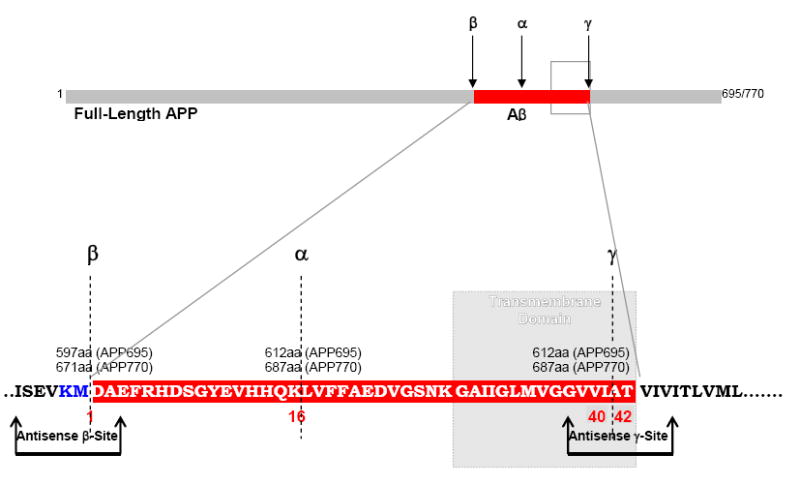
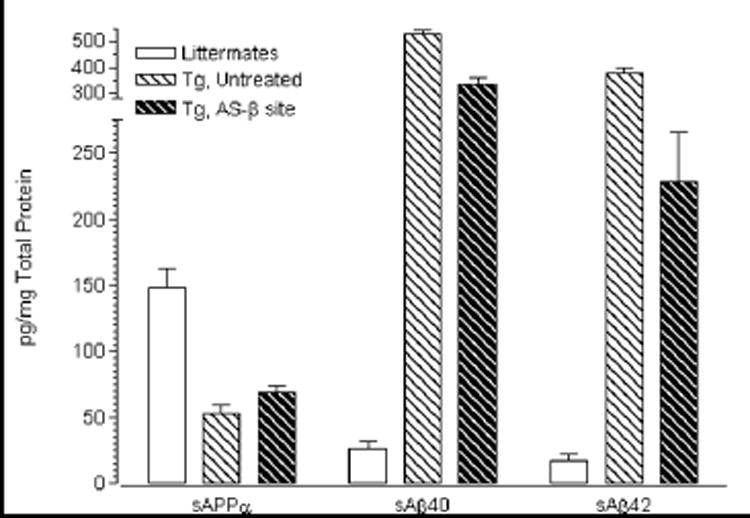
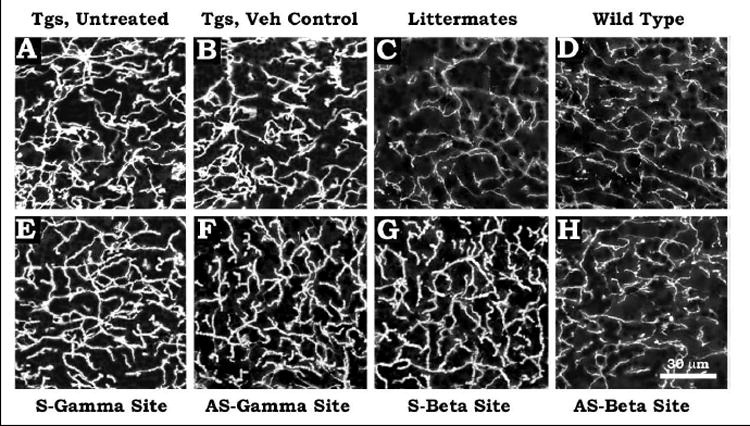
Misprocessing of beta-amyloid precursor protein (APP) leading to the formation of elevated quantities of beta-amyloid peptide (Abeta), derived by a cleavage at the beta-secretase site (N-671/673aa) and by a cleavage at the gamma-secretase site (C-711/713aa) of APP, is considered a key event in the pathogenesis of Alzheimer disease (AD). Point mutations near the beta-secretase site in the human gene for APP, such as in the Swedish mutation-KM670/671NL, lead to a form of dominantly inherited AD. These mutations are known to promote beta-site cleavage and to increase levels of Abeta. Abeta has been shown previously to increase acetyl cholinesterase (AChE) activity in vitro. We wished to test whether translational blocking of APP-mRNA at the mutated beta-site by antisense (AS) oligodeoxynucleotides (ODNs) directed to the mutated site will reduce cerebral amyloid in the Swedish transgenic mouse model (Tg2576). Mice were injected i.c.v. with AS-ODNs directed at the mutated beta-site (AS-beta site) or with AS-ODNs directed at the normal gamma-site (AS-gamma site) of human APP-mRNA, and compared with procedural controls that received i.c.v. injections of sense ODNs at the beta-site (S-beta site), sense ODNs at the gamma-site (S-gamma site) or mismatched ODNs, and with untreated littermates (Lt) and untreated transgenic mice (Tgs). ODNs were injected into the 3rd ventricle once a week for 4 weeks. Brains were processed for enzyme-linked immunosorbent assay analysis of beta- and gamma-cleaved soluble Abeta40 (sAbeta40), beta- and gamma-cleaved soluble Abeta42 (sAbeta42) and alpha-cleaved soluble beta-amyloid precursor protein (sAPPalpha). The physiological relevance of AS ODNs was tested by evaluating the cerebral distribution of AChE before and after the treatment. AChE was found increased about fivefold in Tg cortex as compared with control brain. Results show that compared with untreated and procedural controls, AS-beta increased cerebral levels of sAPPalpha by 43% and reduced sAbeta40/42 by approximately 39%; while simultaneously reducing the cortical density of AChE by approximately fourfold in the treated Tg animals, almost to the level found in the control brain (all values P<0.0001, analysis of variance, unpaired two-tailed Student's t-test), while AS-gamma did not have any effect. These results indicate that AS directed to the mutated beta-site may be an effective approach to treat familial AD.
Figures
References
-
- Adlerz I, Soomets U, Holmlund I, Viirlaid S, Langel U, Iverfeldt K. Down-regulation of amyloid precursor protein by peptide nucleic acid oligomer in cultured rat primary neurons and astrocytes. Neurosci Lett. 2003;336(1):55–59. - PubMed
-
- Banks WA, Farr SA, Butt W, Kumar VB, Franko MW, Morley JE. Delivery across the blood-brain barrier of antisense directed against amyloid beta: reversal of learning and memory deficits in mice overexpressing amyloid precursor protein. J Pharmacol Exp Ther. 2001;297(3):1113–1121. - PubMed
-
- Boules M, Williams K, Gollatz E, Fauq A, Richelson E. Down-regulation of amyloid precursor protein by peptide nucleic acid in vivo. J Mol Neurosci. 2004;24(1):123–128. - PubMed
-
- Broaddus WC, Prabhu SS, Gillies GT, Neal J, Conrad WS, Chen ZJ, Fillmore H, Young HF. Distribution and stability of antisense phosphorothioate oligonucleotides in rodent brain following direct intraparenchymal controlled-rate infusion. J Neurosurg. 1998;88(4):734–742. - PubMed
-
- Chauhan NB, Siegel GJ, Lichtor T. Distribution of intraventricularly administered antiamyloid-beta peptide (Abeta) antibody in the mouse brain. J Neurosci Res. 2001;66(2):231–235. - PubMed
Publication types
MeSH terms
Substances
Grants and funding
LinkOut - more resources
Full Text Sources
Other Literature Sources
Medical
Research Materials
Miscellaneous
