


The impact of OSHA recordkeeping regulation changes on occupational injury and illness trends in the US: a time-series analysis
- PMID: 17303676
- PMCID: PMC2078472
- DOI: 10.1136/oem.2006.029322
The impact of OSHA recordkeeping regulation changes on occupational injury and illness trends in the US: a time-series analysis
Abstract
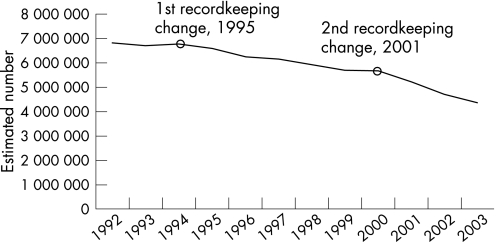
Objectives: The Survey of Occupational Injuries and Illnesses (SOII), based on Occupational Safety and Health Administration (OSHA) logs, indicates that the number of occupational injuries and illnesses in the US has steadily declined by 35.8% between 1992-2003. However, major changes to the OSHA recordkeeping standard occurred in 1995 and 2001. The authors assessed the relation between changes in OSHA recordkeeping regulations and the trend in occupational injuries and illnesses.
Methods: SOII data available from the Bureau of Labor Statistics for years 1992-2003 were collected. The authors assessed time series data using join-point regression models.
Results: Before the first major recordkeeping change in 1995, injuries and illnesses declined annually by 0.5%. In the period 1995-2000 the slope declined by 3.1% annually (95% CI -3.7% to -2.5%), followed by another more precipitous decline occurring in 2001-2003 (-8.3%; 95% CI -10.0% to -6.6%). When stratifying the data, the authors continued to observe significant changes occurring in 1995 and 2001.
Conclusions: The substantial declines in the number of injuries and illnesses correspond directly with changes in OSHA recordkeeping rules. Changes in employment, productivity, OSHA enforcement activity and sampling error do not explain the large decline. Based on the baseline slope (join-point regression analysis, 1992-4), the authors expected a decline of 407 964 injuries and illnesses during the period of follow-up if no intervention occurred; they actually observed a decline of 2.4 million injuries and illnesses of which 2 million or 83% of the decline can be attributed to the change in the OSHA recordkeeping rules.
Conflict of interest statement
Competing interests: None.
Comment in
-
Are work-related conditions less common or were their definitions changed?Occup Environ Med. 2007 Jul;64(7):429-30. doi: 10.1136/oem.2007.033241. Occup Environ Med. 2007. PMID: 17582085 Free PMC article.
References
-
- Chao E L.Fatal occupational injuries in the United States, 1995–1999: a chartbook. Report 965. US Department of Labor. Bureau of Labor Statistics 2000
-
- Occupational Safety and Health Administration OSHA Statement. Statement of Secretary of Labor Alexis Heran on 1999 workplace injury and illness rates, 12 December 2000. Available at http://www.osha.gov/pls/oshaweb/owadisp.show_document?p_table = NEWS_RELEASES&p_id = 1371 (accessed April 2007)
-
- US Department of Labor Occupational Safety and Health Administration. Reporting occupational injury and illness data to OSHA; Final Rule. 29 CFR Part 1904. Docket no R‐02. US Department of Labor 1997
-
- Turk R A. OSHA cuts red tape on injury/illness reporting. Mater Manage Health Care 199766 - PubMed
-
- US Department of Labor Occupational Safety and Health Administration. Reporting occupational injury and illness data to OSHA; Final Rule. 29 CFR Part 1904. Docket no R‐02. Federal Register 2001665196–6135.
Publication types
MeSH terms
Grants and funding
LinkOut - more resources
Full Text Sources
Medical
