Reduction of bloodstream infections associated with catheters in paediatric intensive care unit: stepwise approach
- PMID: 17303886
- PMCID: PMC1800983
- DOI: 10.1136/bmj.39064.457025.DE
Reduction of bloodstream infections associated with catheters in paediatric intensive care unit: stepwise approach
Abstract
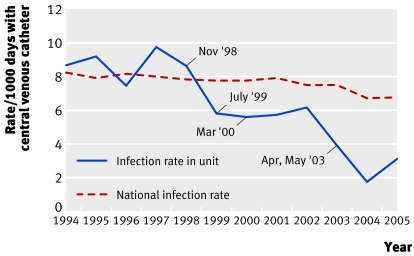
Problem: Bloodstream infections associated with catheters were the most common nosocomial infections in one paediatric intensive care unit in 1994-7, with rates well above the national average.
Design: Clinical data were collected prospectively to assess the rates of infection from 1994 onwards. The high rates in 1994-7 led to the stepwise introduction of interventions over a five year period. At quarterly intervals, prospective data continued to be collected during this period and an additional three year follow-up period.
Setting: A 292 bed tertiary care children's hospital.
Key measures for improvement: We aimed to reduce our infection rates to below the national mean rates for similar units by 2000 (a 25% reduction).
Strategies for change: A stepwise introduction of interventions designed to reduce infection rates, including maximal barrier precautions, transition to antibiotic impregnated central venous catheters, annual handwashing campaigns, and changing the skin disinfectant from povidone-iodine to chlorhexidine. Effects of change Significant decreases in rates of infection occurred over the intervention period. These were sustained over the three year follow-up. Annual rates decreased from 9.7/1000 days with a central venous catheter in 1997 to 3.0/1000 days in 2005, which translates to a relative risk reduction of 75% (95% confidence interval 35% to 126%), an absolute risk reduction of 6% (2% to 10%), and a number needed to treat of 16 (10 to 35).
Lessons learnt: A stepwise introduction of interventions leading to a greater than threefold reduction in nosocomial infections can be implemented successfully. This requires a multidisciplinary team, support from hospital leadership, ongoing data collection, shared data interpretation, and introduction of evidence based interventions.
Conflict of interest statement
Figures
References
-
- US Department of Health and Human Services. CDC's role in monitoring and preventing healthcare-associated infections: hearing before the subcommittee on oversight and investigations (29 March 2006). ()www.hhs.gov/asl/testify/t060329.html
-
- Pratt RJ, Loveday HP, Pellowe CM, Harper P, Jones S, Cookson B, et al. A comparison of international practices in the management and control of hospital-acquired infections. Improving patient care by reducing the risk of hospital acquired infection: a progress report. London: National Audit Office, 2004. (HC 876, 2003-4.)
-
- Bourn J. The management and control of hospital acquired infection in acute NHS trusts in England. London: National Audit Office, 2000. (HC 230, 1999-2000.)
-
- Milliken J, Tait GA, Ford-Jones EL, Mindorff CM, Gold R, Mullins G. Nosocomial infections in a pediatric intensive care unit. Crit Care Med 1988;16:233-7. - PubMed
MeSH terms
Substances
LinkOut - more resources
Full Text Sources
Other Literature Sources