


Reliability and validity of blood pressure measurement in the Secondary Prevention of Small Subcortical Strokes study
- PMID: 17303981
- PMCID: PMC3970705
- DOI: 10.1097/MBP.0b013e3280858d5b
Reliability and validity of blood pressure measurement in the Secondary Prevention of Small Subcortical Strokes study
Abstract
Rationale: The Secondary Prevention of Small Subcortical Strokes study is a multicenter, international trial funded by the National Institutes of Health testing the role of lowering systolic blood pressure to <130 mmHg in the prevention of stroke recurrence and cognitive decline in patients with recent symptomatic small subcortical stroke. Reliable and unbiased blood pressure measurement is critical to successful completion of the trial.
Methods: We looked at the reliability and validity of both the device used for blood pressure measurement and observer performance during measurement to assess the quality of blood pressure determination in the study. The Colin 8800C blood pressure device was tested for performance to Association for the Advancement of Medical Instrumentation standards and for presence of skipped digits. Observer performance was tested by examining adherence to the Secondary Prevention of Small Subcortical Strokes protocol.
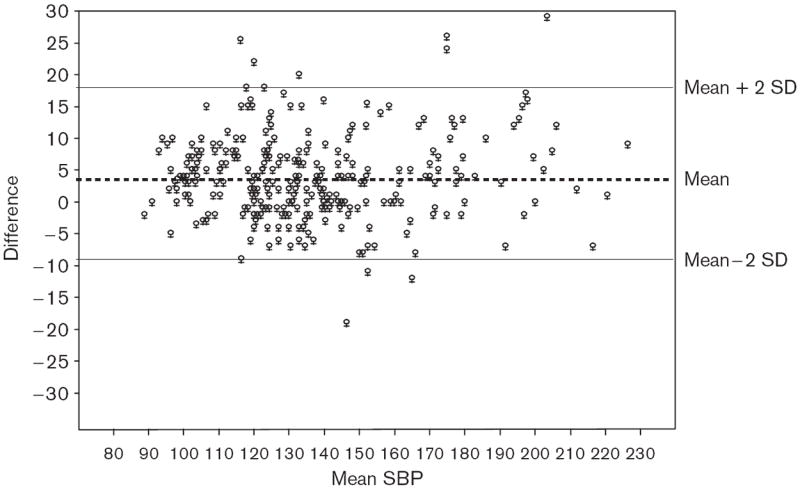
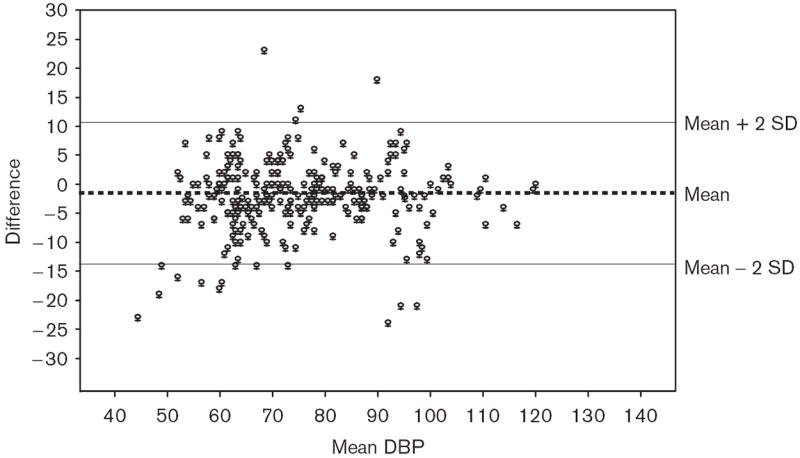
Results: The mean difference (in mmHg) between the Colin device and the average of the two observers was 3.9 (SD 6.7) and -2.1 (SD 6.1) for systolic and diastolic pressures respectively, thereby meeting Association for the Advancement of Medical Instrumentation requirements. No skipped digits were found between 82-230 and 40-120 mmHg for systolic and diastolic pressures, respectively. Observer performance was excellent with greater than 90% of patients having blood pressure measured consistently according to the protocol.
Conclusions: Device and observer performance in Secondary Prevention of Small Subcortical Strokes is excellent. Interpretation of the Secondary Prevention of Small Subcortical Strokes data for the effect of lowering systolic blood pressure on patient outcomes will not likely be adversely affected by these factors. Accuracy will be monitored throughout the remainder of the trial to ensure that this high quality is maintained.
Figures
References
-
- Benavente O, Hart R, Holliday S, Sherman D, Pergola P, Roman G, et al. Secondary Prevention of Small Subcortical Strokes (SPS3) in press.
-
- Hansson L, Hedner T, Dahlof B. Prospective randomized open blinded end-point (PROBE) study. A novel design for intervention trials Prospective randomized open blinded end-point. Blood Pressure. 1992;1:113–119. - PubMed
-
- Hansson L, Zanchetti A, Carruthers SG, Dahlof B, Elmfeldt D, Julius S, et al. Effects of intensive blood-pressure lowering and low-dose aspirin in patients with hypertension: principal results of the Hypertension Optimal Treatment (HOT) randomised trial. Lancet. 1998;351:1755–1762. - PubMed
-
- Lindholm LH, Hansson L, Dahlof B, Ekbom T, Hedner T, De Faire U, et al. The Swedish Trial in old patients with hypertension-2 (STOP-hypertension-2): a progress report. Blood Pressure. 1996;5:300–304. - PubMed
-
- Ogihara T, Matsuzaki M, Matsuoka H, Shimamoto K, Shimada K, Rakugi H. The combination therapy of hypertension to prevent cardiovascular events (COPE) trial: rationale and design. Hypertens Res. 2005;28:331–338. - PubMed
Publication types
MeSH terms
Grants and funding
LinkOut - more resources
Full Text Sources
