Specificity and evolvability in eukaryotic protein interaction networks
- PMID: 17305419
- PMCID: PMC1797819
- DOI: 10.1371/journal.pcbi.0030025
Specificity and evolvability in eukaryotic protein interaction networks
Erratum in
- PLoS Comput Biol. 2007 Mar;3(3):e70
Abstract
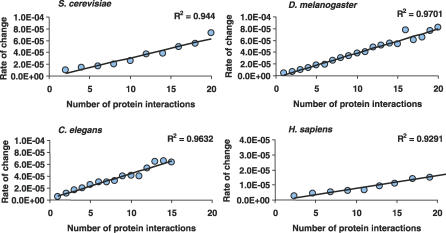
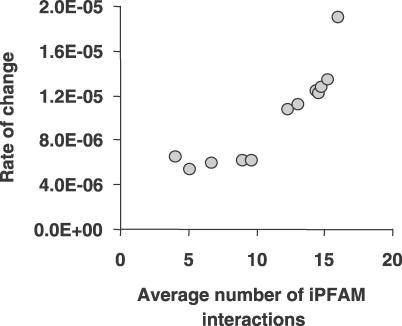
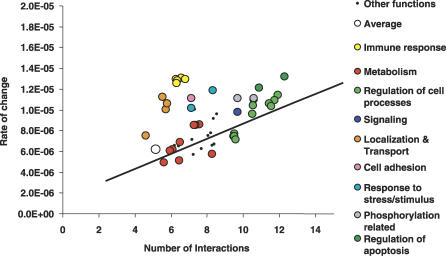
Progress in uncovering the protein interaction networks of several species has led to questions of what underlying principles might govern their organization. Few studies have tried to determine the impact of protein interaction network evolution on the observed physiological differences between species. Using comparative genomics and structural information, we show here that eukaryotic species have rewired their interactomes at a fast rate of approximately 10(-5) interactions changed per protein pair, per million years of divergence. For Homo sapiens this corresponds to 10(3) interactions changed per million years. Additionally we find that the specificity of binding strongly determines the interaction turnover and that different biological processes show significantly different link dynamics. In particular, human proteins involved in immune response, transport, and establishment of localization show signs of positive selection for change of interactions. Our analysis suggests that a small degree of molecular divergence can give rise to important changes at the network level. We propose that the power law distribution observed in protein interaction networks could be partly explained by the cell's requirement for different degrees of protein binding specificity.
Conflict of interest statement
Figures
References
-
- Walhout AJ, Sordella R, Lu X, Hartley JL, Temple GF, et al. Protein interaction mapping in C. elegans using proteins involved in vulval development. Science. 2000;287:116–122. - PubMed
-
- Stelzl U, Worm U, Lalowski M, Haenig C, Brembeck FH, et al. A human protein–protein interaction network: A resource for annotating the proteome. Cell. 2005;122:957–968. - PubMed
-
- Rual JF, Venkatesan K, Hao T, Hirozane-Kishikawa T, Dricot A, et al. Towards a proteome-scale map of the human protein–protein interaction network. Nature. 2005;437:1173–1178. - PubMed
-
- Giot L, Bader JS, Brouwer C, Chaudhuri A, Kuang B, et al. A protein interaction map of Drosophila melanogaster . Science. 2003;302:1727–1736. - PubMed
Publication types
MeSH terms
Substances
LinkOut - more resources
Full Text Sources