. 2007 Feb 16;3(2):e31.
doi: 10.1371/journal.pcbi.0030031. Epub 2007 Jan 2.

Unsupervised learning of visual features through spike timing dependent plasticity

Affiliations

Unsupervised learning of visual features through spike timing dependent plasticity

Timothée Masquelier et al. PLoS Comput Biol. .

Abstract

Spike timing dependent plasticity (STDP) is a learning rule that modifies synaptic strength as a function of the relative timing of pre- and postsynaptic spikes. When a neuron is repeatedly presented with similar inputs, STDP is known to have the effect of concentrating high synaptic weights on afferents that systematically fire early, while postsynaptic spike latencies decrease. Here we use this learning rule in an asynchronous feedforward spiking neural network that mimics the ventral visual pathway and shows that when the network is presented with natural images, selectivity to intermediate-complexity visual features emerges. Those features, which correspond to prototypical patterns that are both salient and consistently present in the images, are highly informative and enable robust object recognition, as demonstrated on various classification tasks. Taken together, these results show that temporal codes may be a key to understanding the phenomenal processing speed achieved by the visual system and that STDP can lead to fast and selective responses.


Conflict of interest statement

Competing interests. The authors have declared that no competing interests exist.

Figures

Figure 1
Figure 1. Overview of the Five-Layer Feedforward Spiking Neural Network
As in HMAX [7], we alternate simple cells that gain selectivity through a sum operation, and complex cells that gain shift and scale invariance through a max operation (which simply consists of propagating the first received spike). Cells are organized in retinotopic maps until the S2 layer (inclusive). S1 cells detect edges. C1 maps subsample S1 maps by taking the maximum response over a square neighborhood. S2 cells are selective to intermediate-complexity visual features, defined as a combination of oriented edges (here we symbolically represented an eye detector and a mouth detector). There is one S1–C1–S2 pathway for each processing scale (not represented). Then C2 cells take the maximum response of S2 cells over all positions and scales and are thus shift- and scale-invariant. Finally, a classification is done based on the C2 cells' responses (here we symbolically represented a face/nonface classifier). In the brain, equivalents of S1 cells may be in V1, S2 cells in V1–V2, S2 cells in V4–PIT, C2 cells in AIT, and the final classifier in PFC. This paper focuses on the learning of C1 to S2 synaptic connections through STDP.
Figure 2
Figure 2. Sample Pictures from the Caltech Datasets
The top row shows examples of faces (all unsegmented), the middle row shows examples of motorbikes (some are segmented, others are not), and the bottom row shows examples of distractors.
Figure 3
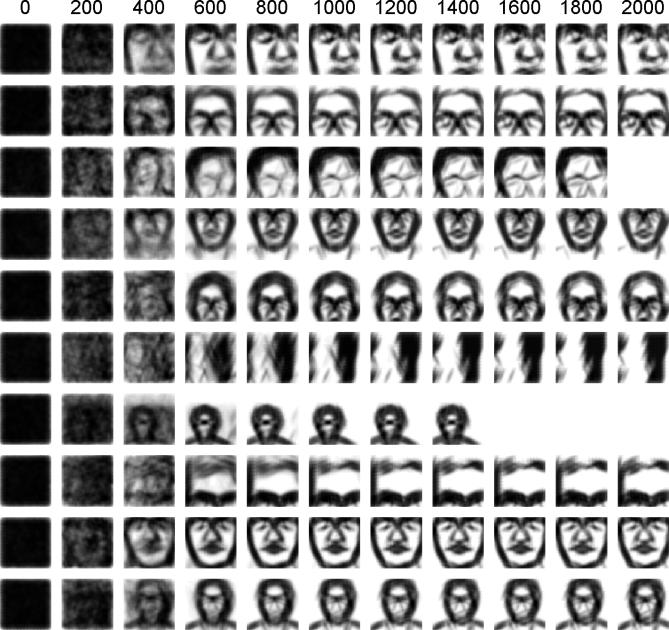
Figure 3. Evolution of Reconstructions for Face Features
At the top is the number of postsynaptic spikes emitted. Starting from random preferred stimuli, cells detect statistical regularities among the input visual spike trains after a few hundred discharges and progressively develop selectivity to those patterns. A few hundred more discharges are needed to reach a stable state. Furthermore, the population of cells self-organizes, with each cell effectively trying to learn a distinct pattern so as to cover the whole variability of the inputs.
Figure 4
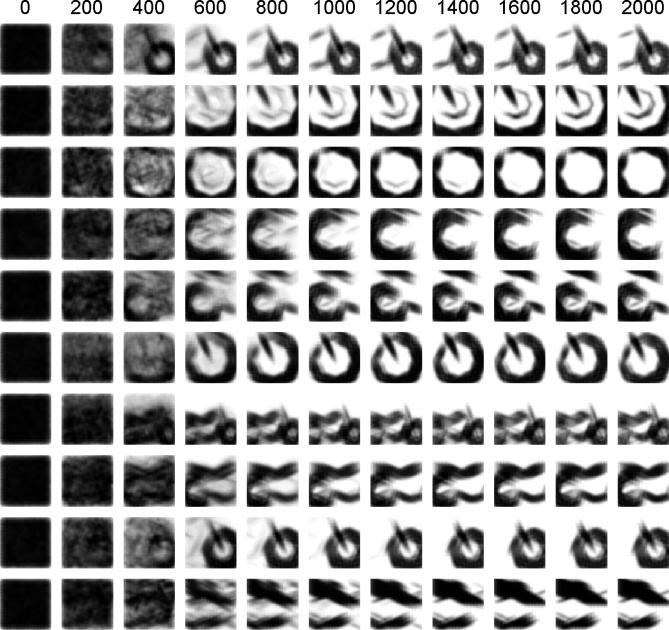
Figure 4. Evolution of Reconstructions for Motorbike Features
Figure 5
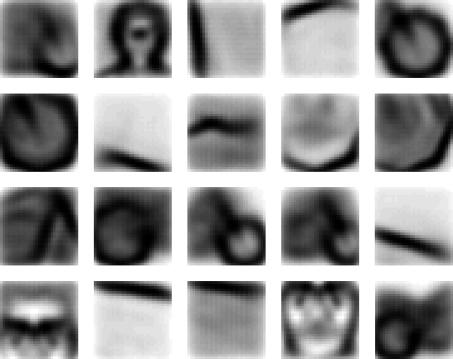
Figure 5. Final Reconstructions for the 20 Features in the Mixed Case
The 20 cells self-organized, some having developed selectivity to face features, and some to motorbike features.
Figure 6
Figure 6. Hebbian Learning
(Top) Final reconstructions for the ten face features. (Bottom) The ten motorbike features.
Figure 7
Figure 7. Hebbian Learning: Final Reconstructions for the 20 Features in the Mixed Case
As with STDP-based learning, the 20 cells self-organized, some having developed selectivity to face features, and some to motorbike features.

References

    1. Kirchner H, Thorpe SJ. Ultra-rapid object detection with saccadic eye movements: Visual processing speed revisited. Vision Res. 2006;46:1762–1776. - PubMed
    1. Hung CP, Kreiman G, Poggio T, DiCarlo JJ. Fast readout of object identity from macaque inferior temporal cortex. Science. 2005;310:863–866. - PubMed
    1. VanRullen R, Thorpe SJ. Rate coding versus temporal order coding: What the retinal ganglion cells tell the visual cortex. Neural Comput. 2001;13:1255–1283. - PubMed
    1. Song S, Miller KD, Abbott LF. Competitive hebbian learning through spike-timing–dependent synaptic plasticity. Nat Neurosci. 2000;3:919–926. - PubMed
    1. Guyonneau R, VanRullen R, Thorpe SJ. Neurons tune to the earliest spikes through STDP. Neural Comput. 2005;17:859–879. - PubMed

Publication types

MeSH terms