


doi: 10.1016/j.immuni.2006.12.007.
Wnt signaling induces matrix metalloproteinase expression and regulates T cell transmigration
Affiliations
- PMID: 17306568
- PMCID: PMC1855210
- DOI: 10.1016/j.immuni.2006.12.007
Item in Clipboard
Wnt signaling induces matrix metalloproteinase expression and regulates T cell transmigration
Immunity.
2007 Feb.
Abstract
Wnts are a family of secreted glycoproteins with diverse developmental roles, including regulation of cell migration; however, little is known about wnt signaling in mature T cells. We find that endothelial-cell-derived wnts, acting through Frizzled receptors, induce matrix metalloproteinase (MMP) 2 and MMP9 expression in effector T cells. Blocking wnt signaling, or MMP activity, reduces T cell migration through the basement membrane in vitro and into inflamed skin in vivo. Wnt signaling stabilizes beta-catenin protein in T cells and directly targets the MMP promoters through tandem TCF sites. Thus, our data support a necessary and previously unexpected role for wnt signaling in T cell extravasation.
Figures
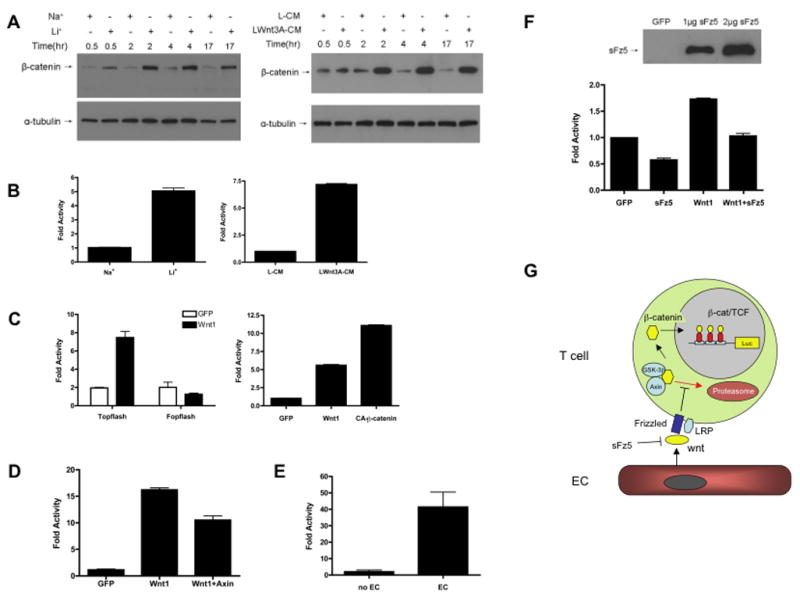
(A) Effector T cells were treated for the indicated times with either 10mM Li+ or Na+, or with control or wnt3A-conditioned medium and harvested for western blotting with an antibody against β-catenin. To confirm equal loading blots were stripped and re-probed for α-tubulin. One of at least three similar experiments. (B) Effector T cells were transfected with the TOPflash reporter vector and then incubated with either 10mM Li+ or Na+, or with control or wnt3A-conditioned medium. Luciferase activity was assayed after 24 hours. Mean and SD of triplicate wells, * – p<0.005 (t-test) for Na+ v Li+, p<0.005 (t-test) for L-CM v wnt3A-CM. One of three similar experiments. (C) (left) Effector T cells were transfected with either the TOPflash reporter or the control FOPflash, which contains mutated LEF/TCF binding sites, along with an expression plasmid for wnt1. (right) Effector T cells were transfected with the TOPflash reporter along with expression vectors for either wnt1 or constitutively active (CA) β-catenin (CA-β-catenin). Luciferase activity was assayed after 24 hours. Mean and SD of triplicate wells, * – p<0.005 (t-test) for GFP v wnt1 (TOPflash) and p<0.005 (t-test) for GFP v wnt1 or GFP v CA-β-catenin. One of three similar experiments. (D) Effector T cells were transfected with TOPflash and expression plasmids for wnt1 or axin as indicated. DNA load was balanced with control plasmid. Mean and SD of triplicate wells, * – p<0.005 (t-test) for wnt1 v wnt1 + axin. One of three similar experiments. (E) Effector T cells were transfected with TOPflash and incubated with EC for 24 hours before assay of luciferase activity. Mean and SD of triplicate wells, * – p<0.005 (t-test). One of three similar experiments. (F) Effector T cells were transfected with TOPflash and incubated with EC expressing sFz5 or wnt1 as indicated. DNA load was balanced with control plasmid. Luciferase activity was assayed after 24 hours. Mean and SD of triplicate wells, * – p<0.005 (t-test) for GFP v sFz5, GFP v wnt1, and wnt1 v wnt1+sFz5. Expression of tagged-sFz5 was confirmed by western blot using an anti-Flag antibody. One of at least three similar experiments. (G) EC-derived wnts signal through Frizzled/LRP receptors and block proteosome-mediated degradation of β-catenin. As β-catenin levels rise it enters the nucleus where it acts as a transcriptional co-factor with LEF/TCF to induce target genes, here the reporter TOPflash. sFz5 blocks wnt signaling.
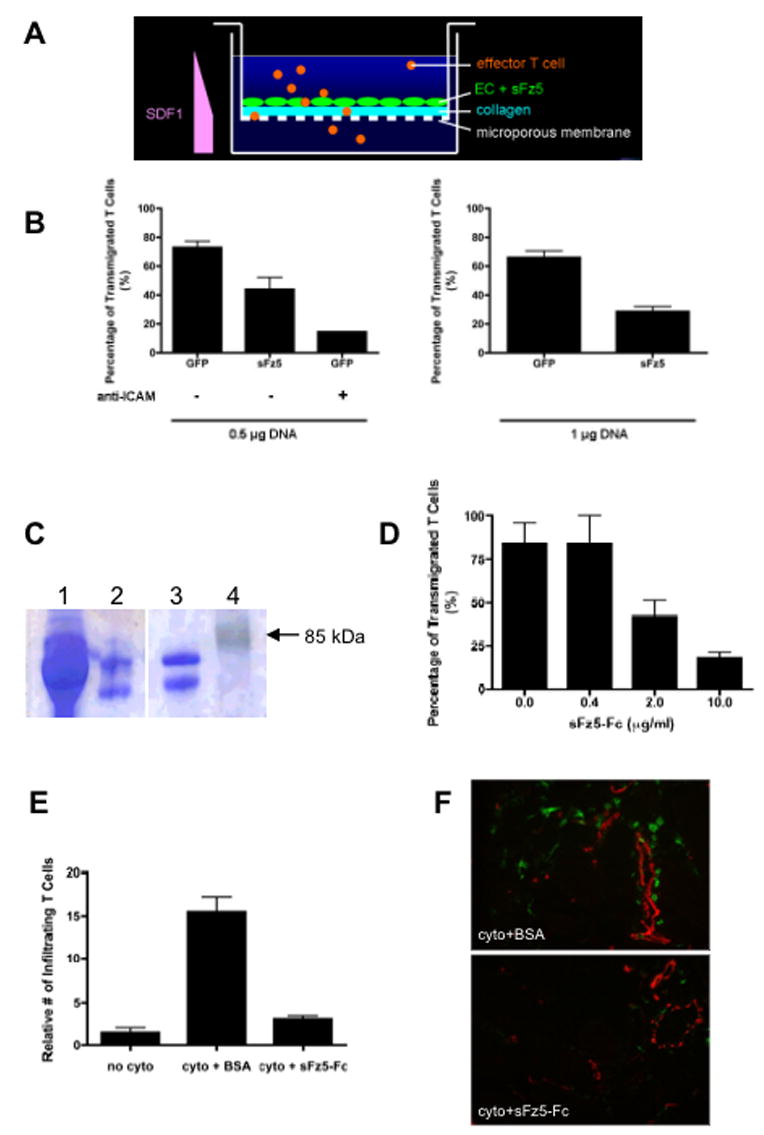
(A) Model system for T cell transmigration assays. (B) EC were transfected with 0.5 μg of GFP or sFz5 (left) or 1 μg of GFP or sFz5 (right), grown to confluence on collagen I-coated inserts, and then stimulated with TNF-α (10ng/ml) for 4hr to induce expression of adhesion molecules. Effector T cells were plated in the upper well in the presence of HB64 (−) or anti-ICAM-1 mAb (left). SDF1-α (100ng/ml) was added to the lower well. Cells that transmigrated into the lower well after 24 hours were counted. Results are representative of more than three independent experiments. Mean and SD of triplicate wells, * – p<0.05 (t-test) for GFP v sFz5, and p<0.005 (t-test) for control, v anti-ICAM-1 mAb. (C) Coomassie blue staining of an SDS-PAGE gel showing purified sFz5-Fc produced in HEK293 cells (lane 2), or purchased (lane 3). Supernatant from transfected HEK293 cells prior to purification is shown in lane 1. MW markers are in lane 4. (D) Effector T cells were added to untransfected EC monolayers in the presence of 10μg/ml BSA or sFz5-Fc protein. Transmigrated T cells were counted after 24 hours. Mean and SD of triplicate wells, * – p<0.005 (t-test) for control (0μg/ml sFz5-Fc, 10μg/ml BSA) v 10μg/ml sFz5-Fc. One of three similar experiments. (E) Mice were injected i.d. on the back with TNFα (10ng) and IFNγ (300U), or with TNF + IFNγ along with BSA or sFz5-Fc (1μg each). Controls received vehicle (PBS) alone, and all injections were in a total volume of 10μl. Skin was harvested after 22 hours and frozen. Sections were stained for CD3 (green) to show T cells and CD31 (red) to highlight blood vessels. Six fields from duplicate sites from each mouse were analyzed (blinded) for each condition. Mean and SD, * – p<0.01 (t-test) for BSA+cytokine v sFz5-Fc+cytokine. One of five similar experiments. (F) Representative sections stained for T cell CD3 (green) and EC CD31 (red). Conditions as indicated.
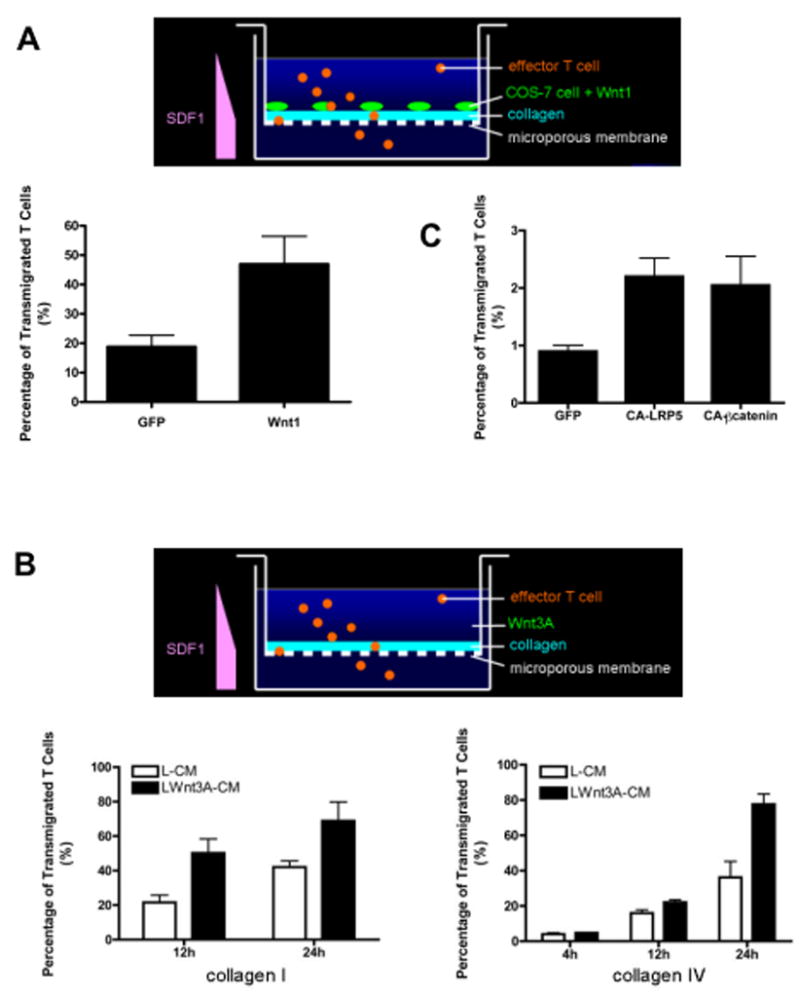
(A) Effector T cells were added to sub-confluent COS-7 cells expressing wnt1 and growing on collagen-coated wells. SDF1-α (100ng/ml) was added to the lower well, and cells that had transmigrated after 24 hours were counted. Mean and SD of triplicate wells, * – p<0.05 (t-test). One of three similar experiments. (B) Effector T cells were added to collagen-coated wells in the presence of control or wnt3A-conditioned medium. SDF1-α was added to the lower well, and cells that had transmigrated after the indicated times were counted. Mean and SD of triplicate wells, * – t-test: For collagen I: p<0.005 (12hr) and p<0.02 (24hr); for collagen IV: p<0.05 (12hr) and p<0.005 (24hr). One of three similar experiments. (C) Effector T cells were transfected with expression vectors for GFP, CA-LRP6 or CA-β-catenin and added to collagen IV-coated wells 24 hours post transfection. SDF1-α was added to the lower well, and cells that had transmigrated were counted. Mean and SD of triplicate wells, * – t-test: for GFP v CA-LRP6: p<0.005; for GFP v CA-β-catenin: p<0.05. One of three similar experiments. Transfected cells consistently migrate at a lower rate than non-transfected cells.
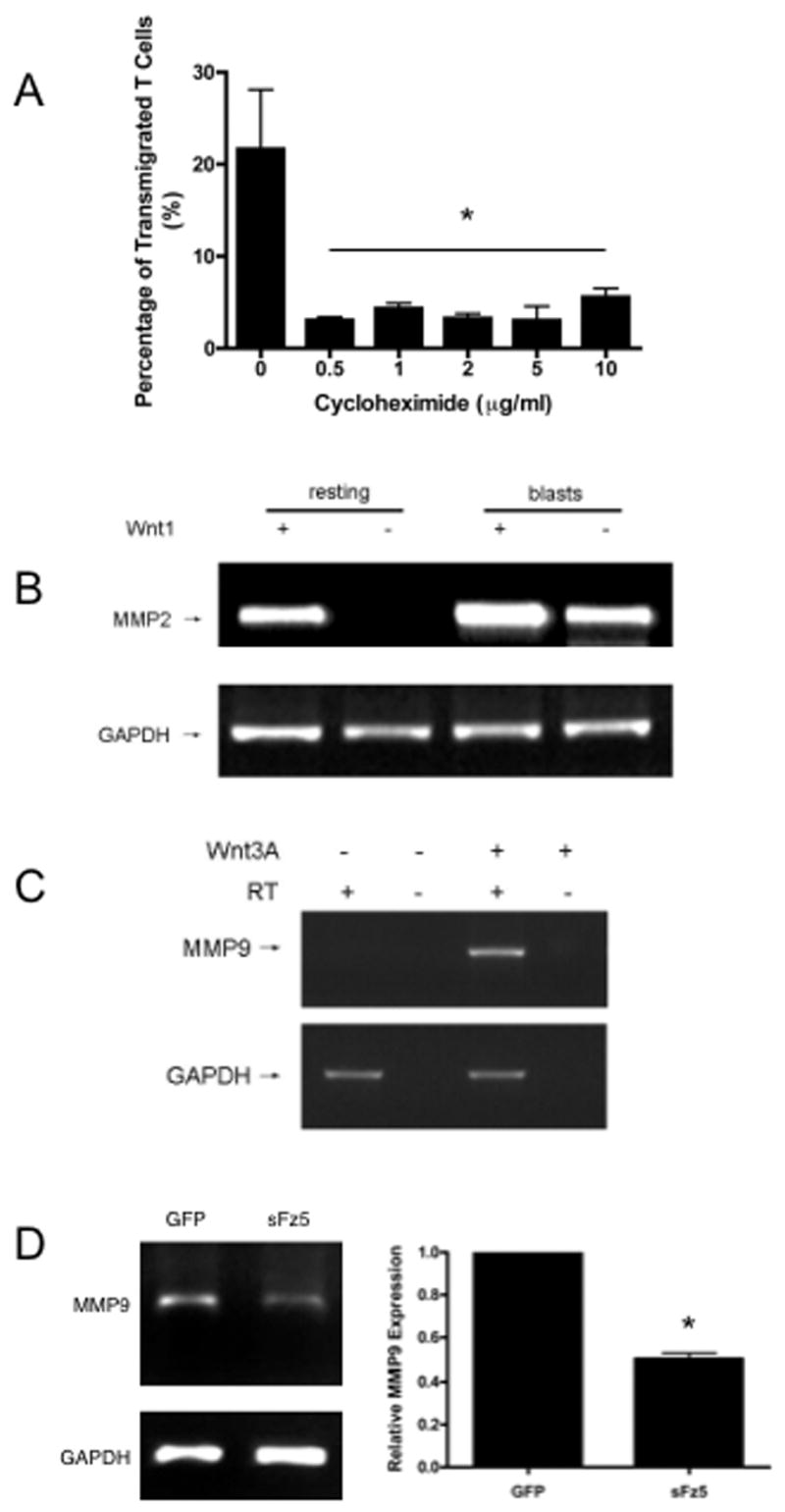
(A) Effector T cell migration is protein synthesis-dependent. Effector T cells were plated in collagen IV-coated wells in the presence of wnt3A-conditioned medium and allowed to migrate for 24 hours in response to SDF1-α (100ng/ml) in the lower well. Cycloheximide or vehicle was added at the indicated concentrations. Mean and SD of triplicate wells, * – p<0.05 (t-test) for all concentrations v control. One of two similar experiments. (B) Resting or effector T cells were transfected with expression plasmids for either GFP or wnt1 and harvested for semi-quantitative RT-PCR analysis 24 hours later. Results are shown for MMP2 and GAPDH. One of three similar experiments. (C) Effector T cells were allowed to migrate through collagen IV-coated wells in the presence of control or wnt3A-conditioned medium as described in Figure 3. Migrated T cells were harvested, and equal numbers were used for semi-quantitative RT-PCR. Results for MMP9 and GAPDH, in the presence or absence of reverse transcriptase (RT), are shown. One of three similar experiments. (D) Effector T cells were allowed to migrate through monolayers of EC expressing either GFP or sFz5, and were then analyzed for MMP9 expression by semi-quantitative RT-PCR. Mean and SD of triplicate RT-PCR samples are shown, * – p<0.005 (t-test) for GFP v sFz5. One of three similar experiments.
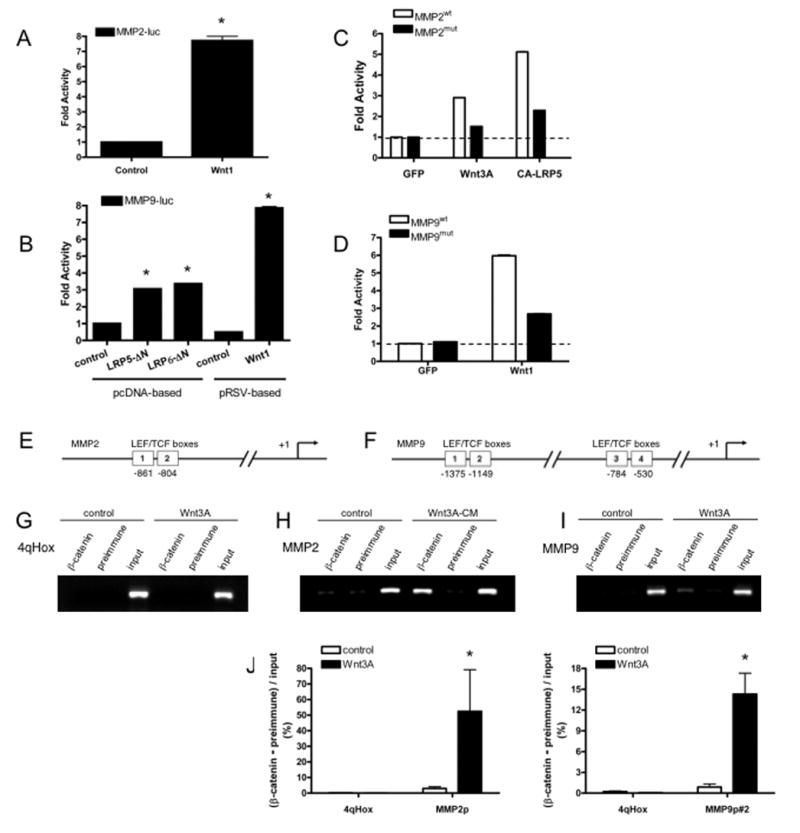
(A) Effector T cells were transfected with MMP2-Luc along with either a control or wnt1 expression plasmid and harvested 24 hours later for analysis of luciferase expression. Mean and SD for triplicate wells, * – p<0.005 (t-test). One of more than three similar experiments. (B) Effector T cells were transfected with MMP9-Luc along with either a control vector, or expression vectors for wnt1, LRP5-ΔN or LRP6-ΔN. Cells were harvested 24 hours later for analysis of luciferase expression. Mean and SD for triplicate wells, * – p<0.005 (t-test) for control v LRP5-ΔN or LRP6-ΔN, or control v wnt1. One of three similar experiments. (C) Effector T cells were transfected with expression vectors for GFP, wnt3A or CA-LRP5, along with either the wild-type (WT) or mutant MMP2 promoter luciferase reporters. The promoter was mutated at both the upstream and downstream putative LEF/TCF sites. Cells were assayed for luciferase activity at 17 hours. Reduced activity of the mutant promoter is relative to the GFP control (dotted line). One of four similar experiments. (D) Effector T cells were transfected with expression vectors for GFP or wnt1, along with either the wild-type (WT) or mutant MMP9 promoter luciferase reporters. The promoter was mutated at both of the proximal putative LEF/TCF sites in the truncated (800bp) promoter. Cells were assayed for luciferase activity at 17 hours. Reduced activity of the mutant promoter is relative to the GFP control (dotted line). One of three similar experiments. (E) Schematic of the MMP2 promoter showing the two putative LEF/TCF sites. (F) Schematic of the MMP9 promoter showing the four putative LEF/TCF sites, one upstream pair and one downstream pair. The downstream pair are within the 800bp truncated promoter. (G, H, I) ChIP analysis was performed by immunoprecipitating DNA/protein complexes from effector T cells with an anti-β-catenin antibody. DNA was amplified using primers specific for an irrelevant sequence, 4qHox, the MMP2 promoter, and the MMP9 promoter (2 sets of primers, only one shown). Controls were immunoprecipitated with pre-immune serum. Input DNA (before immunoprecipitation) was amplified as a positive control for the PCR. Band intensities for each of three PCR reactions were measured and immune minus pre-immune intensities are plotted (J, K). One of three similar experiments.
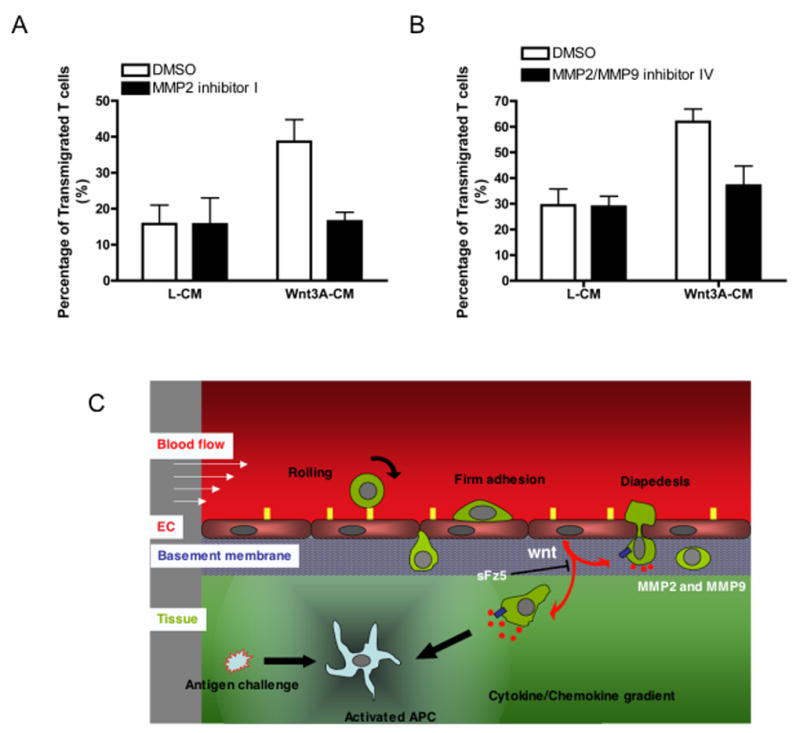
(A) Effector T cells were stimulated to migrate across collagen IV gels as described above, in the presence of control or wnt3A-CM, with DMSO or 10μM MMP2 inhibitor OA-HY. Migrated T cells were harvested and counted. Mean and SD for triplicate wells, * – p<0.05 (t-test) for DMSO(Wnt3A) v inhibitor(Wnt3A). One of three similar experiments. (B) Similar to (A) except MMP inhibitor IV (10nM) was used. Mean and SD for triplicate wells, * – p<0.01 (t-test) for DMSO(Wnt3A) v inhibitor(Wnt3A). One of three similar experiments. (C) Model for wnt regulation of T cell migration. Antigen challenge activates local APC to express cytokines/chemokines that induce adhesion molecules (yellow rectangles) on EC. As recruited T cells cross the EC monolayer lining blood vessels they receive a wnt signal through Fz receptors (blue rectangle). Induction of MMP expression (red dots) allows the T cells to cross the BM and migrate along chemokine gradients through interstitial collagen toward the inflammatory source.
References
-
- Alon R, Feigelson S. From rolling to arrest on blood vessels: leukocyte tap dancing on endothelial integrin ligands and chemokines at sub-second contacts. Semin Immunol. 2002;14:93–104. - PubMed
-
- Barker N, Morin PJ, Clevers H. The Yin-Yang of TCF/beta-catenin signaling. Adv Cancer Res. 2000;77:1–24. - PubMed
-
- Cai Y, Chen T, Xu Q. Astilbin suppresses delayed-type hypersensitivity by inhibiting lymphocyte migration. J Pharm Pharmacol. 2003;55:691–696. - PubMed
-
- Cheng CW, Smith SK, Charnock-Jones DS. Wnt-1 signaling inhibits human umbilical vein endothelial cell proliferation and alters cell morphology. Exp Cell Res. 2003;291:415–425. - PubMed
Publication types
MeSH terms
Substances
Grants and funding
LinkOut - more resources
Full Text Sources
Other Literature Sources
Molecular Biology Databases
Miscellaneous
