


Determination of key aspects of precursor cell proliferation, cell cycle length and kinetics in the adult mouse subgranular zone
- PMID: 17307295
- PMCID: PMC2230096
- DOI: 10.1016/j.neuroscience.2006.12.064
Determination of key aspects of precursor cell proliferation, cell cycle length and kinetics in the adult mouse subgranular zone
Abstract
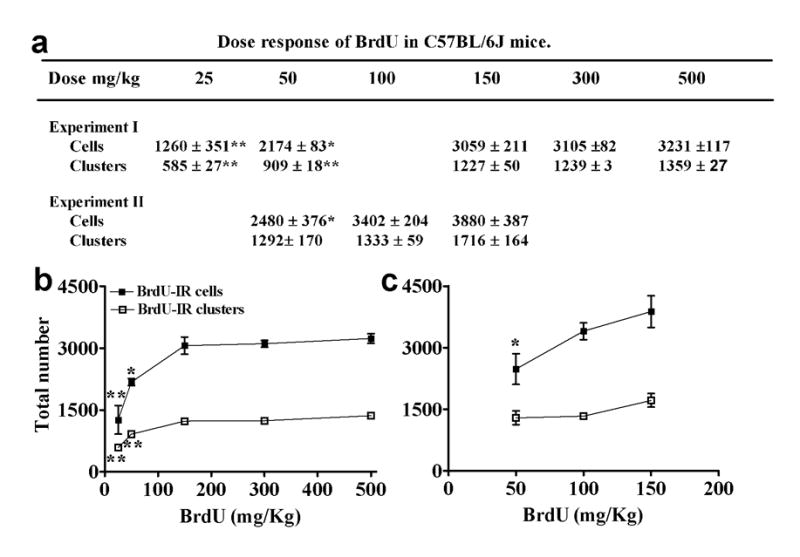
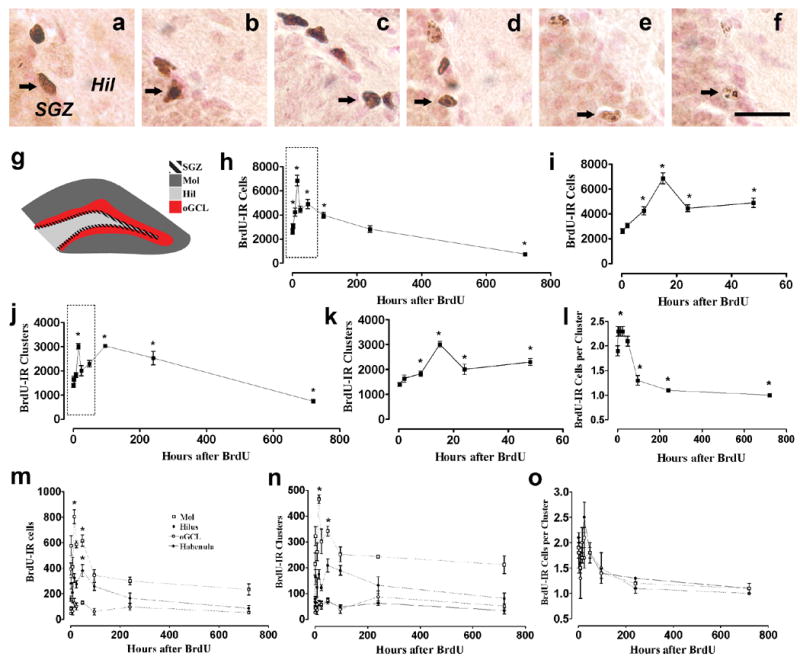
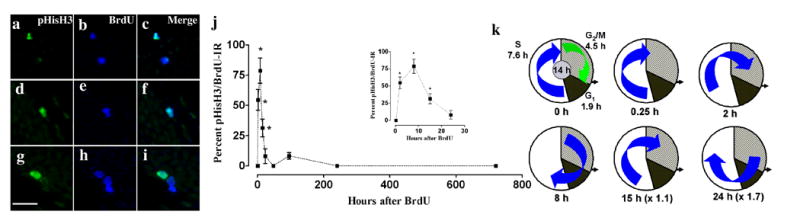
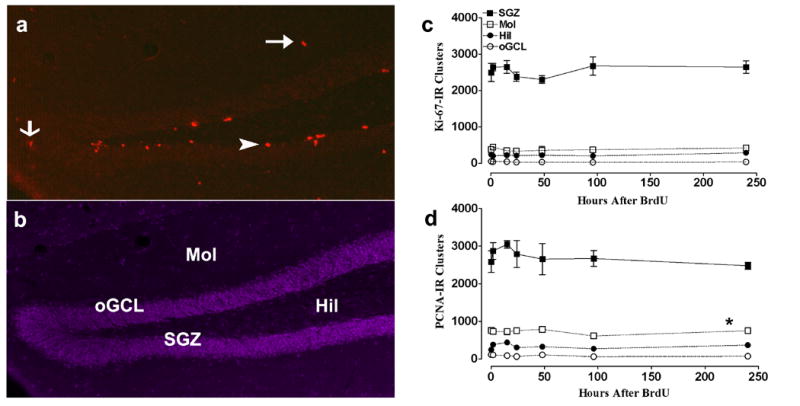
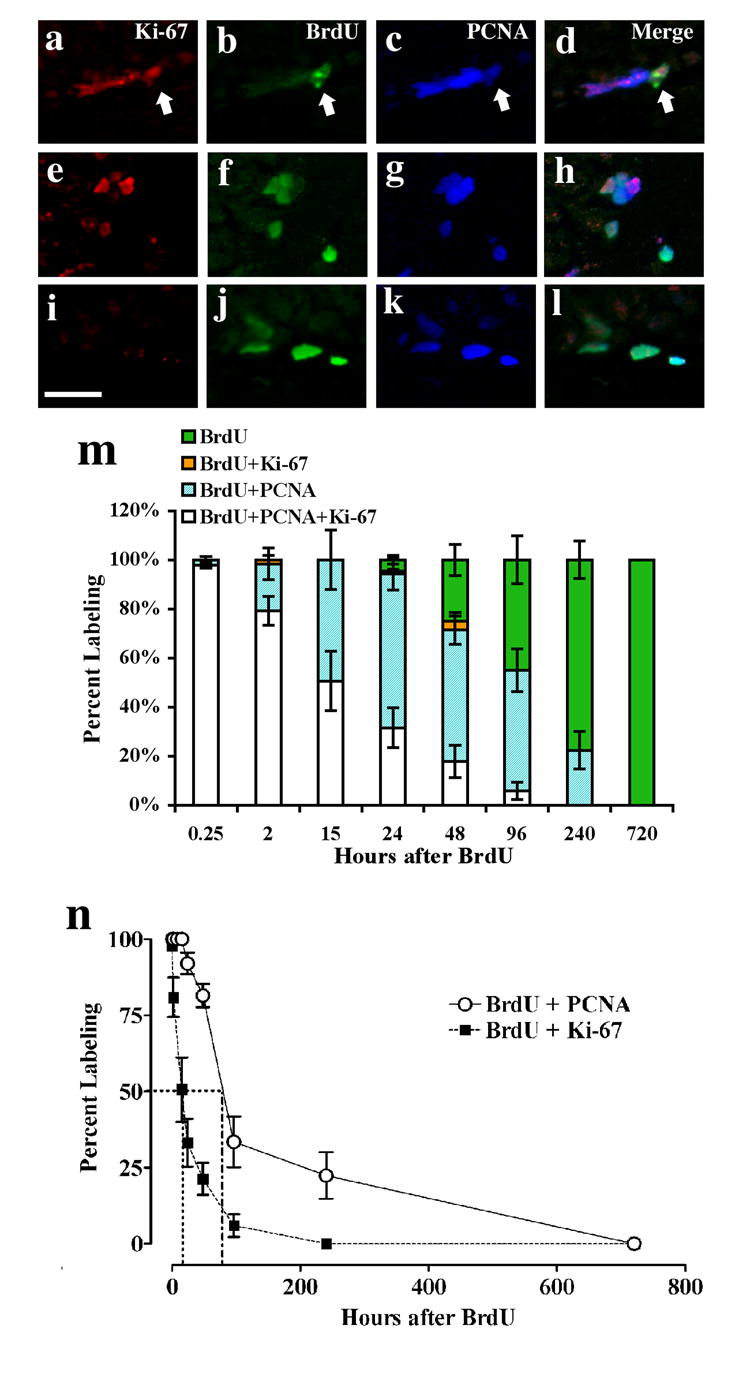
Neurogenesis studies on the adult mouse hippocampal subgranular zone (SGZ) typically report increases or decreases in proliferation. However, key information is lacking about these proliferating SGZ precursors, from the fundamental--what dose of bromodeoxyuridine (BrdU) is appropriate for labeling all S phase cells?--to the detailed--what are the kinetics of BrdU-labeled cells and their progeny? To address these questions, adult C57BL/6J mice were injected with BrdU and BrdU-immunoreactive (IR) cells were quantified. Initial experiments with a range of BrdU doses (25-500 mg/kg) suggested that 150 mg/kg labels all actively dividing precursors in the mouse SGZ. Experiments using a saturating dose of BrdU suggested BrdU bioavailability is less than 15 min, notably shorter than in the developing mouse brain. We next explored precursor division and maturation by tracking the number of BrdU-IR cells and colabeling of BrdU with other cell cycle proteins from 15 min to 30 days after BrdU. We found that BrdU and the Gap2 and mitosis (G2/M) phase protein pHisH3 maximally colocalized 8 h after BrdU, indicating that the mouse SGZ precursor cell cycle length is 14 h. In addition, triple labeling with BrdU and proliferating cell nuclear antigen (PCNA) and Ki-67 showed that BrdU-IR precursors and/or their progeny express these endogenous cell cycle proteins up to 4 days after BrdU injection. However, the proportion of BrdU/Ki-67-IR cells declined at a greater rate than the proportion of BrdU/PCNA-IR cells. This suggests that PCNA protein is detectable long after cell cycle exit, and that reliance on PCNA may overestimate the length of time a cell remains in the cell cycle. These findings will be critical for future studies examining the regulation of SGZ precursor kinetics in adult mice, and hopefully will encourage the field to move beyond counting BrdU-IR cells to a more mechanistic analysis of adult neurogenesis.
Figures
References
-
- Abrous DN, Koehl M, Le Moal M. Adult neurogenesis: from precursors to network and physiology. Physiol Rev. 2005;85:523–569. - PubMed
-
- Alexiades MR, Cepko C. Quantitative analysis of proliferation and cell cycle length during development of the rat retina. Dev Dyn. 1996;205:293–307. - PubMed
-
- Alvarez-Buylla A, Lim DA. For the long run: maintaining germinal niches in the adult brain. Neuron. 2004;41:683–686. - PubMed
-
- Amaral D, Witter M. The Rat Nervous System San Diego. Academic Press; 1995. Hippocampal Formation; pp. 443–493.
-
- Bacchi CE, Gown AM. Detection of cell proliferation in tissue sections. Braz J Med Biol Res. 1993;26:677–687. - PubMed
Publication types
MeSH terms
Substances
Grants and funding
LinkOut - more resources
Full Text Sources
Miscellaneous
