


Gene expression and biochemical analysis of cheese-ripening yeasts: focus on catabolism of L-methionine, lactate, and lactose
- PMID: 17308183
- PMCID: PMC1855621
- DOI: 10.1128/AEM.02720-06
Gene expression and biochemical analysis of cheese-ripening yeasts: focus on catabolism of L-methionine, lactate, and lactose
Abstract
DNA microarrays of 86 genes from the yeasts Debaryomyces hansenii, Kluyveromyces marxianus, and Yarrowia lipolytica were developed to determine which genes were expressed in a medium mimicking a cheese-ripening environment. These genes were selected for potential involvement in lactose/lactate catabolism and the biosynthesis of sulfur-flavored compounds. Hybridization conditions to follow specifically the expression of homologous genes belonging to different species were set up. The microarray was first validated on pure cultures of each yeast; no interspecies cross-hybridization was observed. Expression patterns of targeted genes were studied in pure cultures of each yeast, as well as in coculture, and compared to biochemical data. As expected, a high expression of the LAC genes of K. marxianus was observed. This is a yeast that efficiently degrades lactose. Several lactate dehydrogenase-encoding genes were also expressed essentially in D. hansenii and K. marxianus, which are two efficient deacidifying yeasts in cheese ripening. A set of genes possibly involved in l-methionine catabolism was also used on the array. Y. lipolytica, which efficiently assimilates l-methionine, also exhibited a high expression of the Saccharomyces cerevisiae orthologs BAT2 and ARO8, which are involved in the l-methionine degradation pathway. Our data provide the first evidence that the use of a multispecies microarray could be a powerful tool to investigate targeted metabolism and possible metabolic interactions between species within microbial cocultures.
Figures
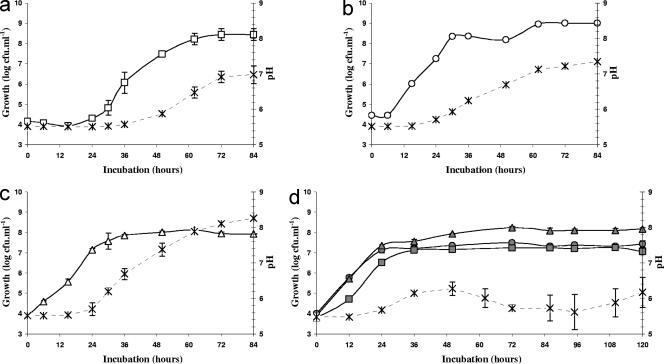
 pH levels. Error bars represent standard deviations calculated on the average values of six determinations.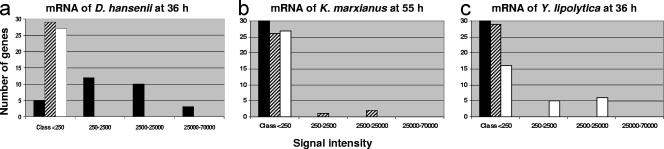
Similar articles
-
Transcriptional analysis of L-methionine catabolism in the cheese-ripening yeast Yarrowia lipolytica in relation to volatile sulfur compound biosynthesis.Appl Environ Microbiol. 2008 Jun;74(11):3356-67. doi: 10.1128/AEM.00644-07. Epub 2008 Apr 4. Appl Environ Microbiol. 2008. PMID: 18390675 Free PMC article.
-
Transcriptomic response of Debaryomyces hansenii during mixed culture in a liquid model cheese medium with Yarrowia lipolytica.Int J Food Microbiol. 2018 Jan 2;264:53-62. doi: 10.1016/j.ijfoodmicro.2017.10.026. Epub 2017 Oct 24. Int J Food Microbiol. 2018. PMID: 29111498
-
Comparison of volatile sulphur compound production by cheese-ripening yeasts from methionine and methionine-cysteine mixtures.Appl Microbiol Biotechnol. 2007 Jul;75(6):1447-54. doi: 10.1007/s00253-007-0971-3. Epub 2007 Apr 13. Appl Microbiol Biotechnol. 2007. PMID: 17431610
-
Cheese yeasts.Yeast. 2019 Mar;36(3):129-141. doi: 10.1002/yea.3368. Epub 2019 Jan 24. Yeast. 2019. PMID: 30512214 Review.
-
Native and Recombinant Yeast Producers of Lactic Acid: Characteristics and Perspectives.Int J Mol Sci. 2025 Feb 25;26(5):2007. doi: 10.3390/ijms26052007. Int J Mol Sci. 2025. PMID: 40076630 Free PMC article. Review.
Cited by
-
Potential characterization of yeasts isolated from Kazak artisanal cheese to produce flavoring compounds.Microbiologyopen. 2018 Feb;7(1):e00533. doi: 10.1002/mbo3.533. Epub 2017 Dec 26. Microbiologyopen. 2018. PMID: 29277964 Free PMC article.
-
The Effect of the Ratio of Gamma Aminobutyric Acid-Producing Saccharomyces cerevisiae DL6-20 and Kluyveromyces marxianus B13-5 Addition on Cheese Quality.Front Microbiol. 2022 Jun 23;13:900394. doi: 10.3389/fmicb.2022.900394. eCollection 2022. Front Microbiol. 2022. PMID: 35814701 Free PMC article.
-
Phenotypic and Genetic Characterization of the Cheese Ripening Yeast Geotrichum candidum.Front Microbiol. 2020 May 7;11:737. doi: 10.3389/fmicb.2020.00737. eCollection 2020. Front Microbiol. 2020. PMID: 32457706 Free PMC article.
-
Lactate and amino acid catabolism in the cheese-ripening yeast Yarrowia lipolytica.Appl Environ Microbiol. 2008 Nov;74(21):6505-12. doi: 10.1128/AEM.01519-08. Epub 2008 Sep 5. Appl Environ Microbiol. 2008. PMID: 18776032 Free PMC article.
-
Effects of physicochemical parameters on volatile sulphur compound formation from L-methionine catabolism by non-growing cells of Kluyveromyces lactis.AMB Express. 2018 Jul 3;8(1):109. doi: 10.1186/s13568-018-0639-7. AMB Express. 2018. PMID: 29971574 Free PMC article.
References
-
- Alexandre, H., V. Ansanay-Galeote, S. Dequin, and B. Blondin. 2001. Global gene expression during short-term ethanol stress in Saccharomyces cerevisiae. FEBS Lett. 498:98-103. - PubMed
-
- Arfi, K., H. E. Spinnler, R. Tâche, and P. Bonnarme. 2002. Production of volatile compounds by cheese-ripening yeasts: requirement for a methanethiol donor for S-methyl thioacetate synthesis by Kluyveromyces lactis. Appl. Microbiol. Biotechnol. 58:503-510. - PubMed
-
- Arfi, K., M. N. Leclercq-Perlat, H. E. Spinnler, and P. Bonnarme. 2005. Importance of curd-neutralising yeasts on the aromatic potential of Brevibacterium linens during cheese ripening. Int. Dairy J. 15:883-891.
-
- Barnett, J. A., R. W. Payne, and D. Yarrow. 2000. Yeasts: characteristics and identification, 3rd ed. Cambridge University Press, Cambridge, United Kingdom.
Publication types
MeSH terms
Substances
LinkOut - more resources
Full Text Sources
Molecular Biology Databases
Research Materials
