. 2007 May;45(5):1581-7.
doi: 10.1128/JCM.01024-06. Epub 2007 Feb 21.

Development of a loop-mediated isothermal amplification assay for rapid detection of BK virus

Affiliations

Development of a loop-mediated isothermal amplification assay for rapid detection of BK virus

Bipin Raj Bista et al. J Clin Microbiol. 2007 May.

Abstract

Loop-mediated isothermal amplification (LAMP) is a novel method for rapid amplification of DNA. Its advantages include rapidity and minimal equipment requirement. The LAMP assay was developed for BK virus (BKV), which is a leading cause of morbidity in renal transplant recipients. The characteristics of the assay, including its specificity and sensitivity, were evaluated. BKV LAMP was performed using various incubation times with a variety of specimens, including unprocessed urine and plasma samples. A ladder pattern on gel electrophoresis, typical of successful LAMP reactions, was observed specifically only for BKV and not for other viruses. The sensitivity of the assay with 1 h of incubation was 100 copies/tube of a cloned BKV fragment. Additionally, a positive reaction was visually ascertained by a simple color reaction using SYBR green dye. BKV LAMP was also successful for urine and plasma specimens without the need for DNA extraction. Due to its simplicity and specificity, the LAMP assay can potentially be developed for "point of care" screening of BKV.


Figures
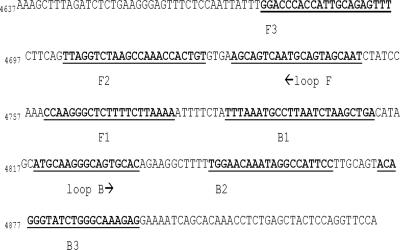
FIG. 1.
FIG. 1.
Segment of large T-antigen gene sequence (nucleotide positions 4676 to 4893) showing the locations and orientations of various primers used in the BKV LAMP assay.
FIG. 2.
FIG. 2.
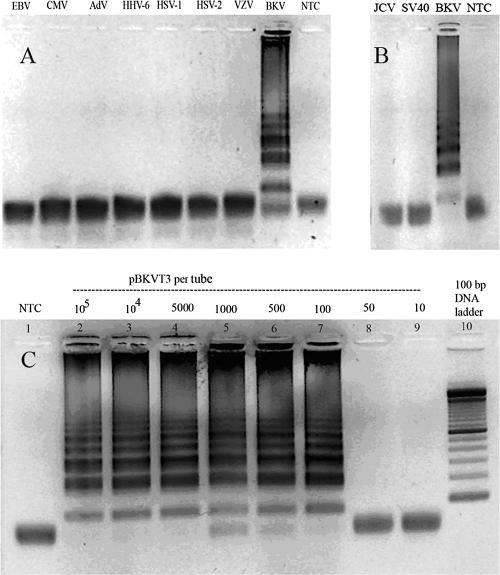
Specificity and sensitivity of the BKV LAMP assay. (A) The specificity of the BKV LAMP assay is shown in the positive reaction, visible as a ladder-like pattern in lanes with BKV DNA only. A negative reaction was obtained when the target of amplification was other non-BKV DNA viruses, i.e., EBV, CMV, Ad, HHV-6, HSV-1, HSV-2, VZV, or no-target control (NTC). (B) The LAMP reaction was negative for two related polyomaviruses, JCV and SV40, and amplified only BKV. (C) The BKV LAMP reaction was carried out with the serial dilutions of cloned BKV plasmid (pBKVT3), and the sensitivity of the reaction was determined to be 100 copies per tube.
FIG. 3.
FIG. 3.
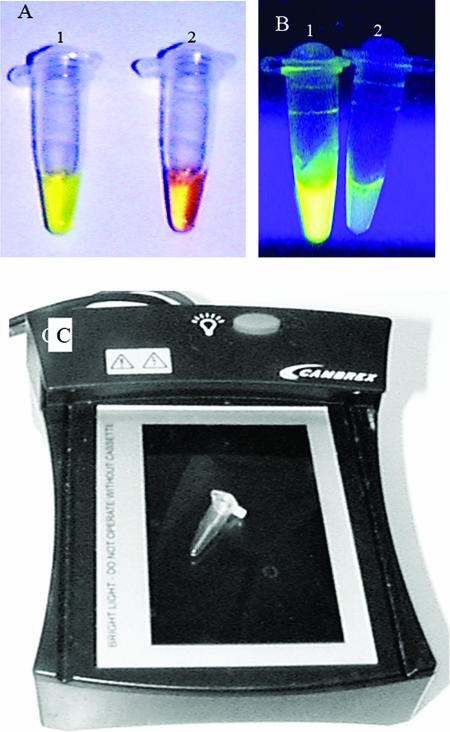
Visual detection of LAMP products. (A) The BKV LAMP products were detected after addition of SYBR green I dye. The tube with a positive reaction (tube 1) shows a color change to yellowish green, which can be distinguished from the reddish orange color of a negative reaction. (B) The same positive sample, when visualized under UV transillumination, shows a bright green fluorescence in tube 1 (positive reaction) compared to what is observed for tube 2 (negative reaction). (C) A portable blue light illuminator that can be used in a clinic setting for transillumination of LAMP products. A 0.5-ml PCR tube is placed on it to show the relative size of the transilluminator.
FIG. 4.
FIG. 4.
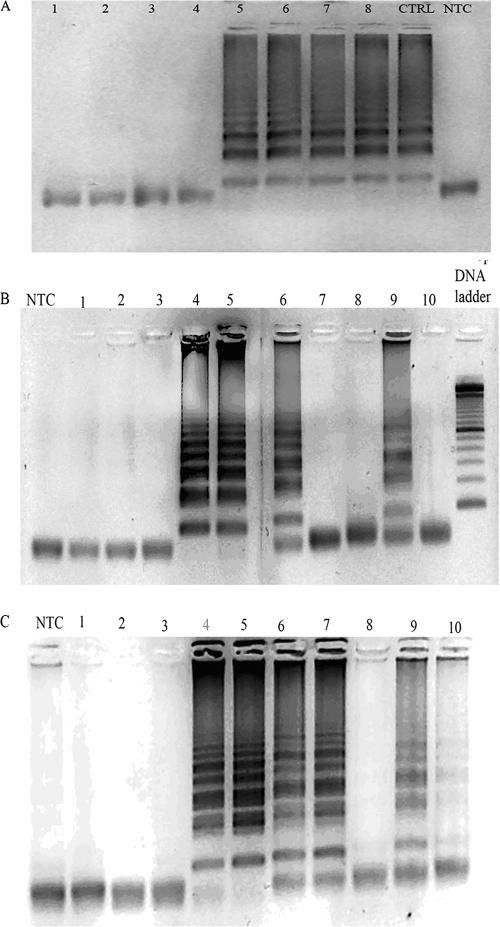
BKV LAMP with plasma and urine samples from renal transplant patients. (A) Four plasma samples from a single patient with different viral loads assayed with and without heating of samples. The LAMP reaction was negative in unprocessed and unheated plasma samples (lanes 1 to 4) and positive in the plasma only after heat treatment of the same samples for 10 min (lanes 5 to 8) or after DNA extraction (CTRL, lane 9). Lane 1, 2,264 copies/ml; lane 2, 333,200 copies/ml; lane 3, 50,480 copies/ml; lane 4, 157,200 copies/ml. Lanes 5 to 8 show the same four samples after heat treatment. Lane 5, 2,264 copies/ml (heated plasma); lane 6, 333,200 copies/ml (heated plasma); lane 7, 50,480 copies/ml (heated plasma); lane 8, 157,200 copies/ml (heated plasma); lane 9, positive control with extracted DNA (333,200 copies/ml). (B) The LAMP reaction was carried out with unextracted, freshly voided urine samples from 10 renal transplant patients. The corresponding BKV DNA copies were as follows: lane 1, 58,000 copies/ml; lane 2, 6,000 copies/ml; lane 3, 40,000 copies/ml; lane 4, 3.4E+9 copies/ml; lane 5, 1.7E+9 copies/ml; lane 6, 54,000 copies/ml; lane 7, 110,000 copies/ml; lane 8, 390,000 copies/ml; lane 9, 52,000 copies/ml; lane 10, 20,000 copies/ml. (C) The BKV LAMP reaction was carried out with DNA extracted from the same urine samples as those shown in panel B. Note that the reaction was now strongly positive in lane 7 and faintly positive in lane 10, in addition to lanes 4, 5, 6, and 9 in panel B.

References

    1. Brennan, D. C., I. Agha, D. L. Bohl, M. A. Schnitzler, K. L. Hardinger, M. Lockwood, et al. 2005. Incidence of BK with tacrolimus versus cyclosporine and impact of preemptive immunosuppression reduction. Am. J. Transplant. 5:582-594. - PubMed
    1. Drachenberg, C. B., J. C. Papadimitriou, H. H. Hirsch, R. Wali, C. Crowder, J. Nogueira, et al. 2004. Histological patterns of polyomavirus nephropathy: correlation with graft outcome and viral load. Am. J. Transplant. 4:2082-2092. - PubMed
    1. Drachenberg, C. B., H. H. Hirsch, E. Ramos, and J. C. Papadimitriou. 2005. Polyomavirus disease in renal transplantation: review of pathological findings and diagnostic methods. Hum. Pathol. 36:1245-1255. - PubMed
    1. Hariharan, S. 2006. BK virus nephritis after renal transplantation. Kidney Int. 69:655-662. - PubMed
    1. Hirsch, H. H. 2005. BK virus: opportunity makes a pathogen. Clin. Infect. Dis. 41:354-360. - PubMed

Publication types

MeSH terms

LinkOut - more resources