


Postprandial glucagon-like peptide-1 (GLP-1) response is positively associated with changes in neuronal activity of brain areas implicated in satiety and food intake regulation in humans
- PMID: 17317222
- PMCID: PMC1991301
- DOI: 10.1016/j.neuroimage.2006.12.035
Postprandial glucagon-like peptide-1 (GLP-1) response is positively associated with changes in neuronal activity of brain areas implicated in satiety and food intake regulation in humans
Abstract
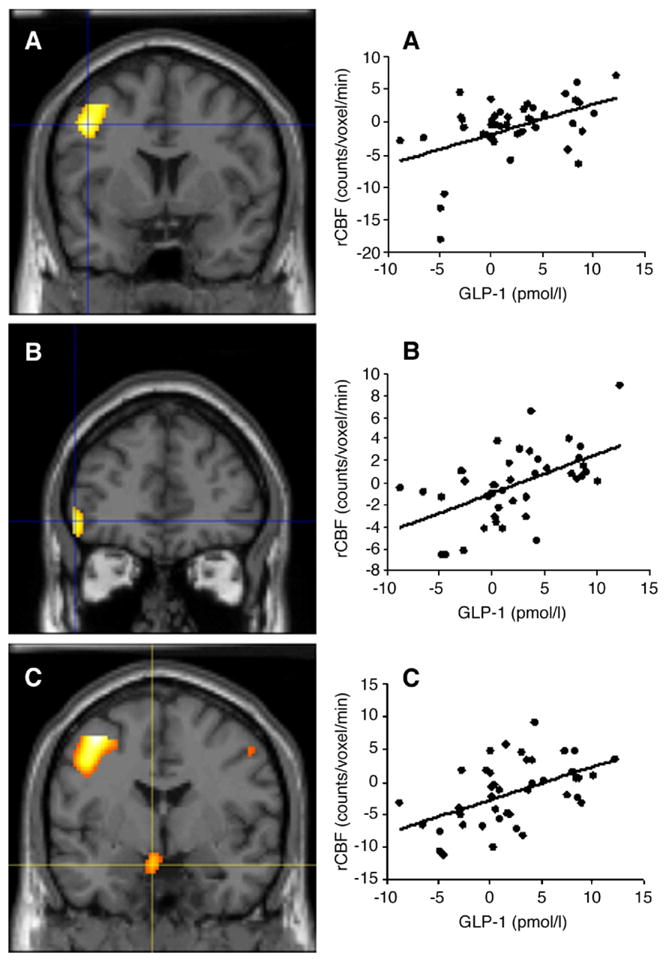
Postprandial glucagon-like peptide-1 (GLP-1) secretion can act as a meal termination signal in animals and humans. We tested the hypothesis that the postprandial changes in plasma GLP-1 concentrations are associated with changes in the human brain activity in response to satiety by performing a post-hoc analysis of a cross-sectional study of neuroanatomical correlates of hunger and satiation using (15)O-water positron-emission tomography (PET). Forty-two subjects (22M/20F, age 31+/-8 years) spanning a wide range of adiposity (body fat: 7-44%) were included in this analysis. Outcome measures included changes in PET-measured regional cerebral blood flow (rCBF) and plasma concentrations of GLP-1, glucose, insulin, and free-fatty acids (FFA), elicited by the administration of a satiating amount of a liquid formula meal. The peak postprandial increases in plasma GLP-1 concentrations were correlated with increases in rCBF in the left dorsolateral prefrontal cortex (including the left middle and inferior frontal gyri), previously implicated in PET studies of human satiation, and the hypothalamus, previously implicated in the regulation of food intake in animal and human studies, both before and after adjustment for sex, age, body fat, and changes in plasma glucose, insulin, and serum FFA concentrations. The postprandial GLP-1 response is associated with activation of areas of the human brain previously implicated in satiation and food intake regulation.
Figures
References
-
- Adam TC, Westerterp-Plantenga MS. Glucagon-like peptide-1 release and satiety after a nutrient challenge in normal-weight and obese subjects. Br J Nutr. 2005a;93:845–851. - PubMed
-
- Adam TC, Westerterp-Plantenga MS. Nutrient-stimulated GLP-1 release in normal-weight men and women. Horm Metab Res. 2005b;37:111–117. - PubMed
-
- Ahren B, Holst JJ, Mari A. Characterization of GLP-1 effects on beta-cell function after meal ingestion in humans. Diabetes Care. 2003;26:2860–2864. - PubMed
-
- Alvarez E, Martinez MD, Roncero I, Chowen JA, Garcia-Cuartero B, Gispert JD, Sanz C, Vazquez P, Maldonado A, de Caceres J, Desco M, Pozo MA, Blazquez E. The expression of GLP-1 receptor mRNA and protein allows the effect of GLP-1 on glucose metabolism in the human hypothalamus and brainstem. J Neurochem. 2005;92:798–806. - PubMed
-
- Chaikomin R, Doran S, Jones KL, Feinle-Bisset C, O’Donovan D, Rayner CK, Horowitz M. Initially more rapid small intestinal glucose delivery increases plasma insulin, GIP, and GLP-1 but does not improve overall glycemia in healthy subjects. Am J Physiol: Endocrinol Metab. 2005;289:E504–E507. - PubMed
Publication types
MeSH terms
Substances
Grants and funding
LinkOut - more resources
Full Text Sources
Other Literature Sources
Medical
