


Expression of oncogenic K-ras from its endogenous promoter leads to a partial block of erythroid differentiation and hyperactivation of cytokine-dependent signaling pathways
- PMID: 17317860
- PMCID: PMC1890843
- DOI: 10.1182/blood-2006-09-047050
Expression of oncogenic K-ras from its endogenous promoter leads to a partial block of erythroid differentiation and hyperactivation of cytokine-dependent signaling pathways
Abstract
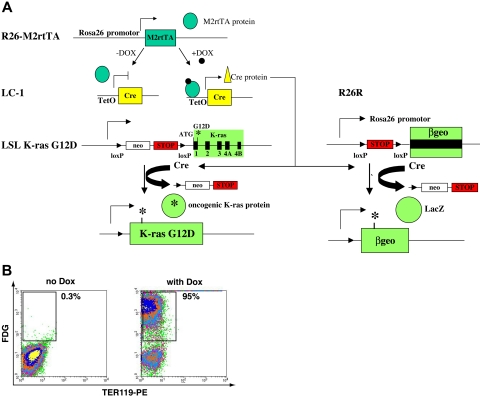
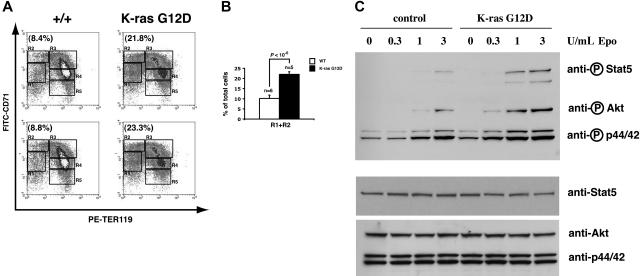
When overexpressed in primary erythroid progenitors, oncogenic Ras leads to the constitutive activation of its downstream signaling pathways, severe block of terminal erythroid differentiation, and cytokine-independent growth of primary erythroid progenitors. However, whether high-level expression of oncogenic Ras is required for these phenotypes is unknown. To address this issue, we expressed oncogenic K-ras (K-ras(G12D)) from its endogenous promoter using a tetracycline-inducible system. We show that endogenous K-ras(G12D) leads to a partial block of terminal erythroid differentiation in vivo. In contrast to results obtained when oncogenic Ras was overexpressed from retroviral vectors, endogenous levels of K-ras(G12D) fail to constitutively activate but rather hyperactivate cytokine-dependent signaling pathways, including Stat5, Akt, and p44/42 MAPK, in primary erythroid progenitors. This explains previous observations that hematopoietic progenitors expressing endogenous K-ras(G12D) display hypersensitivity to cytokine stimulation in various colony assays. Our results support efforts to modulate Ras signaling for treating hematopoietic malignancies.
Figures
References
-
- Shannon K. The Ras signaling pathway and the molecular basis of myeloid leukemogenesis. Curr Opin Hematol. 1995;2:305–308. - PubMed
-
- Lauchle JO, Braun BS, Loh ML, Shannon K. Inherited predispositions and hyperactive Ras in myeloid leukemogenesis. Pediatr Blood Cancer. 2006;46:579–585. - PubMed
-
- Vardiman JW, Harris NL, Brunning RD. The World Health Organization (WHO) classification of the myeloid neoplasms. Blood. 2002;100:2292–2302. - PubMed
-
- Zhang J, Socolovsky M, Gross AW, Lodish HF. Role of Ras signaling in erythroid differentiation of mouse fetal liver cells: functional analysis by a flow cytometry-based novel culture system. Blood. 2003;102:3938–3946. - PubMed
-
- Zhang J, Lodish HF. Constitutive activation of the MEK/ERK pathway mediates all effects of oncogenic H-ras expression in primary erythroid progenitors. Blood. 2004;104:1679–1687. - PubMed
Publication types
MeSH terms
Substances
Grants and funding
LinkOut - more resources
Full Text Sources
Molecular Biology Databases
Miscellaneous
