. 2007 Apr;143(4):1918-28.
doi: 10.1104/pp.106.093476. Epub 2007 Feb 23.

HKT1;5-like cation transporters linked to Na+ exclusion loci in wheat, Nax2 and Kna1

Affiliations

HKT1;5-like cation transporters linked to Na+ exclusion loci in wheat, Nax2 and Kna1

Caitlin S Byrt et al. Plant Physiol. 2007 Apr.

Abstract

Bread wheat (Triticum aestivum) has a greater ability to exclude Na+ from its leaves and is more salt tolerant than durum wheat (Triticum turgidum L. subsp. durum [Desf.]). A novel durum wheat, Line 149, was found to contain a major gene for Na+ exclusion, Nax2, which removes Na+ from the xylem in the roots and leads to a high K+-to-Na+ ratio in the leaves. Nax2 was mapped to the distal region on chromosome 5AL based on linkage to microsatellite markers. The Nax2 locus on 5AL coincides with the locus for a putative Na+ transporter, HKT1;5 (HKT8). The Nax2 region on 5AL is homoeologous to the region on chromosome 4DL containing the major Na+ exclusion locus in bread wheat, Kna1. A gene member of the HKT1;5 family colocates to the deletion bin containing Kna1 on chromosome 4DL. This work provides evidence that Nax2 and Kna1 are strongly associated with HKT1;5 genes.


Figures
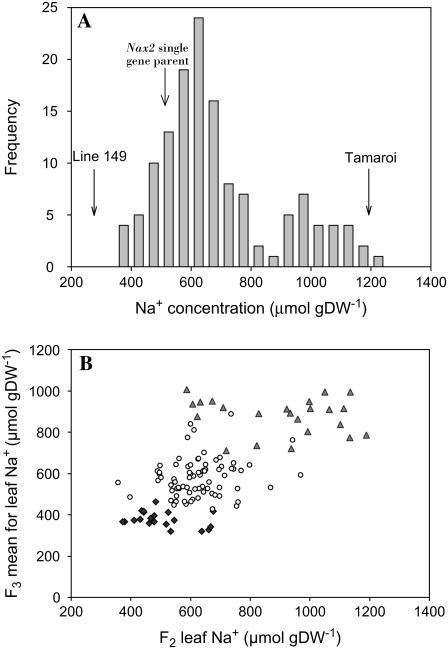
Figure 1.
Figure 1.
A, Frequency distribution for leaf 3 Na+ concentrations of the BC5F2 lines in the single gene Nax2 mapping population. Arrows indicate parental means (n = 6); Line 149: 278 ± 37, Nax2 single gene parent: 473 ± 72, Tamaroi: 1,193 ± 48. Adapted from James et al. (2006). B, Relationship between the F2 and F2:3 progeny means for Na+ concentration of leaf 3. Plants were grown at 150 mm NaCl for 10 d. ▴, Homozygous lacking Nax2; ○, heterozygous for Nax2; ♦, homozygous for Nax2.
Figure 2.
Figure 2.
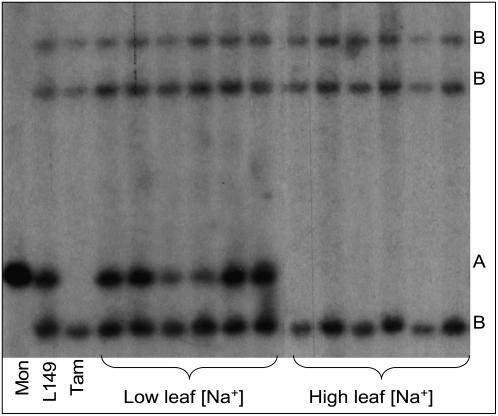
Cosegregation of the A genome HKT1;5 fragment with Nax2. Southern-blot hybridization with the HKT1;5 probe after HindIII digestion of DNA from T. monococcum (Mon), Line 149 (L149), Tamaroi (Tam), and plants from the Nax2 BC5F3 mapping population with low leaf 3 Na+ concentrations and high leaf 3 Na+ concentrations. The genome origin of each band is shown on the right. In the Nax2 mapping family the A genome fragment (inherited from the monococcum) cosegregates with Nax2 in all of the 137 families.
Figure 3.
Figure 3.
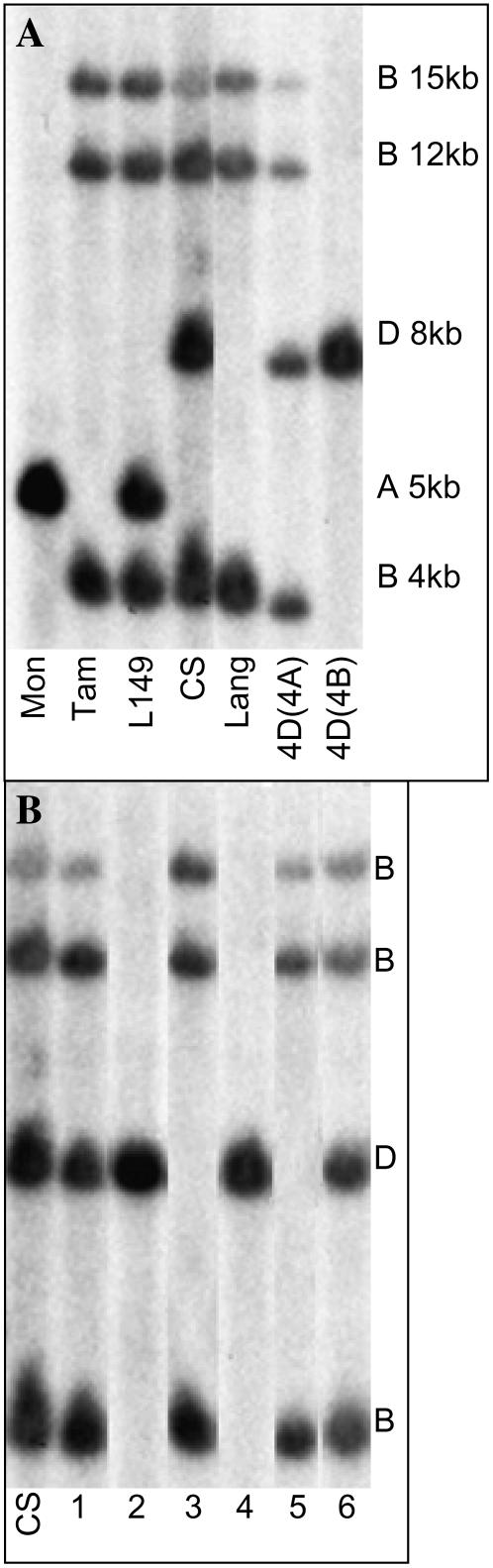
Chromosomal location of the HKT1;5 fragments. Southern-blot hybridization with the HKT1;5 probe after HindIII restriction digest. A, DNA from T. monococcum (Mon), Tamaroi (Tam), Line 149 (L149), CS, Langdon (Lang), and Langdon substitution lines 4D(4A) and 4D(4B). The genome locations of the HKT1;5 gene members and the approximate sizes (kilo bp) of the fragments are shown on the right. B, DNA from CS; CS chromosome arm deletion lines for chromosome 4B: N4AT4B (1), m4BT4A (2), N4DT4B (3); and CS ditelomeric lines Dt4BS (4), Dt4DS (5), and Dt4DL (6); n = nullitetrasomic (no copies); T = tetrasomic (four copies); m = monosomic (one copy); Dt = ditelomeric (for Dt4BS the long arm of 4B is missing and the short arm of 4B is present). The genome locations of the HKT1;5 gene members are shown on the right.
Figure 4.
Figure 4.
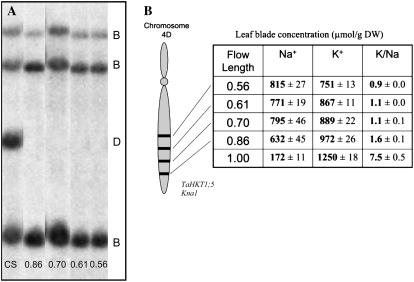
A, Southern-blot hybridization with HKT1;5 probe after HindIII restriction digest of DNA from CS and CS chromosome deletion lines 0.86, 0.70, 0.61, and 0.56. The TaHKT1;5-D gene member maps to the most distal deletion bin. The genome location of the TaHKT1;5 gene members are shown on the right. B, CS and CS chromosome deletion lines were grown in salt tanks (see “Materials and Methods”). Fl describes remaining fraction of chromosome 4DL. Kna1 maps to the same location (Dubcovsky et al., 1996) as TaHKT1;5-D. Leaf blade Na+ and K+ concentrations were recorded after leaf 3 had grown for 10 d in 50 mm NaCl.
Figure 5.
Figure 5.
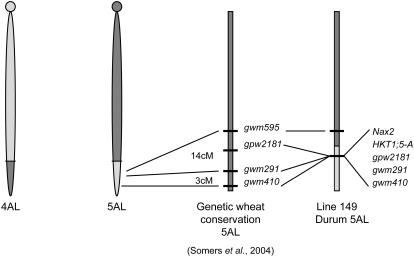
Part of chromosome 5AL originated from part of chromosome 4AL due to an ancient reciprocal translocation between the distal ends of chromosomes 4AL and 5AL. Durum 5AL represents the fragment containing Nax2 that introgressed from Line 149 into the Tamaroi background in the Nax2 mapping population. Proximal to the introgression is gwm595. Nax2 is linked to gwm291, gwm410, and gpw2181. (See Somers et al. [2004].)
Figure 6.
Figure 6.
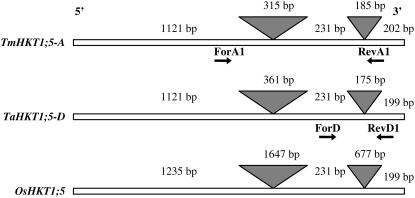
Gene structures of TmHKT1;5-A, TaHKT1;5-D, and OsHKT1;5. The gray triangles represent the intron regions of the gene. The arrows indicate the primers designed for gene expression analysis (Fig. 7).
Figure 7.
Figure 7.
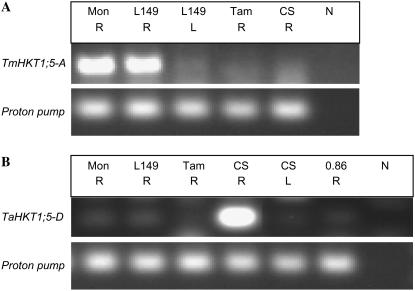
Expression of HKT1;5 in wheat analyzed using reverse-transcriptase PCR. A, Expression of TmHKT1;5-A. A product of the expected size (442 bp) was observed for the T. monococcum and Line 149 root samples. B, Expression of TaHKT1;5-D. A product of the expected size (147 bp) was observed for the CS root sample. Mon = T. monococcum; L149 = Line 149; Tam = Tamaroi; 0.86 = CS deletion line missing the distal 14% of chromosome 4DL; n = no template control; R = root tissue; L = leaf tissue. Plants were grown in hydroponic solution for 2 weeks before addition of 50 mm NaCl, tissue was harvested 48 h after addition of NaCl. Proton pump was used as a control.

References

    1. Allen GJ, Wyn Jones RG, Leigh RA (1995) Sodium transport measured in plasma membrane vesicles isolated from wheat genotypes with differing K+/Na+ discrimination traits. Plant Cell Environ 18 105–115
    1. Berthomieu P, Conéjéro G, Nublat A, Brackenbury WJ, Lambert C, Savio C, Uozumi N, Oiki S, Yamada K, Cellier F (2003) Functional analysis of AtHKT1 in Arabidopsis shows that Na+ recirculation by the phloem is crucial for salt tolerance. EMBO J 22 2004–2014 - PMC - PubMed
    1. Bonnett DG, Rebetzke GJ, Spielmeyer W (2005) Strategies for efficient implementation of molecular markers in wheat breeding. Mol Breed 15 75–85
    1. Davenport R, James RA, Zakrisson-Plogander A, Tester M, Munns R (2005) Control of sodium transport in durum wheat. Plant Physiol 137 807–818 - PMC - PubMed
    1. Dubcovsky J, María GS, Epstein E, Luo MC, Dvořák J (1996) Mapping of the K+/Na+ discrimination locus Kna1 in wheat. Theor Appl Genet 92 448–454 - PubMed

Publication types

Associated data

LinkOut - more resources