. 2007 Apr;6(4):616-21.
doi: 10.1128/EC.00020-07. Epub 2007 Feb 23.

The MAT1 locus of Histoplasma capsulatum is responsive in a mating type-specific manner

Affiliations

The MAT1 locus of Histoplasma capsulatum is responsive in a mating type-specific manner

Meggan Bubnick et al. Eukaryot Cell. 2007 Apr.

Abstract

Recombination events associated with sexual replication in pathogens may generate new strains with altered virulence. Histoplasma capsulatum is a mating-competent, pathogenic fungus with two described phenotypic mating types, + and -. The mating (MAT) locus of H. capsulatum was identified to facilitate molecular studies of mating in this organism. Through syntenic analysis of the H. capsulatum genomic sequence databases, a MAT1-1 idiomorph region was identified in H. capsulatum strains G217B and WU24, and a MAT1-2 idiomorph region was identified in the strain G186AR. A mating type-specific PCR assay was developed, and two clinical isolates of opposite genotypic mating type, UH1 and VA1, were identified. A known--mating type strain, T-3-1 (ATCC 22635), was demonstrated to be of MAT1-2 genotypic mating type. The clinical isolates UH1 and VA1 were found to be mating compatible and also displayed mating-type-dependent regulation of the MAT transcription factors in response to extracts predicted to contain mating pheromones. These studies support a role for the identified MAT1 locus in determining mating type in H. capsulatum.


Figures
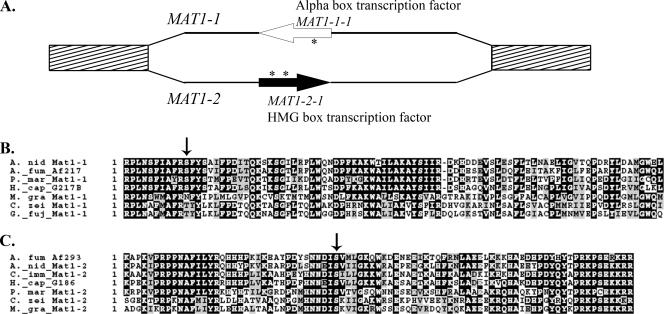
FIG. 1.
FIG. 1.
MAT1 locus in H. capsulatum. (A) Representation of the MAT1-1 and MAT1-2 idiomorph regions, as identified in strains G217B and G186AR, respectively. Hatched boxes indicate regions with 96 to 98% sequence identity between the two strains. Black lines indicate the MAT1 idiomorph regions, with only 34% sequence identity. Predicted open reading frames are represented by arrows, white for MAT1-1-1 and black for MAT1-2-1, with introns designated by asterisks. (B and C) Alignment of H. capsulatum α1 (B) and HMG (C) regions with MAT1-1 and MAT1-2 protein sequences in other ascomycete fungi. The positions of conserved introns are noted by arrows. The organism abbreviations are as follows: A. nid, Aspergillus nidulans; A. fum, Aspergillus fumigatus; P. mar, Penicillium marneffei; H. cap, Histoplasma capsulatum; C. zei, Cercospora zeina; G. fuj, Gibberella fujikuroi; C. imm, Coccidioides immitis; M. gra, Mycosphaerella graminicola.
FIG. 2.
FIG. 2.
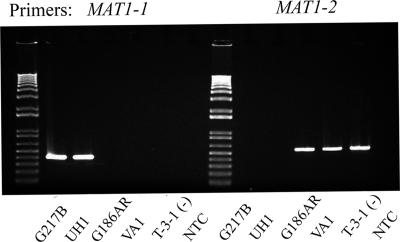
Results of MAT1 locus PCR assay. PCR was performed using primers specific to either the MAT1-1 or the MAT1-2 idiomorph region. Both primer pairs were used to test DNA isolated from various H. capsulatum strains. Lane 1, molecular weight marker; lanes 2 to 6, H. capsulatum strains as indicated under each lane; lane 7, “no template” control (NTC).
FIG. 3.
FIG. 3.
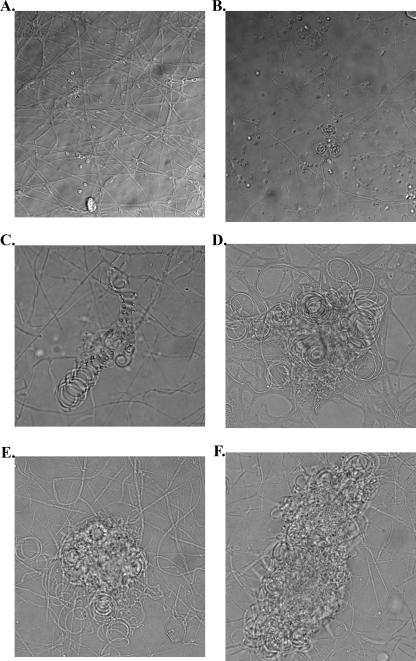
Results of mating compatibility test between UH1 and VA1. Organisms were plated on A-YEM and grown for 3 weeks. (A) UH1 self-cross. (B to F) UH1 crossed with VA1. (B and C) Coiled hyphae, consistent with younger mating structures. (D to F) Coiled hyphae covered by short, branching hyphae, consistent with more mature mating structures.
FIG. 4.
FIG. 4.
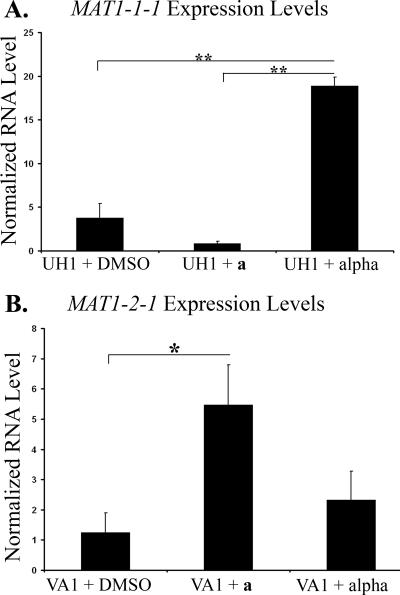
Expression levels of MAT1 transcription factors. H. capsulatum strains UH1 (A) and VA1 (B) were stimulated with DMSO, a pheromone extract, or α pheromone extract for 30 min. RNA levels of MAT1-1-1 (A) and MAT1-2-1 (B) were determined by qRT-PCR and normalized to RNA levels of GAPDH. *, P ≤ 0.05; **, P ≤ 0.01.

References

    1. Astell, C. R., L. Ahlstrom-Jonasson, M. Smith, K. Tatchell, K. A. Nasmyth, and B. D. Hall. 1981. The sequence of the DNAs coding for the mating-type loci of Saccharomyces cerevisiae. Cell 27:15-23. - PubMed
    1. Bookout, A. L., C. L. Cummins, D. J. Mangelsdorf, J. M. Pesola, and M. F. Kramer. 2006. High-throughput real-time quantitative reverse transcription PCR, p. 15.8.1-28. In F. M. Ausubel, R. Brent, R. E. Kingston, D. D. Moore, J. G. Seidman, J. A. Smith, and K. Struhl (ed.), Current protocols in molecular biology. John Wiley and Sons, Hoboken, NJ. - PubMed
    1. Bussey, H. 1988. Proteases and the processing of precursors to secreted proteins in yeast. Yeast 4:17-26. - PubMed
    1. Caldwell, G. A., F. Naider, and J. M. Becker. 1995. Fungal lipopeptide mating pheromones: a model system for the study of protein prenylation. Microbiol. Rev. 59:406-422. - PMC - PubMed
    1. Carter, D. A., A. Burt, J. W. Taylor, G. L. Koenig, and T. J. White. 1996. Clinical isolates of Histoplasma capsulatum from Indianapolis, Indiana, have a recombining population structure. J. Clin. Microbiol. 34:2577-2584. - PMC - PubMed

MeSH terms

LinkOut - more resources