Comparative Study
. 2007 Apr 16;179(1):118-25.
doi: 10.1016/j.bbr.2007.01.024. Epub 2007 Feb 1.

Transplantation of GABAergic neurons but not astrocytes induces recovery of sensorimotor function in the traumatically injured brain

Affiliations
Comparative Study

Transplantation of GABAergic neurons but not astrocytes induces recovery of sensorimotor function in the traumatically injured brain

G D Becerra et al. Behav Brain Res. .

Abstract

Embryonic stem (ES) cells have been investigated in many animal models of injury and disease. However, few studies have examined the ability of pre-differentiated ES cells to improve functional outcome following traumatic brain injury (TBI). The purpose of the present study was to compare the effect of murine ES cells that were pre-differentiated into GABAergic neurons or astrocytes on functional recovery following TBI. Neural and astrocyte induction was achieved by co-culturing ES cells on a bone marrow stromal fibroblast (M2-10B4) feeder layer and incubating them with various mitogenic factors. Rats were initially prepared with a unilateral controlled cortical contusion injury of the sensorimotor cortex or sham procedure. Rats were transplanted 7 days following injury with approximately 100K GABAergic neurons, astrocytes, fibroblasts, or media. Animals were assessed on a battery of sensorimotor tasks following transplantation. The stromal fibroblast cells (M2-10B4), as a control cell line, did not differ significantly from media infusions. Transplantation of GABAergic neurons facilitated complete and total recovery on the vibrissae-forelimb placing test as opposed to all other groups, which failed to show any recovery. It was also found that GABAergic neurons reduced the magnitude of the initial impairment on the limb use test. Histological analysis revealed infiltration of host brain with transplanted neurons and astrocytes. The results of the present study suggest that transplantation of pre-differentiated GABAergic neurons significantly induces recovery of sensorimotor function; whereas, astrocytes do not.


Figures

Fig. 1
Fig. 1
Histological plates. (A) Differentiating neural stem cells, first day after re-plating on polyornithin/fibronectin. Scale bar is 100 μm. (B) GABAergic progenitors, expressing GAD67 following mitogen treatment. Scale bar is 50 μm. (C) Embryoid body, 11 days after plating expressing MAP2. Scale bar is 50 μm. (D) Cells expressing GAD67 after differentiation with Shh. Scale bar is 50 μm. (E) Astrocyte progenitors, expressing GFAP. Scale bar is 50 μm. (F) Dorsal view of the brain showing unilateral contusion site (black circle) and both transplantation sites (red asterisks).
Fig. 2
Fig. 2
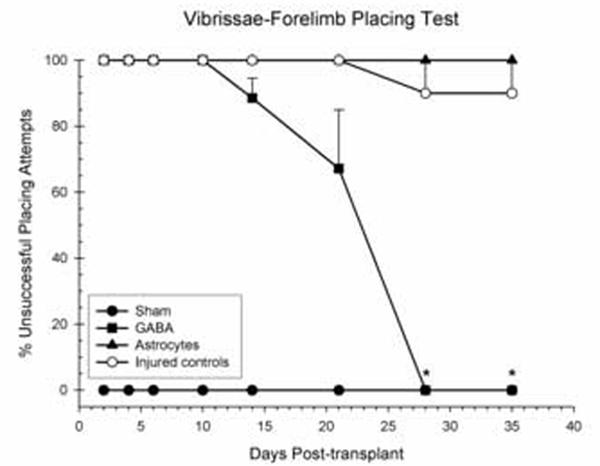
Shown is the effect of GABAergic neurons, astrocytes, or injured controls (stromal cells or media) transplanted 1 week following unilateral CCI of the SMC or sham surgery on the vibrissae-forelimb placing test. Plotted for each group is the mean (±SEM) percentage of unsuccessful placing attempts per test day. Injury significantly impaired performance on this test. Transplantation of GABAergic neurons induced a complete and total recovery by day 28 (*p < 0.05).
Fig. 3
Fig. 3
Shown is the effect of GABAergic neurons, astrocytes, or injured controls (stromal cells or media) transplanted 1 week following unilateral CCI of the SMC or sham surgery on the forelimb preference test (mean percentage ±SEM). The 50% point (represented by the line) indicates equal placing for either forelimb, no asymmetry in forelimb use. Preference for the contralateral forelimb is represented in the range above 50% (down arrow), ipsilateral forelimb preference is represented in the range below 50% (up arrow). Injury significantly impaired the use of the contralateral forelimb on this test, resulting in an increased ipsilateral bias. Transplantation of GABAergic neurons significantly reduced the ipsilateral bias compared to injured controls (* = p < 0.05). The GABA group was not significantly different from shams on either day (^).
Fig. 4
Fig. 4
Histological plates. (A, D) GFAP expression around the developing injury cavity (*). (B, E) Expression of murine specific antibody (M2) at the transplant site. (C, F) Merged image showing astrocytes expressing both M2 and GFAP in border of the lesion cavity. (G, J) Expression of GAD67, a marker for GABA immunoreactivity in the transplanted cortex (H, K) Expression of murine specific antibody (M2) at the transplant site. (I, L) Merged image showing neurons expressing both GABA and M2 immunofluorescence in the transplanted cortex. Scale bar for A-F is 100μm; scale bar for G-L is 50μm

References

    1. Akerud P, Canals JM, Snyder EY, Arenas E. Neuroprotection through delivery of glial cell line-derived neurotrophic factor by neural stem cells in a mouse model of Parkinson′s disease. J Neurosci. 2001;21:8108–8118. - PMC - PubMed
    1. Bakshi A, Shimizu S, Keck CA, Cho S, LeBold DG, Morales D, Arenas E, Snyder EY, Watson DJ, McIntosh TK. Neural progenitor cells engineered to secrete GDNF show enhanced survival, neuronal differentiation and improve cognitive function following traumatic brain injury. Eur J Neurosci. 2006;23:2119–2134. - PubMed
    1. Baldelli P, Hernandez-Guijo JM, Carabelli V, Carbone E. Brain-derived neurotrophic factor enhances GABA release probability and nonuniform distribution of N- and P/Q-type channels on release sites of hippocampal inhibitory synapses. J Neurosci. 2005;25:3358–3368. - PMC - PubMed
    1. Barberi T, Klivenyi P, Calingasan NY, Lee H, Kawamata H, Loonam K, Perrier AL, Bruses J, Rubio ME, Topf N, Tabar V, Harrison NL, Beal MF, Moore MA, Studer L. Neural subtype specification of fertilization and nuclear transfer embryonic stem cells and application in parkinsonian mice. Nat Biotechnol. 2003;21:1200–1207. - PubMed
    1. Barth TM, Jones TA, Schallert T. Functional subdivisions of the rat somatic sensorimotor cortex. Behav Brain Res. 1990;39:73–95. - PubMed

Publication types

MeSH terms

Substances