


Differential activation of insulin receptor substrates 1 and 2 by insulin-like growth factor-activated insulin receptors
- PMID: 17325037
- PMCID: PMC1899985
- DOI: 10.1128/MCB.01447-06
Differential activation of insulin receptor substrates 1 and 2 by insulin-like growth factor-activated insulin receptors
Erratum in
- Mol Cell Biol. 2007 Sep;27(17):6264
Abstract
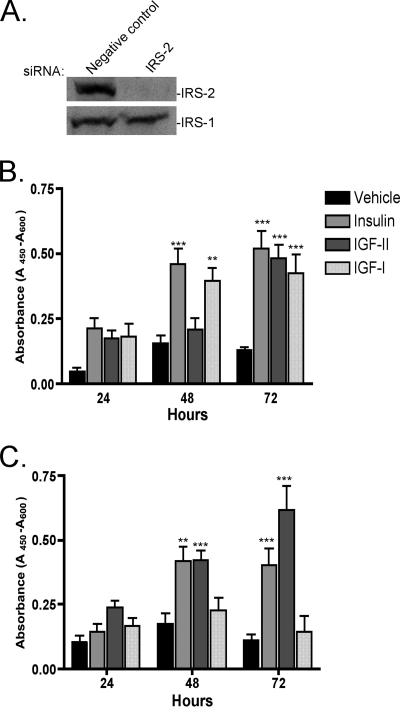
The insulin-like growth factors (insulin-like growth factor I [IGF-I] and IGF-II) exert important effects on growth, development, and differentiation through the IGF-I receptor (IGF-IR) transmembrane tyrosine kinase. The insulin receptor (IR) is structurally related to the IGF-IR, and at high concentrations, the IGFs can also activate the IR, in spite of their generally low affinity for the latter. Two mechanisms that facilitate cross talk between the IGF ligands and the IR at physiological concentrations have been described. The first of these is the existence of an alternatively spliced IR variant that exhibits high affinity for IGF-II as well as for insulin. A second phenomenon is the ability of hybrid receptors comprised of IGF-IR and IR hemireceptors to bind IGFs, but not insulin. To date, however, direct activation of an IR holoreceptor by IGF-I at physiological levels has not been demonstrated. We have now found that IGF-I can function through both splice variants of the IR, in spite of low affinity, to specifically activate IRS-2 to levels similar to those seen with equivalent concentrations of insulin or IGF-II. The specific activation of IRS-2 by IGF-I through the IR does not result in activation of the extracellular signal-regulated kinase pathway but does induce delayed low-level activation of the phosphatidylinositol 3-kinase pathway and biological effects such as enhanced cell viability and protection from apoptosis. These findings suggest that IGF-I can function directly through the IR and that the observed effects of IGF-I on insulin sensitivity may be the result of direct facilitation of insulin action by IGF-I costimulation of the IR in insulin target tissues.
Figures


References
-
- Andersen, A. S., T. Kjeldsen, F. C. Wiberg, H. Vissing, L. Schaffer, J. S. Rasmussen, P. De Meyts, and N. P. Moller. 1992. Identification of determinants that confer ligand specificity on the insulin receptor. J. Biol. Chem. 267:13681-13686. - PubMed
-
- Bach, L. A., S. J. Headey, and R. S. Norton. 2005. IGF-binding proteins-the pieces are falling into place. Trends Endocrinol. Metab. 16:228-234. - PubMed
-
- Bailyes, E. M., B. T. Nave, M. A. Soos, S. R. Orr, A. C. Hayward, and K. Siddle. 1997. Insulin receptor/IGF-I receptor hybrids are widely distributed in mammalian tissues: quantification of individual receptor species by selective immunoprecipitation and immunoblotting. Biochem. J. 327:209-215. - PMC - PubMed
-
- Blakesley, V. A., H. Kato, C. T. Roberts, Jr., and D. LeRoith. 1995. Mutation of a conserved amino acid residue (tryptophan 1173) in the tyrosine kinase domain of the IGF-I receptor abolishes autophosphorylation but does not eliminate biologic function. J. Biol. Chem. 270:2764-2769. - PubMed
-
- Bondy, C. A., and C. M. Cheng. 2004. Signaling by insulin-like growth factor 1 in brain. Eur. J. Pharmacol. 490:25-31. - PubMed
Publication types
MeSH terms
Substances
LinkOut - more resources
Full Text Sources
Other Literature Sources
