Anti-rheumatic activities of histone deacetylase (HDAC) inhibitors in vivo in collagen-induced arthritis in rodents
- PMID: 17325656
- PMCID: PMC2013883
- DOI: 10.1038/sj.bjp.0707165
Anti-rheumatic activities of histone deacetylase (HDAC) inhibitors in vivo in collagen-induced arthritis in rodents
Abstract
Background and purpose: Rheumatoid arthritis (RA) is a chronic inflammatory disease. Histone deacetylase inhibitors (HDACi), a new class of anti-cancer agents, have recently been reported to exhibit potent anti-inflammatory activities. A proof of concept study was carried out with suberoylanilide hydroxamic acid (SAHA) and MS-275, two HDACi currently undergoing clinical investigations for various oncological indications.
Experimental approach: The anti-rheumatic effects of SAHA and MS-275 were assessed in both mouse and rat collagen induced arthritis (CIA) models.
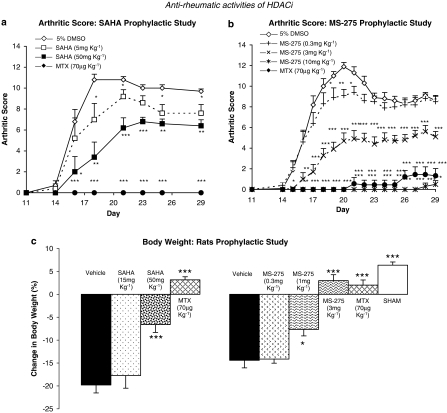
Key results: SAHA exhibited moderate prophylactic efficacy. It attenuated paw swelling due to inflammation, decreased bone erosion in both mice and rats and reduced slightly the RA-induced bone resorption in rats. However, SAHA could not inhibit the onset of arthritis. In contrast, MS-275 displayed dramatic anti-rheumatic activities. In prophylactic intervention, high doses of MS-275 prevented bone erosion and markedly delayed the onset of arthritis; at low doses, MS-275 strongly attenuated paw swelling, bone erosion, and bone resorption associated with RA. Furthermore, the therapeutic efficacy of MS-275 was also documented. After the onset of arthritis, it could stop the disease progression and joint destruction. An anti inflammatory effect of MS-275 was also confirmed through its capacity to decrease serum IL-6 and IL-1beta levels in the CIA induced mouse model. The anti-rheumatic activity of MS-275 was also confirmed through histological observation. No synovial hyperplasia, pannus formation, cartilage or bone destruction were observed in the high dose prophylactic intervention in mice.
Conclusion and implication: This study strongly supported HDACi as an innovative therapeutic strategy for RA.
Figures



Comment in
-
HDAC inhibitors as anti-inflammatory agents.Br J Pharmacol. 2007 Apr;150(7):829-31. doi: 10.1038/sj.bjp.0707166. Epub 2007 Feb 26. Br J Pharmacol. 2007. PMID: 17325655 Free PMC article.
References
-
- ACR American College of Rheumatology subcommittee on rheumatoid arthritis guidelines. Guidelines for the management of rheumatoid arthritis: 2002 Update. Arthritis Rheum. 2002;46:328–346. - PubMed
-
- Argiles JM, Lopez-Soriano FJ. Catabolic proinflammatory cytokines. Curr Opin Clin Nutr Metab Care. 2002;1:245–251. - PubMed
-
- Bansback NJ, Regier DA, Ara R, Brennan A, Shojania K, Esdaile JM, et al. An overview of economic evaluations for drugs used in rheumatoid arthritis: focus on tumour necrosis factor-alpha antagonists. Drugs. 2005;65:473–496. - PubMed
-
- Blanchard F, Chipoy C. Histone deacetylase inhibitors: new drugs for the treatment of inflammatory diseases. Drug Discov Today. 2005;10:197–204. - PubMed
-
- Bush KA, Farmer KM, Walker JS, Kirkham BW. Reduction of joint inflammation and bone erosion in rat adjuvant arthritis by treatment with interleukin-17 receptor IgG1 Fc fusion protein. Arthritis Rheum. 2002;46:802–805. - PubMed
Publication types
MeSH terms
Substances
LinkOut - more resources
Full Text Sources
Other Literature Sources
Medical