


Which biomarker predicts benefit from EGFR-TKI treatment for patients with lung cancer?
- PMID: 17325698
- PMCID: PMC2360106
- DOI: 10.1038/sj.bjc.6603665
Which biomarker predicts benefit from EGFR-TKI treatment for patients with lung cancer?
Abstract
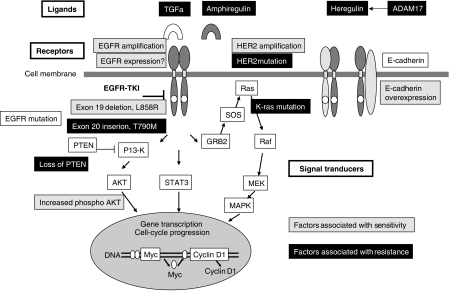
Subsets of patients with non-small cell lung cancer respond remarkably well to small molecule tyrosine kinase inhibitors (TKI) specific for epidermal growth factor receptor (EGFR) such as gefitinib or erlotinib. In 2004, it was found that EGFR mutations occurring in the kinase domain are strongly associated with EGFR-TKI sensitivity. However, subsequent studies revealed that this relationship was not perfect and various predictive markers have been reported. These include EGFR gene copy numbers, status of ligands for EGFR, changes in other HER family genes or molecules downstream to EGFR including KRAS or AKT. In this review, we would like to review current knowledge of predictive factors for EGFR-TKI. As all but one phase III trials failed to show a survival advantage of the treatment arm involving EGFR-TKIs, it is necessary to select patients by these biomarkers in future clinical trials. Through these efforts, it would be possible to individualise EGFR-TKI treatment for patients suffering from lung cancer.
Figures
References
-
- Ando M, Okamoto I, Yamamoto N, Takeda K, Tamura K, Seto T, Ariyoshi Y, Fukuoka M (2006) Predictive factors for interstitial lung disease, antitumor response, and survival in non-small-cell lung cancer patients treated with gefitinib. J Clin Oncol 24: 2549–2556 - PubMed
-
- Bell DW, Lynch TJ, Haserlat SM, Harris PL, Okimoto RA, Brannigan BW, Sgroi DC, Muir B, Riemenschneider MJ, Iacona RB, Krebs AD, Johnson DH, Giaccone G, Herbst RS, Manegold C, Fukuoka M, Kris MG, Baselga J, Ochs JS, Haber DA (2005) Epidermal growth factor receptor mutations and gene amplification in non-small-cell lung cancer: molecular analysis of the IDEAL/INTACT gefitinib trials. J Clin Oncol 23: 8081–8092 - PubMed
-
- Cappuzzo F, Hirsch FR, Rossi E, Bartolini S, Ceresoli GL, Bemis L, Haney J, Witta S, Danenberg K, Domenichini I, Ludovini V, Magrini E, Gregorc V, Dogilioni C, Sidoni A, Tonato M, Franklin WA, Crino L, Bunn Jr PA, Varella-Garcia M (2005a. Epidermal growth factor receptor gene and protein and gefitinib sensitivity in non-small cell lung cancer. J Natl Cancer Inst 97: 643–655 - PubMed
-
- Cappuzzo F, Magrini E, Ceresoli GL, Bartolini S, Rossi E, Ludovini V, Gregorc V, Ligorio C, Cancellieri A, Damiani S, Spreafico A, Paties CT, Lombardo L, Calandri C, Bellezza G, Tonato M, Crino L (2004) Akt phosphorylation and gefitinib efficacy in patients with advanced non-small-cell lung cancer. J Natl Cancer Inst 96: 1133–1141 - PubMed
-
- Cappuzzo F, Toschi L, Domenichini I, Bartolini S, Ceresoli GL, Rossi E, Ludovini V, Cancellieri A, Magrini E, Bemis L, Franklin WA, Crino L, Bunn PA, Jr, Hirsch FR, Varella-Garcia M (2005b) HER3 genomic gain and sensitivity to gefitinib in advanced non-small-cell lung cancer patients. Br J Cancer 93: 1334–1340 - PMC - PubMed
Publication types
MeSH terms
Substances
LinkOut - more resources
Full Text Sources
Other Literature Sources
Medical
Research Materials
Miscellaneous
