


Role of social support and self-efficacy in treatment outcomes among clients with co-occurring disorders
- PMID: 17329040
- PMCID: PMC2753536
- DOI: 10.1016/j.drugalcdep.2007.01.009
Role of social support and self-efficacy in treatment outcomes among clients with co-occurring disorders
Abstract
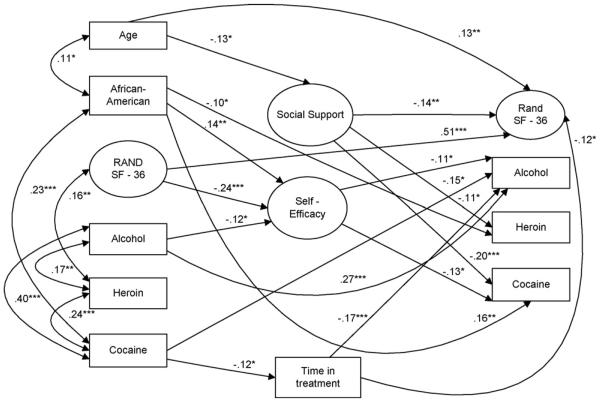
Individuals with co-occurring substance use and psychiatric disorders have a more severe clinical course and poorer outcomes than do individuals with one disorder. In an attempt to find intervening variables that may contribute to improvement in treatment outcomes among individuals with co-occurring disorders, we investigated the roles of social support and self-efficacy in a sample of 351 clients with co-occurring disorders in residential drug abuse treatment programs (53% male; 35% African American, 13% Hispanic). Given their demographic variability, we also explored how ethnicity and age influence self-efficacy and access to social support, as well as their relationships to the outcomes. Structural equation modeling was used to examine the impact of the demographics and baseline psychological status, substance use, social support, and self-efficacy on mental health and substance use outcomes 6 months after treatment entry. Time in treatment was included as a control. Greater social support at baseline predicted better mental health status and less heroin and cocaine use; greater self-efficacy predicted less alcohol and cocaine use. Older clients reported less social support. African-American ethnicity was associated with more cocaine use at baseline and follow-up; however, African Americans reported more self-efficacy, which moderated their cocaine use. The current study highlights the potential therapeutic importance of clients' personal resources, even among a sample of severely impaired individuals.
Figures
References
-
- Alvidrez J, Havassy BE. Racial distribution of dual-diagnosis clients in public sector mental health and drug treatment setting. J. Health Care Poor Underserved. 2005;16:53–62. - PubMed
-
- American Association of Community Psychiatrists Principles for the care and treatment of persons with co-occurring psychiatric and substance disorders. 2000. http://www.comm.psych.pitt.edu/finds/dualdx.html (accessed April 7, 2006)
-
- Annis HM, Graham JM. Situational Confidence Questionnaire. Addiction Research Foundation; Toronto, Canada: 1988.
-
- Bentler PM. EQS 6 Structural Equations Program Manual. Multivariate Software, Inc.; Encino, CA: 2005.
-
- Burleson JA, Kaminer Y. Self-efficacy as a predictor of treatment outcome in adolescent substance use disorders. Addict. Behav. 2005;30:1751–1764. - PubMed
