Comparative Study
. 2007 Apr;14(4):375-81.
doi: 10.1128/CVI.00387-06. Epub 2007 Feb 28.

Preclinical evaluation of microneedle technology for intradermal delivery of influenza vaccines

Affiliations
Comparative Study

Preclinical evaluation of microneedle technology for intradermal delivery of influenza vaccines

Jason B Alarcon et al. Clin Vaccine Immunol. 2007 Apr.

Abstract

Recent clinical studies have suggested that, for certain strains of influenza virus, intradermal (i.d.) delivery may enable protective immune responses using a lower dose of vaccine than required by intramuscular (i.m.) injection. Here, we describe the first preclinical use of microneedle technology for i.d. administration of three different types of influenza vaccines: (i) a whole inactivated influenza virus, (ii) a trivalent split-virion human vaccine, and (iii) a plasmid DNA encoding the influenza virus hemagglutinin. In a rat model, i.d. delivery of the whole inactivated virus provided up to 100-fold dose sparing compared to i.m. injection. In addition, i.d. delivery of the trivalent human vaccine enabled at least 10-fold dose sparing for the H1N1 strain and elicited levels of response across the dose range similar to those of i.m. injection for the H3N2 and B strains. Furthermore, at least fivefold dose sparing from i.d. delivery was evident in animals treated with multiple doses of DNA plasmid vaccine, although such effects were not apparent after the first immunization. Altogether, the results demonstrate that microneedle-based i.d. delivery elicits antibody responses that are at least as strong as via i.m. injection and that, in many cases, dose sparing can be achieved by this new immunization method.


Figures
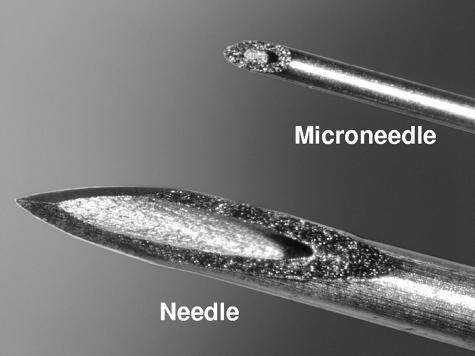
FIG. 1.
FIG. 1.
Comparison of standard 27-Ga needle to 34-Ga microneedle. The displayed microneedle has an inner diameter of 76 μm, an outer diameter of 178 μm, and a total exposed length of 1.0 mm.
FIG. 2.
FIG. 2.
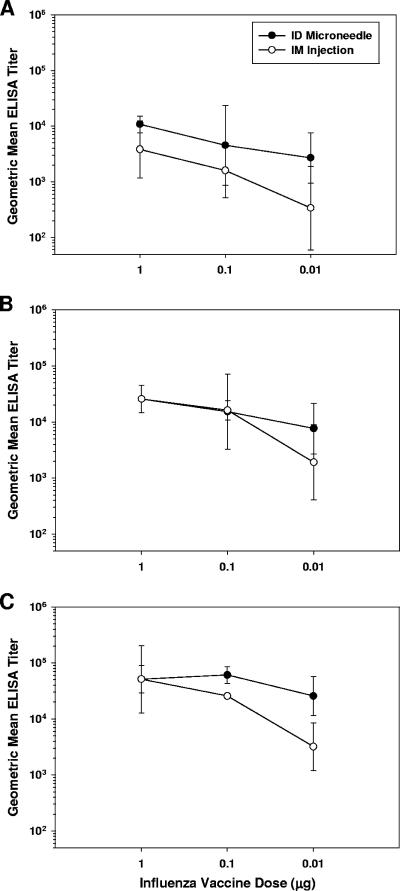
Serum antibody response in rats (n = 4 per group) following immunization with 1, 0.1, or 0.01 μg of whole inactivated influenza virus A/PR/8/34 on days 0, 21, and 42. Influenza virus-specific antibodies were measured by ELISA on (A) day 21, (B) day 42, and (C) day 56. Displayed are ELISA GMTs ± standard deviation.
FIG. 3.
FIG. 3.
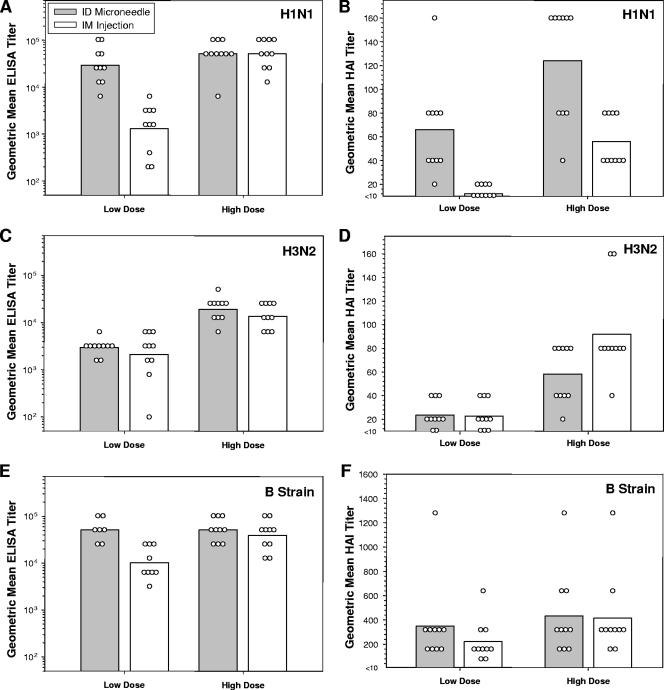
Rats (n = 10 per group) were immunized with either a high dose (100 μl of undiluted vaccine) or a low dose (100 μl of vaccine diluted 1:10) of trivalent split-virion influenza vaccine (Fluzone 2003-2004 formulation) and analyzed for serum antibody response 21 days later. Bars represent group GMT, and open symbols represent the responses from individual animals. (A) ELISA response against the H1N1 (A/NC/20/99) strain. (B) HAI response against the H1N1 (A/NC/20/99) strain. (C) ELISA response against the H3N2 (A/Pan/2007/99) strain. (D) HAI response against the H3N2 (A/Pan/2007/99) strain. (E) ELISA response against the B (B/HK/1434/02) strain. Due to insufficient quantities of sera from some animals, for analysis of ELISA titers against the B strain, only seven individuals from the i.d. “low-dose” group and nine animals from the i.m. “low-dose” group were analyzed. (F) HAI response against the B (B/HK/1434/02) strain.
FIG. 4.
FIG. 4.
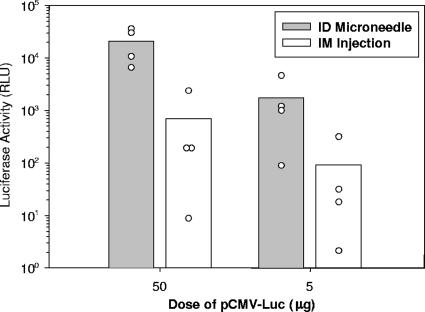
Luciferase activity in skin or muscle following i.d. or i.m. administration of either 50 μg or 5 μg of pCMV-Luc (n = 4 rats per group). As a negative control, rats were injected with the unrelated reporter plasmid, pCMV-β. Tissues were collected 24 h postdelivery and analyzed by luciferase assay for reporter gene expression. Luciferase activity is expressed as mean increase in RLU over background luciferase activity from tissue sites that had been injected with pCMV-β. Bars represent group means, and open symbols represent responses from individual animals.
FIG. 5.
FIG. 5.
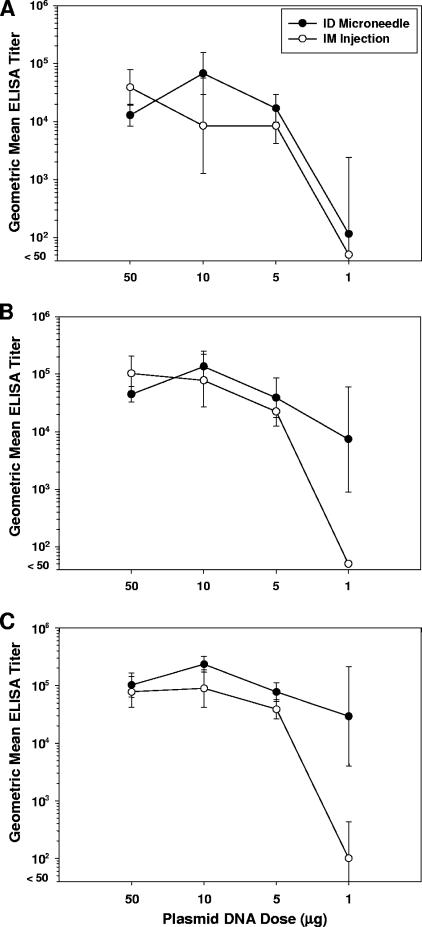
Serum antibody response in rats (n = 5 per group) following immunization with 50, 10, 5, or 1 μg of pCMV-HA on days 0, 21, and 42. Antibodies against whole inactivated influenza virus A/PR/8/34 were measured by ELISA on (A) day 21, (B) day 42, and (C) day 56. Displayed are ELISA GMTs ± standard deviation.

References

    1. Alchas, P. G. December 2002. Intradermal delivery device including a needle assembly. U.S. patent 6,494,865.
    1. Alchas, P. G., C. E. Guillermo, and M. S. Korisch. May 2003. Prefillable intradermal injector. U.S. patent 6,569,123.
    1. Alchas, P. G., and P. Laurent. May 2003. Method of intradermally injecting substances. U.S. patent 6,569,143.
    1. Alchas, P. G., P. Laurent, C. E. Guillermo, and M. S. Korisch. January 2005. Intradermal needle. U.S. patent 6,843,781.
    1. Audsley, J. M., and G. A. Tannock. 2004. The role of cell culture vaccines in the control of the next influenza pandemic. Exp. Opin. Biol. Ther. 4:709-717. - PubMed

Publication types