Review
. 2007 Mar;12(3):211-20.
doi: 10.1017/s1092852900020939.

Modulation of fear and anxiety by the endogenous cannabinoid system

Affiliations
Review

Modulation of fear and anxiety by the endogenous cannabinoid system

Jasmeer P Chhatwal et al. CNS Spectr. 2007 Mar.

Abstract

The last decade has witnessed remarkable progress in the understanding of the mammalian cannabinoid system, from the cloning of the endogenous cannabinoid receptor to the discovery of new pharmacologic compounds acting on this receptor. Current and planned studies in humans include compounds with effects ranging from direct antagonists to inhibitors of reuptake and breakdown. This progress has been accompanied by a much greater understanding of the role of the cannabinoid system in modulating the neural circuitry that mediates anxiety and fear responses. This review focuses on the neural circuitry and pharmacology of the cannabinoid system as it relates to the acquisition, expression, and extinction of conditioned fear as a model of human anxiety. Preclinical studies suggest that these may provide important emerging targets for new treatments of anxiety disorders.


Figures
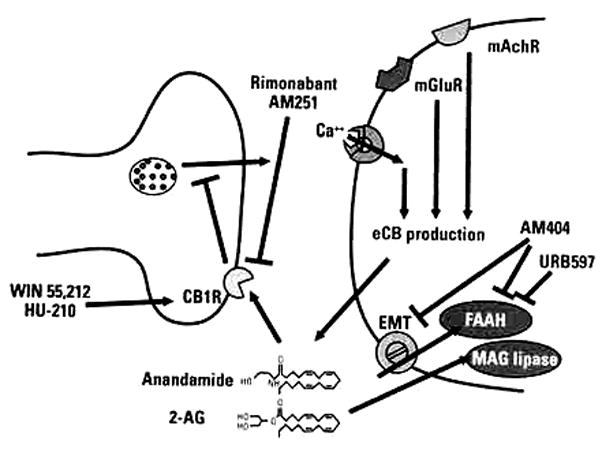
FIGURE 1
FIGURE 1. Organization of the cannabinoid system
Increased intracellular calcium in the postsynaptic bouton is thought to be a major signal for the production of endocannabinoid transmitters (anandamide and 2-AG are shown). The mechanisms by which these local increases are mediated may vary by cell type and may involve NMDA receptors, mGluRs, mAChRs as well as G-protein induced increases in calcium release from intracellular stores. Reuptake and degradation of anandamide is thought to be a coupled process of transport across the membrane by the EMT, and degradation by FAAH, which degrades anandamide and related eCBs, and/or MAG lipase, which degrades 2-AG and related eCBs. Once they are produced in the postsynaptic cell, eCBs are thought to diffuse in a retrograde fashion to activate pre-synaptic CB1 receptors. Activation of CB1 receptors leads to decreases in transmitter release from the pre-synaptic terminal, by decreasing calcium influx through voltage-gated calcium channels, and by increasing inwardly-rectifying potassium currents. Several pharmacologic manipulators of eCB transmission are noted; including the CB1 agonists WIN 55,212-2 and HU-210, the CB1 antagonists rimonabant and AM251, and two inhibitors of eCB reuptake and/or breakdown (AM404 and URB597). mAChRs=muscarinic acetylcholine receptors; mGluRs=metabotropic glutamate receptors; eCB=endogenous cannabinoid; CB1=cannabinoid-type 1; EMT=endocannabinoid membrane transporter; FAAH=fatty acid amide hydrolase; MAG=monoacyl-glycerol; 2-AG=2-arachidonoyl glycerol; NMDA=N/-methyl -D- asparte. Chhatwal JP, Ressler KJ. CNS Spectr. Vol 12, No 3. 2007.
FIGURE 2
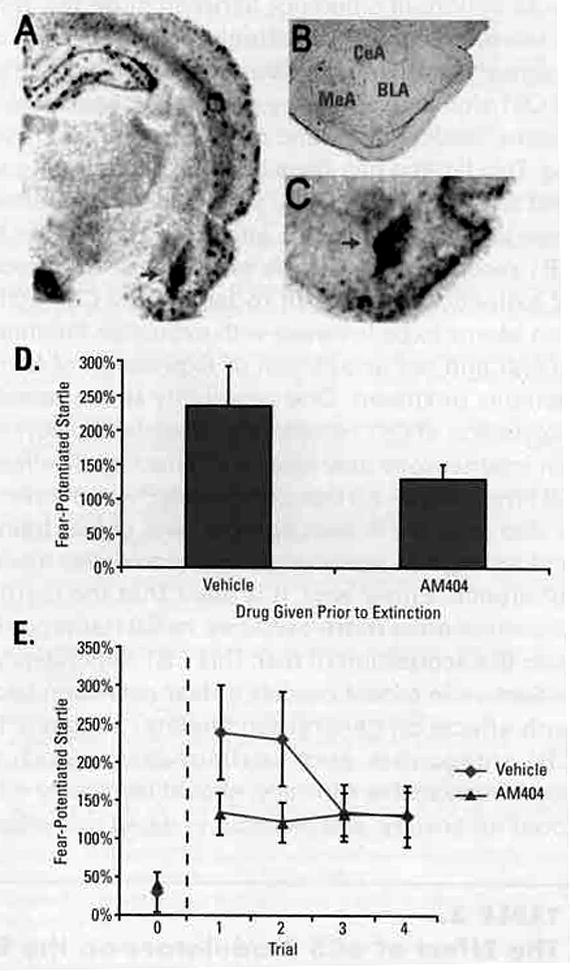
FIGURE 2. Administration of an inhibitor of eCB reuptake and breakdown enhances extinction
(A–C) CB1 mRNA expression is very high within the BLA, which is thought to be an important locus of associative emotional learning), with much lower levels seen in the CeA and MeA. (D) Animals receiving 10 mg/kg AM404 prior to extinction training show significantly reduced levels of conditioned fear when tested drug-free. This suggests that AM404 administration enhances extinction learning, and facilitates the learned inhibition of fear. (E) Following extinction, animals were tested for the resilience: of their extinction memories by presentation of a 0.4 mA footshock (dashed line) in the absence of the light CS. While all animals showed some re-emergence of fear following footshock, animals that received AM404 prior to extinction showed less fear than vehicle treated controls, suggesting that, in addition to enhancing extinction, AM404 administration may render extinction more resistant to shock-induced reinstatement, an animal model of stress-induced relapse. Chhatwal JP, Davis M. Maguschak KA, Ressler KJ, Enhancing cannabinoid neurotransmission augments the extinction of conditioned fear. Neuropsychopharmacology. 2005;30:516–524. Reproduced with permission by Nature Publishing Group. Copyright (2005). *P< .05 compared with vehicle group. CB1=cannabinoid-type 1; CeA=central nuclei of the amygdala: BLA=basolateral amygdala; MeA=medial nuclei of the amygdala; CS=conditioned stimulus. Chhatwal JP, Ressler KJ. CNS Spectr. Val 12, No 3. 2007.

References

    1. Stein DJ, Ipser JC, Seedat S. Pharmacotherapy for post traumatic stress disorder (PTSD) Cochrane Database Syst Rev. 2006;1:CD002795. - PMC - PubMed
    1. Davidson JR. Pharmacologic treatment of acute and chronic stress following trauma: 2006. J Clin Psychiatry. 2006;67(suppl 2):34–39. - PubMed
    1. Holmes A, Heilig M, Rupniak NM, Steckler T, Griebel G. Neutopeptide systems as novel therapeutic targets for depression and anxiety disorders. Trends Pharmacol Sci. 2003;24:580–538. - PubMed
    1. Roy-Byrne PP. The GABA-benzodiazepine receptor complex: structure, function, and role in anxiety. J Clin Psychiatry. 2005;66(suppl 2):14–20. - PubMed
    1. Otto MW, Bruce SE, Deckersbach T. Benzodiazepine use, cognitive impairment, and cognitive-behavioral therapy for anxiety disorders: issues in the treatment of a patient in need. J Clin Psychiatry. 2005;66(suppl 2):34–38. - PubMed

Publication types