


Ribosomal frameshifting in decoding antizyme mRNAs from yeast and protists to humans: close to 300 cases reveal remarkable diversity despite underlying conservation
- PMID: 17332016
- PMCID: PMC1874602
- DOI: 10.1093/nar/gkm035
Ribosomal frameshifting in decoding antizyme mRNAs from yeast and protists to humans: close to 300 cases reveal remarkable diversity despite underlying conservation
Abstract
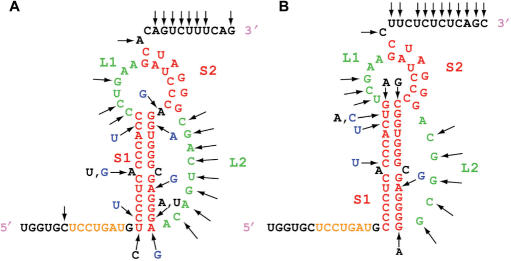
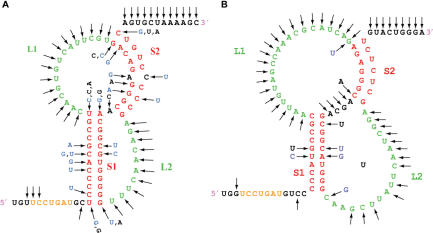
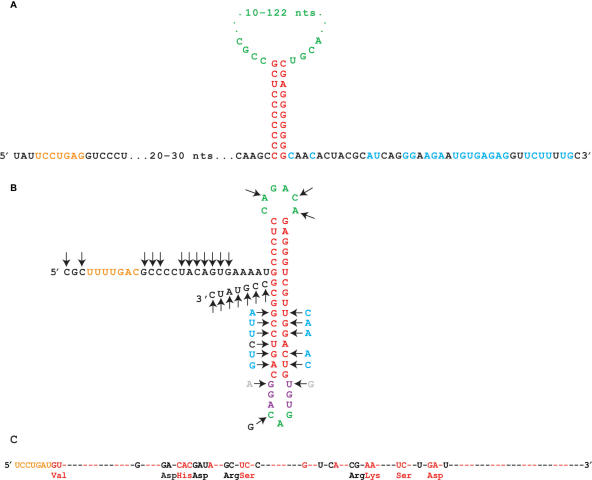
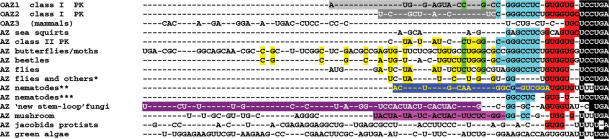
The protein antizyme is a negative regulator of intracellular polyamine levels. Ribosomes synthesizing antizyme start in one ORF and at the codon 5' adjacent to its stop codon, shift +1 to a second and partially overlapping ORF which encodes most of the protein. The ribosomal frameshifting is a sensor and effector of an autoregulatory circuit which is conserved in animals, fungi and protists. Stimulatory signals encoded 5' and 3' of the shift site act to program the frameshifting. Despite overall conservation, many individual branches have evolved specific features surrounding the frameshift site. Among these are RNA pseudoknots, RNA stem-loops, conserved primary RNA sequences, nascent peptide sequences and branch-specific 'shifty' codons.
Figures

References
-
- Gesteland RF, Atkins JF. Recoding: dynamic reprogramming of translation. Ann. Rev. Biochem. 1996;65:741–768. - PubMed
-
- Namy O, Rousset JP, Napthine S, Brierley I. Reprogrammed genetic decoding in cellular gene expression. Mol. Cell. 2004;13:157–168. - PubMed
-
- Baranov PV, Gesteland RF, Atkins JF. Recoding: translational bifurcations in gene expression. Gene. 2002;286:187–201. - PubMed
-
- Brandt J, Veith AM, Volff J-N. A family of neofunctionalized Ty3/gypsy retrotransposon genes in mammalian genomes. Cytog. Genome Res. 2005;110:307–317. - PubMed
Publication types
MeSH terms
Substances
LinkOut - more resources
Full Text Sources
Other Literature Sources
Molecular Biology Databases
