


Autoantibody selection and production in early human life
- PMID: 17332890
- PMCID: PMC1804337
- DOI: 10.1172/JCI31578
Autoantibody selection and production in early human life
Abstract
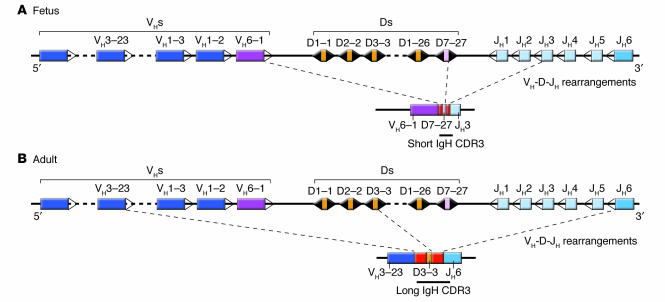
Natural antibodies are autoreactive/polyreactive antibodies believed to be secreted in the absence of xenoantigens. The origin and functional role of this limited and selective autoimmunity are not clear, nor is the specificity and range of autoantigens that drive the development of B cells producing natural antibodies. In this issue of the JCI, Merbl et al. report that in utero, humans generate natural IgM and IgA antibodies that recognize a uniform set of autoantigens (see the related article beginning on page 712), some of which are associated with autoimmune diseases. The authors postulate that this "autoimmunity" at birth favors the emergence of autoimmune diseases in later life. We present a molecular basis for the limited and common repertoire of antibodies produced by fetal B cells, which may be distinct from the abnormalities in B cell development described in patients with autoimmune diseases.
Figures
Comment on
-
Newborn humans manifest autoantibodies to defined self molecules detected by antigen microarray informatics.J Clin Invest. 2007 Mar;117(3):712-8. doi: 10.1172/JCI29943. J Clin Invest. 2007. PMID: 17332892 Free PMC article.
References
-
- Wardemann H., et al. Predominant autoantibody production by early human B cell precursors. Science. 2003;301:1374–1377. - PubMed
-
- Coutinho A., Kazatchkine M.D., Avrameas S. Natural autoantibodies. Curr. Opin. Immunol. 1995;7:812–818. - PubMed
-
- Herzenberg L.A., et al. The Ly-1 B cell lineage. . Immunol. Rev. 1986;93:81–102. - PubMed
-
- Hayakawa K., et al. Positive selection of natural autoreactive B cells. Science. 1999;285:113–116. - PubMed
Publication types
MeSH terms
Substances
LinkOut - more resources
Full Text Sources
Medical
Miscellaneous
