


Signal transduction induced in endothelial cells by growth factor receptors involved in angiogenesis
- PMID: 17334501
- PMCID: PMC2879321
Signal transduction induced in endothelial cells by growth factor receptors involved in angiogenesis
Abstract
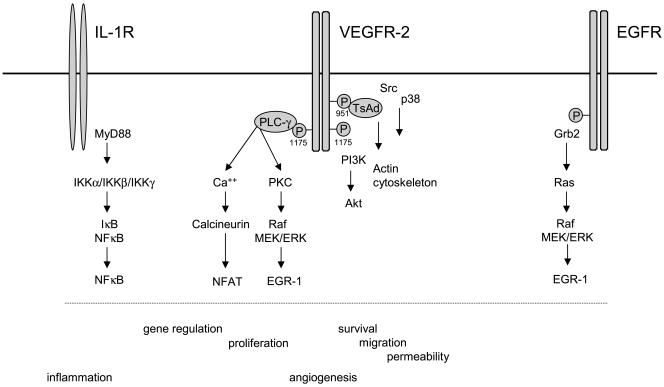
New vessel formation during development and in the adult is triggered by concerted signals of largely endothelial-specific receptors for ligands of the VEGF, angiopoietin and ephrin families. The signals and genes induced by these receptors operate in the context of additional signals transduced by non-endothelial specific growth factor receptors, inflammatory cytokine receptors as well as adhesion molecules. We summarize here available data on characteristic signaling of the VEGF receptor-2 and the current state of knowledge regarding the additional different receptor tyrosine kinases of the VEGF, Tie and Ephrin receptor families. Furthermore, the potential cross-talk with signals induced by other growth factors and inflammatory cytokines as well as the modulation by VE-cadherin is discussed.
Figures
References
-
- Coultas L, Chawengsaksophak K, Rossant J. Endothelial cells and VEGF in vascular development. Nature. 2005;438:937–945. - PubMed
-
- Alitalo K, Tammela T, Petrova TV. Lymphangiogenesis in development and human disease. Nature. 2005;438:946–953. - PubMed
-
- Carmeliet E. Angiogenesis in life, disease and medicine. Nature. 2005;438:932–936. - PubMed
-
- Yancopoulos GD, Davis S, Gale NW, et al. Vascular-specific growth factors and blood vessel formation. Nature. 2000;407:242–248. - PubMed
-
- Eklund L, Olsen BR. Tie receptors and their angiopoietin ligands are context-dependent regulators of vascular remodeling. Exp Cell Res. 2006;312:630–641. - PubMed
Publication types
MeSH terms
Substances
Grants and funding
LinkOut - more resources
Full Text Sources
Other Literature Sources
Miscellaneous